Non-Patent Literature (NPL) Search

Because the most critical prior art isn't always found in a patent office

NPL Search — Final Code

What is an NPL Search?

Non-Patent Literature (NPL) Search refers to an effort to look for "prior art" in literature that does not include patent publications, such as scientific journals, conference proceedings, textbooks, thesis papers, or any other literature, such as old product catalogues/manuals.

Conducting a thorough non-patent literature prior art search is a vital component of any comprehensive prior art search to uncover critical patent prior art and NPL prior art. Following a structured NPL search methodology allows for effective NPL validation and advanced literature search IP tracking. This deep-dive approach is particularly critical when executing a patent validity NPL search to challenge or defend the strength of an invention.

What is an NPL Search?
Why Conduct an NPL Search

Why Conduct an NPL Search?

  • Use for Invalidating a Patent: The non-patent literature is used for invalidation of the patent since it acts as a smoking gun to show that the technology has been publicly disclosed through scientific publications in advance of its patent application.
  • Emerging Technologies: In rapidly evolving technologies like AI and software-related technologies, innovations are generally first published in scientific papers and only later patented. This NPL prior art is crucial for building a strong invalidity defense search.
  • Full Spectrum View of the State-of-the-Art: A literature prior art search enables one to understand the full landscape of the field of technology.
How We Do It at Intellect Bastion

How We Do It at Intellect Bastion

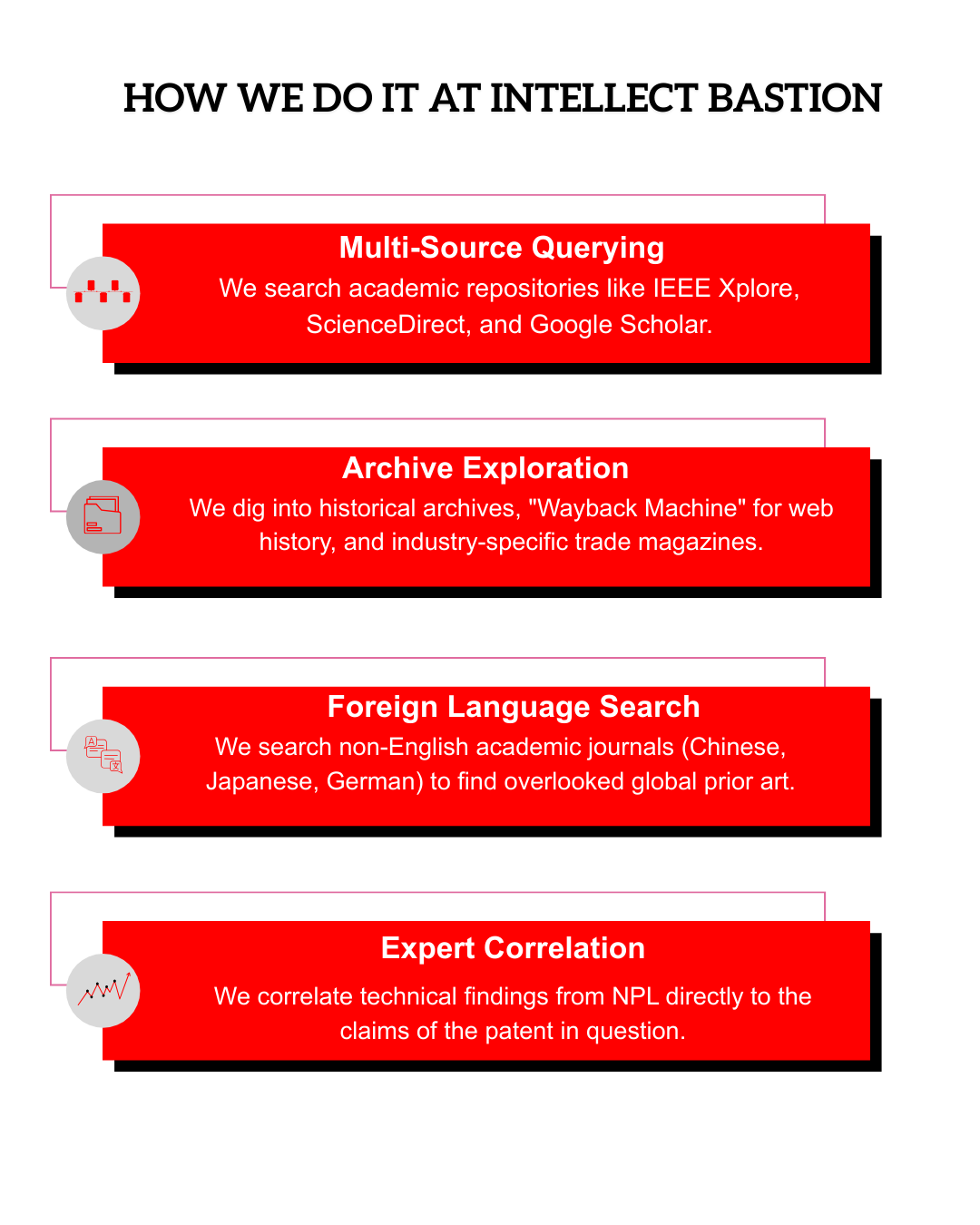
  • Querying Multiple Academic Databases: Searching academic repositories such as IEEE Xplore, ScienceDirect, and Google Scholar. This step is a core part of our NPL methodology utilized in our IP search services.
  • Archive Mining: Searching old publications in archive websites, wayback machine, and specialized industrial publications. We incorporate this into our custom patent search workflow via specialized prior art services.
  • Multi-Language Querying: Non-English academic databases (Chinese, Japanese, German) for prior art not covered by other sources. Our IP research agency handles this global outreach through a structured patent search workflow.
  • Technical Correlation to Claims: Correlating technical disclosures found in NPL to claims of the patent at hand. Our professional IP research services ensure this step produces a comprehensive prior art documentation.
Why Choose Intellect Bastion

Why Choose Intellect Bastion for Technical Searches?

  • Technical Knowledge: Our team comprises Ph.Ds. and engineers who understand the jargon of your science. As leading technical patent search experts and patent search experts, they bring unparalleled academic depth to every project.
  • Exclusive Databases: We work from premium databases that are not accessible using any free search engines. This allows our IP research firm to deliver high-quality, comprehensive insights comparable to top-tier international standards.
  • Insightful Syntheses: It is not about data, but about explaining why a certain paper or sequence of events is relevant to your case. This is why businesses look to patent outsourcing companies in India for strategic IP consulting services in India. Partnering with an affordable IP research firm specializing in patent outsourcing India solutions ensures you get elite technical patent search capabilities tailored precisely to your legal and corporate needs.
A 3D cartoon character on a phone call next to a contact form for a free consultation on patent validity and invalidity search services in India.
There is some error. Please try again
We have received your request. We will connect with you shortly for further discussion

Fill In The Form Below To Get FREE Consultation 

The WHATSAPP field must contain between 6 and 19 digits and include the country code without using +/0 (e.g. 1xxxxxxxxxx for the United States)
?

Frequently Asked Questions

Find answers to top questions about Patentability Search, novelty evaluation, and the patent filing process.

Why is NPL search critical if I've already searched patent databases?
Many inventors (most common among academic scientists) will publish their inventions in papers or conferences, but will never file a patent application. The NPL can be used to kill your patent even if they did not file for it.
Do you search academic journals (IEEE, PubMed, ScienceDirect)?
Yes. We have subscriptions to all the key scientific journal publishers (Elsevier, Wiley, IEEE, and more) for searching for papers behind the subscription walls.
Can you find "prior art" in old conference papers or university theses?
Yes. We search university websites and abstracts of conference sessions called "Poster Sessions," where companies present new research results to each other.
How do you handle "wayback machine" searches for websites that no longer exist?
We use the internet archive to access old web pages and timestamping to prove that technology existed publicly on a certain date.
Do you search product manuals, white papers, or trade show brochures?
Yes. The "Grey Literature" resources provide the most powerful documentation that the invention existed prior to filing the patent.
How do you search for NPL in foreign languages (e.g., Chinese or Russian journals)?
Native language experts are used to conduct a literature review on localized databases (e.g., CNKI, in China), which are not available on any English search engine.
Can social media posts or YouTube videos be considered prior art?
Correct. If any video or publication "enables" a person to comprehend the working of an invention, and it precedes the filing date, then it would be a valid prior art.
Is NPL search usually bundled with a patent search or sold separately?
Yes, it could be either. But when it comes to invalidation and FTO, Non-Patent Literature (NPL) is almost always considered because of its criticality.
How do you verify the "publication date" of an NPL source for legal purposes?
Proof of Publication is obtained as documents like a library stamp, received by journal dates, or digital certificates.
Can you find "open-source" code repositories (GitHub) for software inventions?
Yes. GitHub, GitLab, and SourceForge are searched to determine whether there were any prior public code commits before filing a software patent.
Tube Card

Don’t File Blind — Do a Patentability Search First

Give your invention the best start! Learn why a patentability search is crucial and how to check originality using the right tools and strategies.