What are Patent Drawing Preparation Services?

Patent drawing preparation involves creating technical illustrations that visually explain an invention or a design as required under patent and design laws.

Patent Drawing Services — Full Page
Patent Drawing Overview

What are Patent Drawing Preparation Services?

In preparing patent drawings, one creates technical drawings that help to illustrate an invention or design, as per the patent and design legislation. Utilizing professional patent illustrations and precise patent drafting is crucial, as high-quality patent drawings are essential in a patent or design application.

  • Utility patents applications (mechanical, electrical, systems inventions) requiring a dedicated professional patent drafting illustration or specific USPTO patent drawing services.
  • Design registration applications (industrial designs) that benefit from specialized IP drawing services.
  • PCT & foreign patent applications processed by an experienced patent drafting company.
Importance of Patent Drawings

Why are Patent Drawings Important?

  • Describe in detail the construction, operation, and characteristics of an invention to ensure full compliance with all the requirements of a patent drawing.
  • Improve claim comprehension using utility drawings and design drawings.
  • Avoid objections based on the lack of clarity or sufficiency by following the standards set out by the USPTO in drawings.
  • Allow easier comprehension of the invention by the examiner during the examination process, especially when dealing with complex mechanical drawings and specialized trademark drawings.
  • Follow the guidelines adopted by the Indian Patent Office and other Patent Offices, including the guidelines for PCT drawings.
  • Badly made or wrong drawings can bring about objections resulting in delays or even resubmission.
Types of Patent Drawings

Types of Patent Drawings We Prepare

Patent Drawings - Utility Patents

  • Machinery, apparatus, structure, and system layouts delivered via utility patent drawing services.
  • Flow charts, block diagrams, and CAD patent drawings to map out complex processes.
  • Perspective, section, and exploded drawings with reference numerals, adhering strictly to patent line drawings conventions and standard patent black and white formatting.

Design Patents

  • Front, rear, top, bottom, and side views created as precise design patent illustrations.
  • Isometric drawings that carefully apply official patent shading rules to show surface contours and depth.
  • Broken line disclaimers, if necessary, to comply with global standards like Indian Patent office, USPTO drawings and EPO patent drawings.
Preparation Process

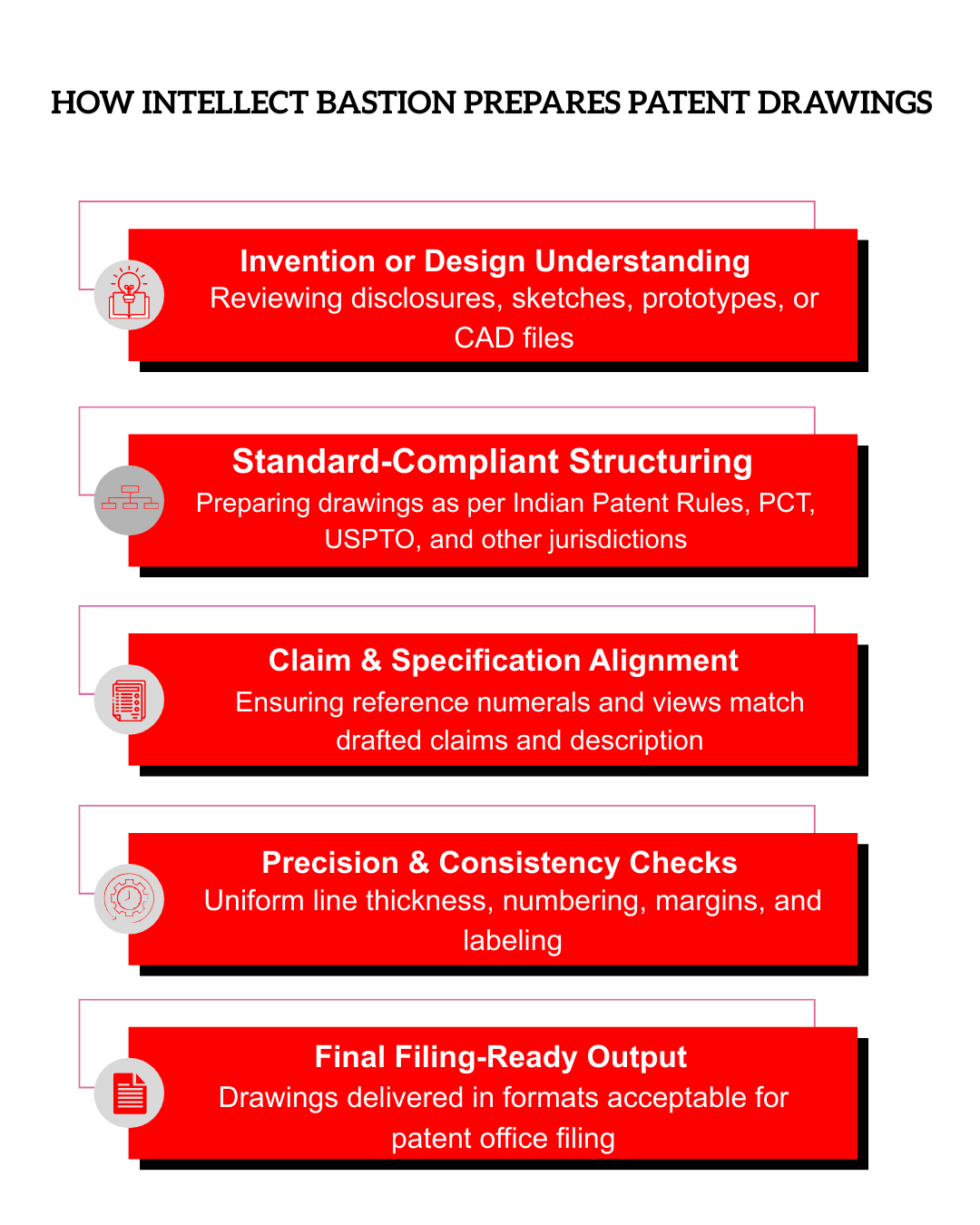
How Intellect Bastion Prepares Patent Drawings

  1. Invention or Design Knowledge — Look at the disclosure, sketch, prototype, or CAD document to kickstart the standard patent illustration workflow.
  2. Structure according to Standard Norms — Prepare drawings based on India, PCT, USPTO, and other regulations, often utilizing specialized CAD patent drawing services.
  3. Matching of Claim & Specification — Reference numerals and views must correspond precisely to the claim & specification, an area where an experienced patent drawing vendor ensures absolute compliance.
  4. Accuracy and Precision Testing — Verify equal line thickness, numbering, margins, and labelling to maintain the highest quality control when you choose to outsource patent drawings.
  5. Final Drawing Submission Ready Form — Drawings are prepared in their final form for filing submission, delivered seamlessly through trusted IP outsourcing services.
Why Choose IB

Why Choose Intellect Bastion for Patent Drawing Services?

  • Drawings prepared from a strict patent prosecution point of view by a reliable patent drawing company.
  • Good synchronization with patent drafting professionals to ensure absolute technical accuracy.
  • Applicable to Indian, PCT, and foreign applications, offering the quality of top-tier firms through affordable patent illustration vendors.
  • Experienced in mechanical, electrical, and product-based inventions.
  • Low chances of objections regarding drawings due to precise execution.
  • We prepare our drawings keeping in view the requirements of patent law and examination procedures.
A 3D cartoon character on a phone call next to a contact form for a free consultation on patent validity and invalidity search services in India.
There is some error. Please try again
We have received your request. We will connect with you shortly for further discussion

Fill In The Form Below To Get FREE Consultation 

The WHATSAPP field must contain between 6 and 19 digits and include the country code without using +/0 (e.g. 1xxxxxxxxxx for the United States)
?

Frequently Asked Questions

Find answers to top questions about Patentability Search, novelty evaluation, and the patent filing process.

Why do I need professional drawings for my patent?
Patent authorities have technical requirements about line thickness, shadings, and margins. Poor quality drawings are among the most frequent causes for delaying or rejecting a patent application.
Can I use 3D CAD models instead of 2D drawings?
Despite designing your models in 3D, patent offices still require 2D line art. 3D models should be rendered to standard views (Perspective, Front, Top and others) with correct line weight in order to be submitted.
Can I just use my own photos of the product?
The Indian patent office allows professional 3D photographs, if they are clear. But most of the patent offices require black-and-white line art. Photographs are not accepted unless there is no other option but to use them (microscopic structures, textile textures and other).
What are "Broken Lines" (dashed lines) used for?
In patent drawings, dash lines or broken lines are used to denote parts of an object which do not belong to the invention.
How many views do I need to provide?
For a Design Patent, there must be at least 4-7 views: front, rear, right side, left side, top, bottom, and perspective view. For Utility Patents, just enough views to sufficiently describe how the invention operates are necessary.
Do I need to include dimensions or measurements?
The drawings of a patent cannot be blueprints and/or engineering plans; they should be "representative" drawings. Don't include the measurements of a specific ratio unless such a ratio is critical for the operation of the invention.
Can I use color in my patent drawings?
The color is allowed but generally discouraged as it would require filing a special request along with paying additional fees and will put a limitation of colour to your patent protection. It is more advisable to use hatchings and/or shadings to show different colors in black and white.
What happens if the examiner says my drawings are "informal"?
This means that your drawings do not satisfy the technical requirements for the format (for example, lines are too blurry or the margins are incorrect). You must file "formal" corrected drawings within a certain period of time.
Can I add new drawings later if I forget a detail?
This is extremely risky. You cannot normally include "new matter" after the filing date. If an element was not included in the original drawings or written description, you may not be able to include this element later on without losing your filing date.
Do I need drawings for a software or process patent?
Yes. Although you are not drawing a physical thing, you need to supply flow charts or logic diagrams of how the software or process works.
Tube Card

Don’t File Blind — Do a Patentability Search First

Give your invention the best start! Learn why a patentability search is crucial and how to check originality using the right tools and strategies.