Frequently Asked Questions
Find answers to top questions about Patentability Search, novelty evaluation, and the patent filing process.
Why is NPL search critical if I've already searched patent databases? ▼
Many inventors (most common among academic scientists) will publish their inventions in papers or conferences, but will never file a patent application. The NPL can be used to kill your patent even if they did not file for it.
Do you search academic journals (IEEE, PubMed, ScienceDirect)? ▼
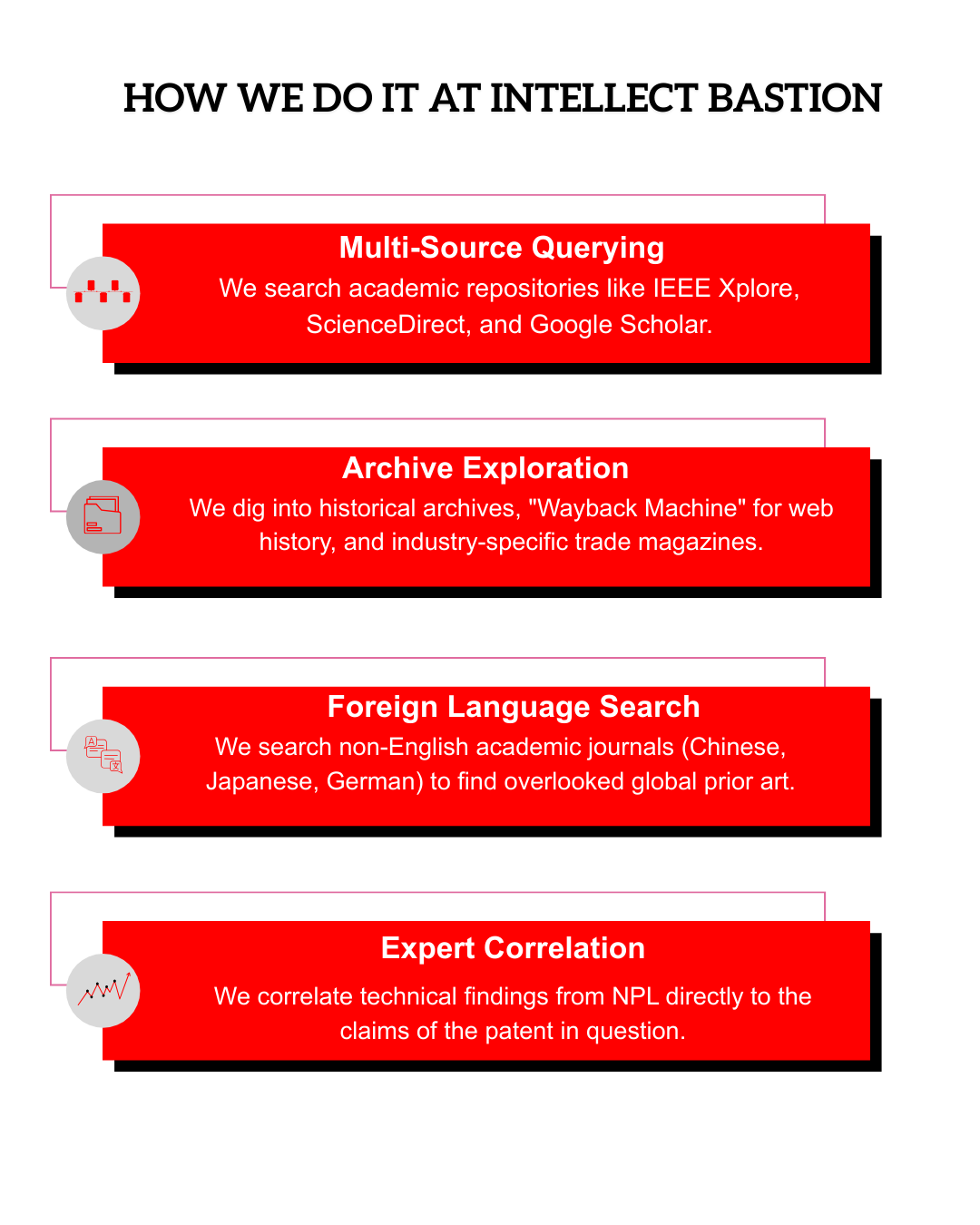
Yes. We have subscriptions to all the key scientific journal publishers (Elsevier, Wiley, IEEE, and more) for searching for papers behind the subscription walls.
Can you find "prior art" in old conference papers or university theses? ▼
Yes. We search university websites and abstracts of conference sessions called "Poster Sessions," where companies present new research results to each other.
How do you handle "wayback machine" searches for websites that no longer exist? ▼
We use the internet archive to access old web pages and timestamping to prove that technology existed publicly on a certain date.
Do you search product manuals, white papers, or trade show brochures? ▼
Yes. The "Grey Literature" resources provide the most powerful documentation that the invention existed prior to filing the patent.
How do you search for NPL in foreign languages (e.g., Chinese or Russian journals)? ▼
Native language experts are used to conduct a literature review on localized databases (e.g., CNKI, in China), which are not available on any English search engine.
Can social media posts or YouTube videos be considered prior art? ▼
Correct. If any video or publication "enables" a person to comprehend the working of an invention, and it precedes the filing date, then it would be a valid prior art.
Is NPL search usually bundled with a patent search or sold separately? ▼
Yes, it could be either. But when it comes to invalidation and FTO, Non-Patent Literature (NPL) is almost always considered because of its criticality.
How do you verify the "publication date" of an NPL source for legal purposes? ▼
Proof of Publication is obtained as documents like a library stamp, received by journal dates, or digital certificates.
Can you find "open-source" code repositories (GitHub) for software inventions? ▼
Yes. GitHub, GitLab, and SourceForge are searched to determine whether there were any prior public code commits before filing a software patent.