
Biological Sequence & Genetic Prior Art Search

Unlocking the complexities of genomic and proteomic intellectual property.

Biological Sequence Search — Final Code

Biological Sequence & Genetic Prior Art Search
What is a Biological Sequence Search?

A Bio-sequence Patent & Literature Search looks into patent filings and prior art concerning specific DNA, RNA, or Protein sequences. This specialized bio-sequence prior art search and DNA RNA protein patent search process serves as a comprehensive biological sequence search services framework. Employing advanced bioinformatics methods, we will compare your sequence against numerous known genetic sequences to see whether there is any similarity. This highly technical bio-sequence search and nucleotide and amino acid sequence search is an essential patent search step for verifying biotech patents, relying on precise sequence search, gene search, and patent indexing protocols.


Biological Sequence Search
Why Conduct This Search

Why is this Search Done?

  • Biotech Innovations: Critical for vaccine creators, diagnostic tool producers, and CRISPR technology developers. Novelty is ensured by biotechnology patentability search with a specialized motif search.
  • Compliance with Regulations: Verify that there is no overlap between your genetic sequence and patented biological material by a thorough biotech freedom to operate search (FTO search), bio-sequence clearance search and in-depth biomedical patent infringement risk analysis.
  • Novelty: Confirm the uniqueness of your protein or gene sequence by utilizing BLAST search, an analytical GenBank search, precise FASTA search, or an advanced STN search.
Our Approach

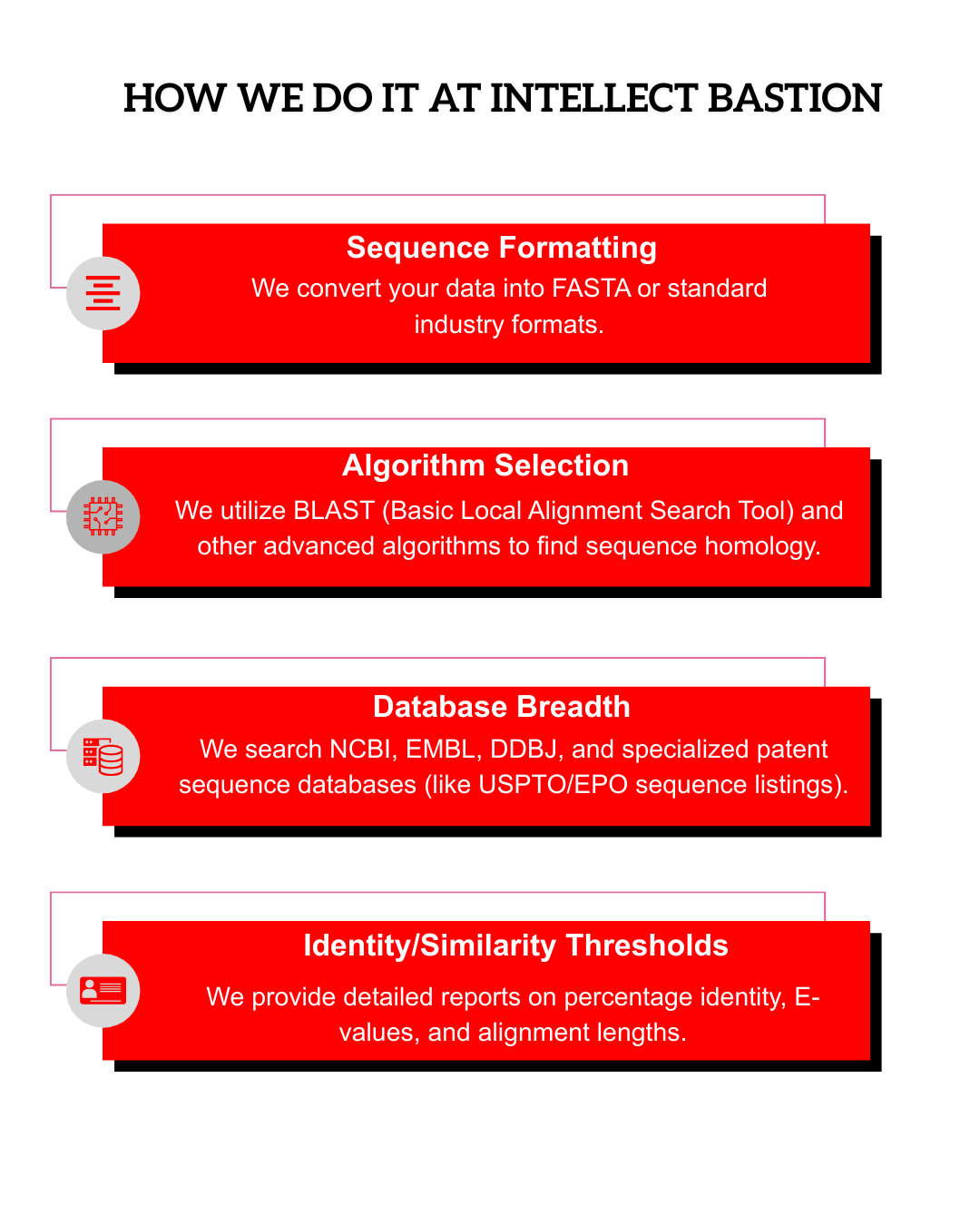
How We Do It at Intellect Bastion

  1. Sequence Formatting: Your data will be formatted in FASTA or industrial standard formats, which is important for running a precise prior art search or executing a patentability search.
  2. Algorithm Used: We use the BLAST algorithm as well as others to discover sequence similarities. Blast patent search services ensure wide coverage, which is useful when conducting a CDR sequence patent search or setting up a broader STN bio-sequence search protocol.
  3. Database Searches: We search the NCBI, EMBL, DDBJ, and special sequence databases for patents. This ensures reliable GenBank patent sequence alignment mapping.
  4. Homology Report: We prepare a report based on percent identities, E-values, and alignment lengths. This analytical breakdown provides a patent clearance summary and defensible IP clearance assessment.

Why Choose IB

Why Choose Intellect Bastion?

Our experts have vast experience in biological sequence patents. Our services include providing detailed reports indicating exact matches, related sequences, and searches for DNA patent search, RNA patent search, protein patent search, Antibody patent search, enzyme patent search, and primer patent search to provide informative decisions. If you are searching for best biotech patent services in India, you are at the right place.

A 3D cartoon character on a phone call next to a contact form for a free consultation on patent validity and invalidity search services in India.
There is some error. Please try again
We have received your request. We will connect with you shortly for further discussion

Fill In The Form Below To Get FREE Consultation 

The WHATSAPP field must contain between 6 and 19 digits and include the country code without using +/0 (e.g. 1xxxxxxxxxx for the United States)
?

Frequently Asked Questions

Find answers to top questions about Patentability Search, novelty evaluation, and the patent filing process.

Which databases (NCBI, GenomeQuest, etc.) do you use for sequence searching?
NCBI (GenBank), EBI, and GenomeQuest databases are used to give access to not only public genome data but also to "Sequence Listings" from private patents.
Can you search for sequences with a certain percentage of "homology" or identity?
Yes. Our search includes using BLAST and Smith-Waterman programs to determine the percentage identity of the sequence compared to your target.
How do you handle searches for modified or synthetic nucleotides?
Yes. You can request our database search to look for artificial amino acids or modified nucleotides, which might be common for recent mRNA studies.
Can you search for "fragments" of a larger gene sequence?
Yes. Sub-sequence searches are done to check whether your particular primer/probe/peptide is contained as part of the larger patented gene.
Do you cover sequences found in "Non-Patent Literature" (scientific journals)?
Absolutely. A lot of genetic discoveries can be published well before the actual patent appears. They could appear in such magazines as Nature or Science.
How do you handle search queries for CDRs (Complementarity-Determining Regions) in antibodies?
Yes. We run searches against specific hyper variable loops within the antibody structure, which are among the most frequently patented parts of biologics.
Can you identify patents related to CRISPR or specific gene-editing techniques?
Yes. We can monitor any relevant patents associated with "Guide RNA" (gRNA) sequences, as well as the Cas9/Cas12 enzymes involved in gene editing.
How are the results presented (e.g., sequence alignment maps)?
We generate a ‘Sequence Alignment Report’ displaying your sequence in relation to the matched patent sequence to demonstrate how "A-T-C-G" or other coding matches exactly.
Can you search for "motifs" or specific biological patterns?
Yes. We run sequence motif searches that could be patented regardless of what the actual DNA sequence looks like.
How do you account for variations in sequence nomenclature?
We have our biological experts take into account IUPAC sequence search, synonymous codons and different ways researchers could document the same genomic information.
Tube Card

Don’t File Blind — Do a Patentability Search First

Give your invention the best start! Learn why a patentability search is crucial and how to check originality using the right tools and strategies.