Innovations are no longer exclusive to a single nation in today’s globalized economy. A product produced in one country may be manufactured in another and sold across the globe. Because of this inventor has to protect their product not only in home Country but also in multiple counties. International protection of your invention becomes crucial if it has commercial potential. If your invention isn’t properly protected, people in other nations can replicate, produce, or market it without your consent. This can lead to loss of inventor`s profit and weaken their position in market.
Since patents are territorial rights, protection in one nation does not always translate to another. In order to obtain protection across several jurisdictions, inventors must take a calculated approach.
Patent filing works on Territorial basis which means each country gives Patent rights separately in accordance with their law. Therefore inventors should wisely choose where to apply based on business goals and budget. Planning will help inventors to analyse the whole plan and work in correct approach.
UNDERSTANDING THE TERRITORIAL NATURE OF PATENTS:
When an inventor files a patent application, the application will fall under only applied jurisdiction and right they receive remain limited to that specific country. Patents works under the principle of territoriality which means each country grants, applies and control in its definite borders according to the law governed in the Country.
Inventors must take some active step if they want to save their invention in multiple country. They cannot rely on a single patent filing to secure global protection. They must file a separate application in each country where want legal protection. Each Country can follow their own Patent laws, examination process and legal enforcement system. Patent office in one country may work accordingly and they have different way to interpret novelty, inventive step and industrial applicability. As a result it is not necessary that if an invention qualifies for a Patent in one Country it will qualify for another country.
PARIS CONVENTION ROUTE
- Direct Filing (Paris Conventional Route) : The Paris convention route can help inventors to file Patent Application in several Countries by doing single initial filing , also know as the priority application.
- Nature of PCT route:
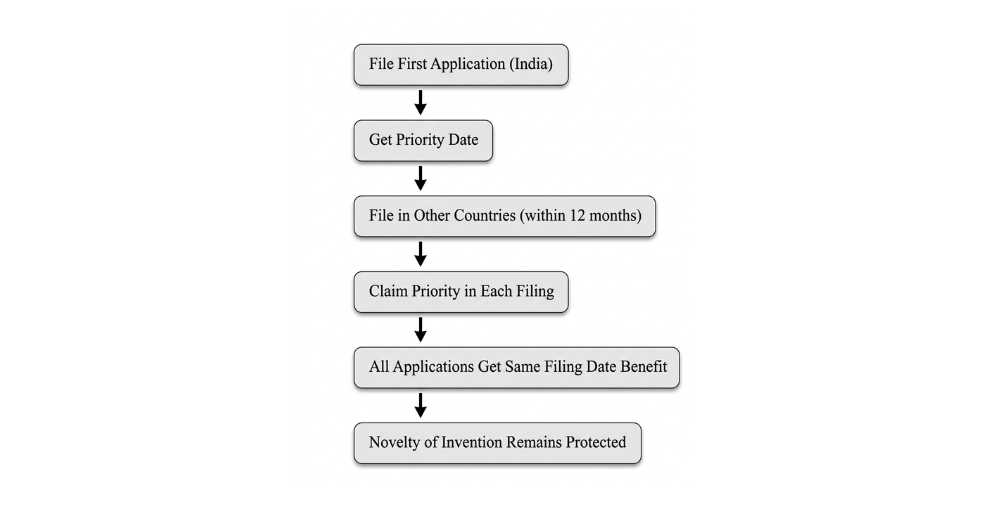
- File first priority application in one country– You file your first patent application, known as priority application, in one Country to establish an official filing date on your invention. The initial filing will secures your priority date, which you can later claim when you are filing in another country. This will help you to protect the novelty and inventiveness of your invention globally.
- File application within 12 months– You can file Patent applications in other countries within 12 months from the date of your first priority date.
- Claim the priority date in all subsequent patent filings– You can claim the priority date in all your subsequent patent filings by referring to your first filed application. This allows your application to get a benefit of the original date even though you submit in another country. Priority Date Concept (Paris Convention Route)
| Step | Action | Explanation |
|---|---|---|
| 1 | File First Application | You file your initial (priority) patent application in your home country or a member state. |
| 2 | Establish Priority Date | The filing date of this first application becomes your "Priority Date" globally. |
| 3 | International Filing | You have 12 months from the priority date to file applications in other countries. |
| 4 | Claim Priority | While filing abroad, you must explicitly reference the first application to link them. |
| 5 | Backdating Benefit | All subsequent filings are legally treated as if they were filed on the original priority date. |
| 6 | Protect Novelty | Patent offices will not count any similar inventions revealed after your priority date against you. |
| 7 | Safeguard Disclosure | Publicly disclosing your invention after Step 1 will not jeopardize your patent rights in other member countries. |
Easy Explanation via flow chart:
PATENT COOPERATION TREATY:
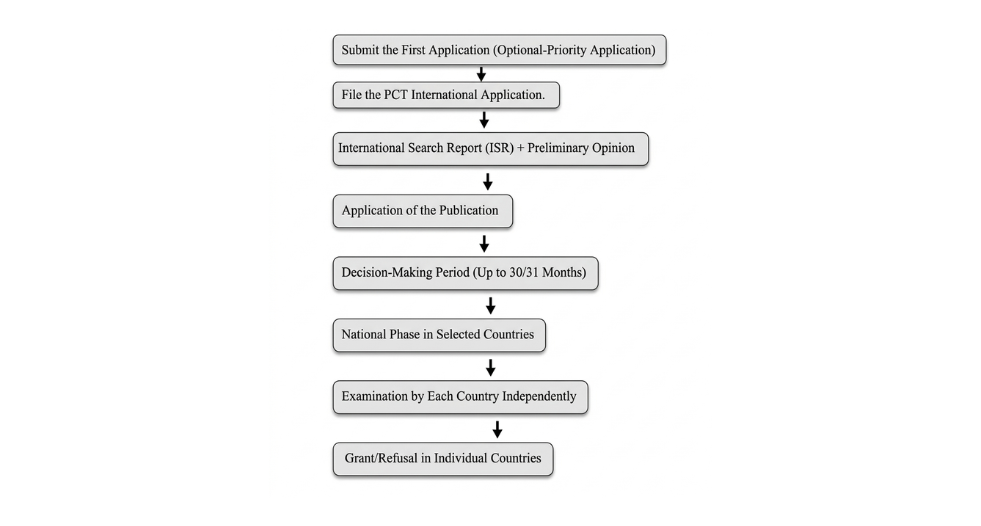
- Overview: The PCT route under the Patent Cooperation Treaty provides a widely used method for getting patent protection in various countries. Under this , you can file single application instead of filing separate application in different Countries at early stage. Then you receive an International Search Report along with a preliminary opinion on the patentability of your invention, which helps you to understand the pros and cons of your invention and chances of success rates in industrial market. The system also gives you 30 to 31 months from priority date to analyse in which countries you want to proceed with your applications.
- No global patent under PCT: It does not provide a global patent while it just simplifies the international filing process. You have to still individually have you enter national phase in countries to take protection and each Country examines your application according to its laws and rules. However you can get time to analyse time assess the commercial viability of your invention and make it market ready.
PCT Route Concept:
| Stage | Action | Explanation |
|---|---|---|
| 1 | File PCT Application | You file one international patent application. |
| 2 | International Search | Authority conducts search and issues ISR. |
| 3 | Preliminary Opinion | You receive opinion on patentability. |
| 4 | Publication | Application gets published internationally. |
| 5 | Decision Time | You get up to 30/31 months to choose countries. |
| 6 | National Phase Entry | You file in selected countries individually. |
| 7 | Examination | Each country examines under its own law. |
| 8 | Grant | Patent gets granted or refused country-wise. |
Easy Explanation via flow chart:
Which of the following route is better: Paris Convention or PCT?
You choose between Paris and Convention route and PCT route based on budget, your goals and overall your patent strategy which you decided to follow. If you know the countries where you want protection and you are ready to invest early, you can use the Paris Convention route. It is faster when you select the jurisdiction where you want to file for your Patent.
However if you need more time to calculate your invention, explore markets or manage cost you should prefer PCT route. It helps you to delay major expenses while you commercialise in market as it is flexible.
How long does International Protection last?
International patent protection usually lasts for 20 years from date of filing of patent application. It is a general rule that when you apply for Patent in later stage you have to apply for Patent renewal or maintenance fees in each country to keep your patent alive. If you are unable to pay the patent renewal fees you can lose your right before 20 years, so you have to be very active when it comes to renewal of Patents. After expiry of period, invention becomes open to public and anyone can attack it without your permission and you will lose all benefits of your invention.
Common Mistakes to Avoid:
- Delay in International filing: Many inventors delay their patent filing internationally and miss some important dates. This delay leads to loss of patent rights in other country and ultimately weaken the overall protections.
- Choosing too many Countries without Strategy: Some inventors file in various country without any planning. This will automatically increase the cost without even providing with the business benefits.
- Ignoring Renewal and Maintenance Fees: Many inventors forget to pay the renewal fees even after patent gets granted. This mistake can result in the loss of valuable patent rights.
- Weak Patent Drafting: Inventors sometimes file patent with poor drafting skills . This reduces the chance of getting protection and make easy for competitors to challenge or object to the invention.
Role of Patent Agents and Attorneys:
Draft Strong Patent Documents: Patent agent and attorneys are the one who drafts clear , detailed and legally sound specifications that will helps you to protect the invention.
Manage International Applications: They handle patent filings in multiple countries that ensures that you comply with each country`s rules and regulations.
Respond to Objections: They prepare and submits response to objection and do patent monetization everything on Indian Patent Office.
Guide you Patent Strategy: They advise you on selecting the right country as they are already into this field.
Address Office Objections and Actions: They draft and submit answers to patent offices’ objections and examination reports.
Track deadlines: They manage the documentation and filing work and make sure that they fulfil every legal requirement so that you can get protection
Conclusion:
Protecting your invention at globally requires a careful planning, timely decisions and right financial investment. Inventors must understand the patent rights don’t extent beyond national borders automatically, it is to be done via process by carefully choosing the right filing route whether through the Paris Convention or the PCT route for extended flexibility. Each route has its own advantages and selecting appropriate route will help the inventor for long term commercial plans.
A strong IP strategy begins with identifying the right countries for protection. Intellect Bastion is a dedicated firm committed to protecting and strengthening innovation in today`s competitive world. The firm combines legal expertise and practical business insight to deliver solutions that not only safeguard the ideas but also helps to boom in market.
Author: Shreya Sinha
IPR Assistant at Intellect Bastion