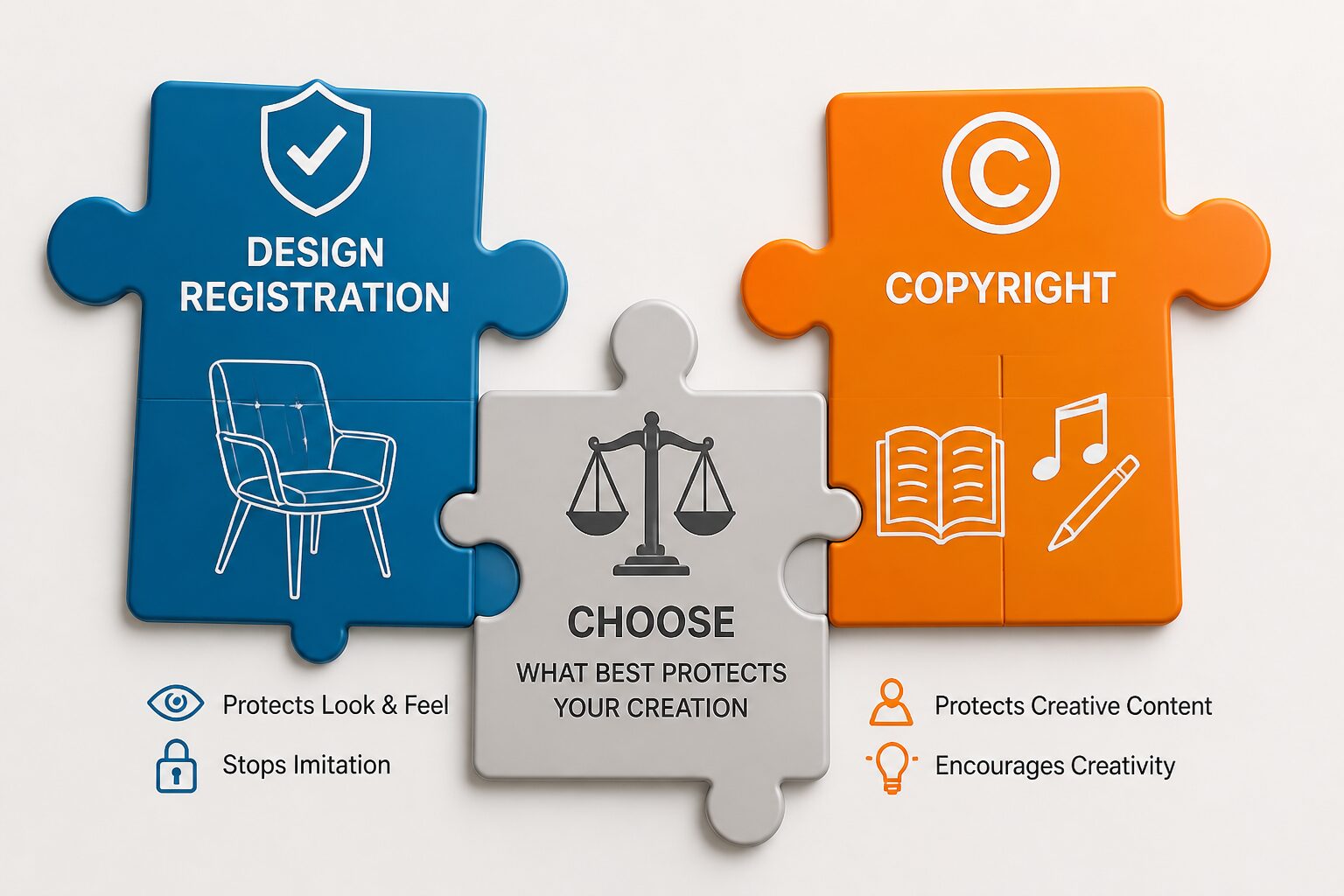
Intellectual property refers to authors’ legal rights to their creations. These works may be tangible, such as an invention or product design, or intangible, such as a trademark or copyright.
Any company that produces tangible items must have a strong product design department. Producing only a unique and novel product design is not enough to ensuring its economic benefits because business rivalries can steal the designs or use it as a model for their own products. Intellectual property (IP) laws are useful for this situation.
IP protection is essential to product design because it shields companies’ concepts and inventions against infringement. To know more about different types of IPR please check our another blog.
1. Intellectual Property for Designers
In the past, designers created designs for industries using conventional methods. Because of this, the majority of designs were created by hand and included paints and drawings on completed items, resembling ancient Indians in various civilizations.
Industrial designers of today employ a variety of instruments and methods to produce goods that are both aesthetically pleasing and useful. Some of these techniques include 3D printing, such as articles with shapes with a 3D effect that are more attractive to the eye.
The necessity to safeguard industrial designs was initially recognized in the nineteenth century, and the Act No. XV of 1859 was enacted to offer design protection. After then, it was titled “The Patterns and Designs Protection Act.”
The Inventions and Designs Act, 1888, which combined and modified the legislation pertaining to the protection of inventors’ designs in a distinct section of the Act, took the place of this Act. Following this, the Act of 1888 was superseded by the British Patent and Designs Act, 1907, which serves as the foundation for both India’s new design law and contemporary patent law.
Since patents and designs were two distinct intellectual property rights connected to any object, there was a perceived need for two distinct regulations. For this reason, two different laws were passed: the Patents Act of 1970 and the Designs Act of 1911.
The Designs Act of 1911 was replaced most recently by the Designs Act of 2000, which sought to protect Indian designs while also bringing Indian design law up to date with international law, which the 1911 Act needed.
Design Registration vs Copyright
Industrial design must be distinguishable from other types of intellectual property rights. Copyright and industrial design are not the same thing. While copyright is present in artistic works, it does not always apply to articles. For instance, an artist’s original sketch is protected by copyright, but it only qualifies as a design topic when it is used in products for a certain industry.
The process of protection of work under copyright and design laws are completely different; however, they protect similar types of work or designs.
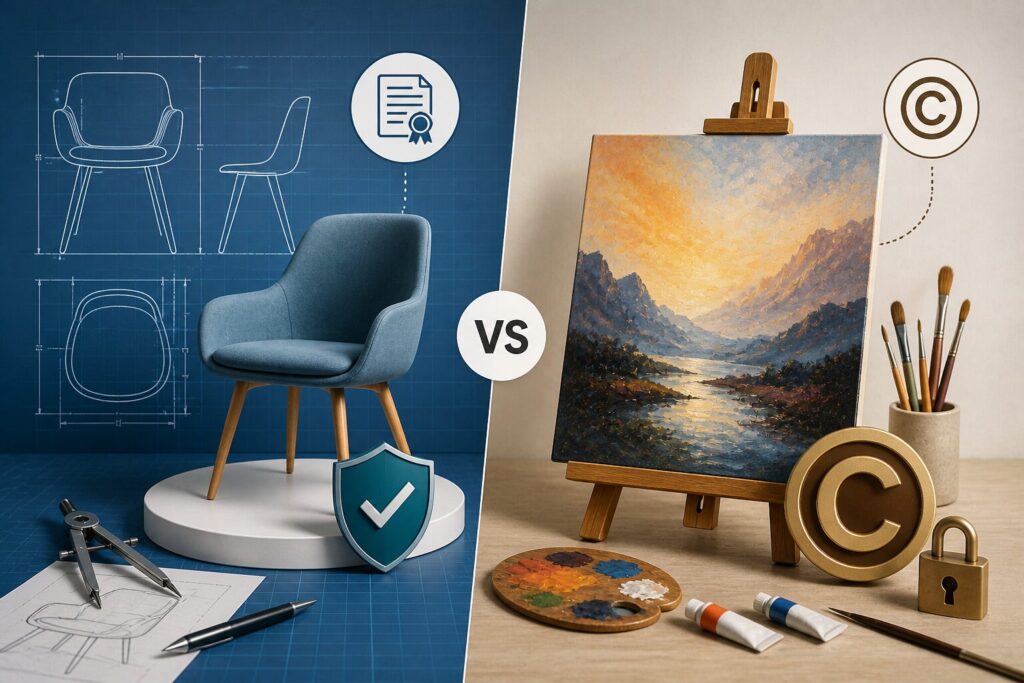
- Copyright protection is a straightforward process that includes simple registration or certification requirements. It is an automatic right that is included to original works that clearly identify their creator.
- However, protection under design legislation implies a formal registration procedure and an earlier application that must be granted by the Registrar. In contrast to copyright, which is free, design registration necessitates payment from the work’s originator.
2. Design Registration vs Copyright: Key Differences
Design Registration offers the designer greater protection for his or her artistic works than copyright. It is more advantageous than copyright since it covers the owner against someone else producing a design that is identical or similar, even in terms of overall impression, whether it was inspired by the registered design or made independently.
But the main goal of copyright is to prevent others from “copying” a creator’s work. The author and owner of the work must demonstrate that the alleged infringer actually copied the original work in order for copyright to be enforced. If the alleged infringement independently creates the same work, copyright would not be enforceable.
Now, we understand design and copyrights. But, choosing design, copyright, or both forms of protection is still hard for your client. Here, we will compare two intellectual properties in given ways (In India):
- Registration – First, after a successful prosecution, design registration are awarded. When a work is created and fixed in a tangible medium, a copyright is automatically developed. However, once more, a nationwide copyright registration is necessary in order to report copyright infringement.
- Time for registration – The registration process for a design takes longer than that for a copyright. Obtaining design rights typically takes longer than a year. However, it typically takes three months to one year to register a copyright.
- Fees – Applying for a copyright is less expensive than applying for a design. Design filing expenses range from INR 1000 to INR 4000. Additionally, maintenance fees for design can range from INR 2000 to INR 8000. However, INR 500 is required for basic copyright registration. There are no maintenance costs associated with copyright.
- The Term of Right – In India, a registered design provides legal protection for ten years after the date of filing, with a further five years available upon renewal. On the other hand, copyrights are valid for the duration of the owner’s life plus an additional 60-70 years.
Designs shall be meaningfully protected by all design and copyrights. The industries in which the works are used, the level of competition in those fields, your budget, and other considerations will determine whether you choose a design, copyright, or both types of protection.
(A) Registered Design Rights
The Designs Act, 2000 is the law that unifies and improves India’s design protection legislation. Its primary goal is to prevent innovative or unique designs from being imitated, safeguarding the owner from suffering damages. The list of unique characteristics included in the Designs Act of 2000 is as follows:
- Acceptance of the Locarno Classification
- Absolute novelty permits the evaluation of novelty based on any article’s previous publication, both in India and abroad.
- Design restoration
- Section 22(4) of the Designs Act, 2000 gives district courts the authority to transfer matters to higher courts.
(B) Copyright for Artists
Intellectual property is your novel or unique creation that has value, not just an idea. By registering your copyright, you can safeguard your intellectual property and stop illegal use. All manner of creative works may be registered, such as Literary Works, artistic Works, Musical Works, dramatic Works, Cinematograph works and computer Programs like Software and applications.
Copyright registration safeguards your original creations and provides numerous benefits.
- Protection Against Infringement
- Public Recognition and Credibility
- Monetary Gains
- Easy Licensing and International Access
3. Does Copyright Protect Product Shape?
A wide range of original creative “works” are protected by copyright, including, for product protection purposes, graphic works, sculptures, collages, architectural works, and works of artistic skill. The exact extent of the right varies from region to territory, just like with design rights. In contrast to patents and registered designs, copyright protection does not require registration; rather, the work must be unique. The fact that copyright protection lasts for a very long period—typically 60-70 years after the author or creator of the work dies is one of its main benefits.
A wide range of original creative “works” are protected by copyright, including, for product protection purposes, graphic works, sculptures, collages, architectural works, and works of artistic skill. The exact extent of the right varies from region to territory, just like with design rights. In contrast to patents and registered designs, copyright protection does not require registration; rather, the work must be unique. The fact that copyright protection lasts for a very long period—typically 60-70 years after the author or creator of the work dies is one of its main benefits.
Protecting Product Design
The intellectual property law that governs the protection of product designs defines a product as any industrial or handicraft object, including elements meant to be integrated into a complex product with several components, as well as packaging, get-up, graphic symbols, and typographic typefaces.
4. When to Register a Design
The registration of designs is the best option if:
- When your design has some commercial value in market.
- When your design is new and unique
- When you expect that can anyone copy
- When you are planning to launch a startup
- When you are interest in Licensing opportunity.
5. How to Protect My Furniture Design from Being Copied
In the field of furniture design, aesthetics can play as important a role as practicality because a furniture piece’s unique appearance may set it apart in a competitive marketplace and help develop a brand’s identity. Fortunately, design can assist protect business investment in the development of distinctive products and are particularly well-suited to protect the visual innovation included into furniture designs.
To protect furniture design, follow these steps:
- Register your unique design by filing it at IP India
- Maintain Confidentiality before filling.
- Hire any professional.
- Monitor Market for infringement.
6. Design Registration Benefits for Startups
A design registration can increase the value of a product. It can make a product more appealing to customers and may even serve as its unique selling feature. Therefore, protecting important designs should to be a key component of any manufacturer’s or designer’s company strategy.
By registering a design, the owner gains the sole authority to stop others from illegally copying or replicating it. This makes financial sense since it increases a company’s competitiveness and frequently generates extra income in one or more of the following ways:
- Registration improves your competitive position by preventing adversaries from stealing and copying a design.
- Registering a valuable design helps to ensure a fair return on investment earnings because industrial designs are business assets that can raise the commercial value of a company and its goods. A design’s value to the business increases with its level of success.
- It is also possible to sell or license a registered design to third parties for a price. You might be able to reach markets that you would not otherwise be able to service by licensing it.
- Industrial design registration promotes honest commercial procedures and fair competition, both of which support the creation of a wide variety of visually appealing goods.
7. Conclusion
Knowing the difference between design registration over copyright registration is important for every businessman or industrialist or artist. If your artistic work involves physical product, or shapes or commercial appeal, choosing design registration right can help you to get stronger protection.
At Intellect Bastion, we provide comprehensive design registration services tailored to your budget and business goals. Our skilled experts consult you through each stage of the design registration procedure ensuring the best possible protection for your intellectual property.
Author: Sibgat Ansari
Patent Associate at Intellect Bastion