A patent gives you a monopoly right to take legal action to stop any competition to your invention for a limited period, normally 20 years.
Most creators thought of it as a certification. But it is not. It is not only a legally enforceable right. A patent gives its owner the ability to control distribution, restrict unapproved manufacturing, and profit from the invention through licensing.
Stages involve in patent prosecution in India
- Patent Filling
- Patent publication
- Request for Examination
- Patent Grant / Refuse
Here you can read our full blog in the Patent registration process “Your Ultimate Guide to Patent Filing in India: Protect Your Ideas Like a Pro!”
Patent Publication and Patent registration or grant are sometimes confusing for inventors or creators, So Iin this blog, we will explain the complete difference between patent publication and Patent Grant, discuss the patent grant process, time taken in grants or legal benefits of patent published and Granted Patent.
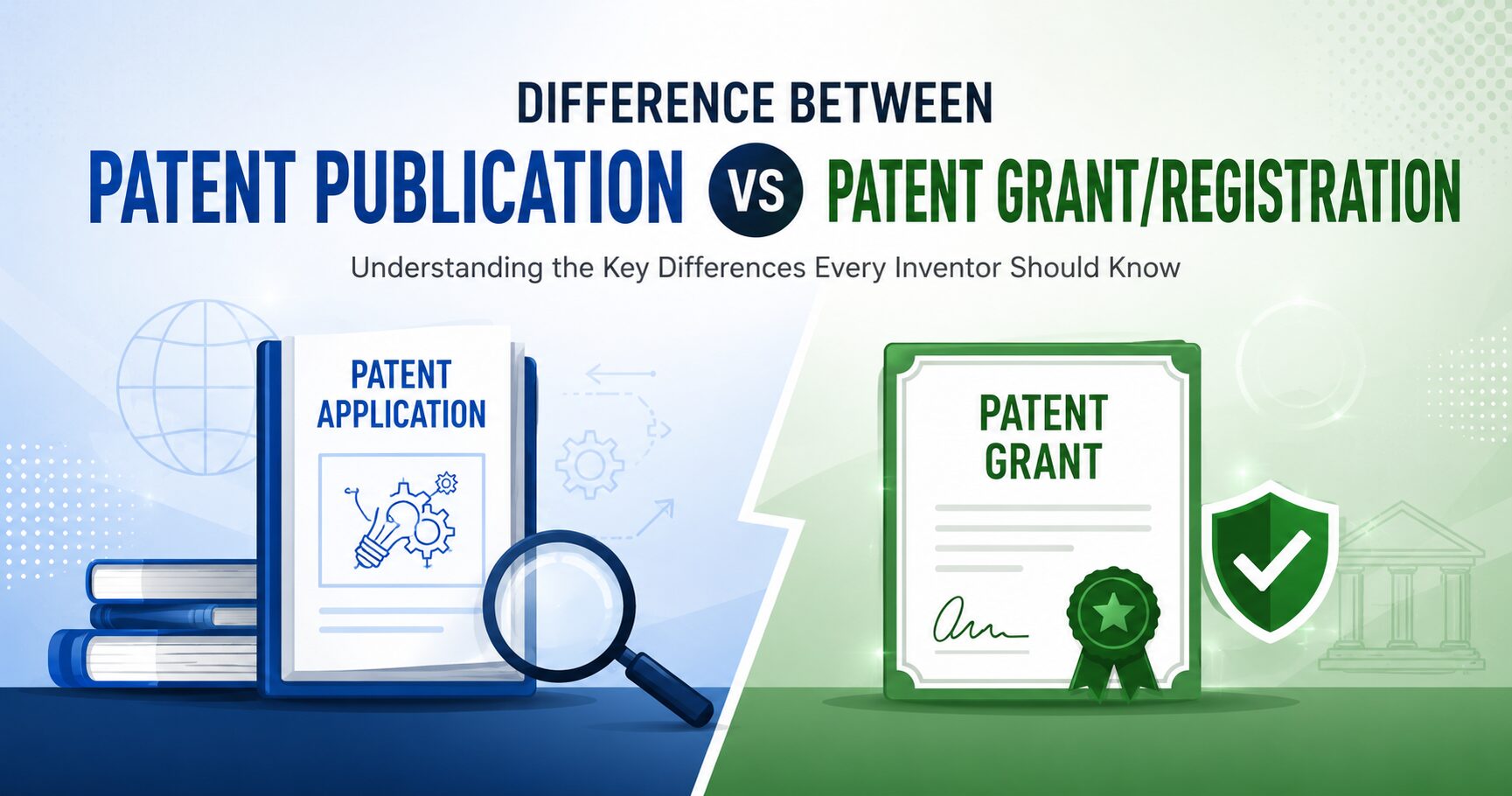
Patent Publication vs. Patent Grant
The patent application is automatically published after eighteen months from the filing. Then your application has been published in the Patent Office Journal. The Patent-E journal updated on every Friday.
Early publication can speed up the prosecution process and provide benefits like discouraging rivals. Whereas provisional applications are not published, when we filed complete specification of the same invention then it published..
Following the grant of the patent, the IPO publishes it in the patent gazette.
Patent status published vs registered
Your invention got published and receive published status when you submit full specification, after the it become public.
When you patnet application got published and all examining are complete then your patent application granted. Then you can download your patent registration certificate for IP India.
What is Patent Publication
The Indian Patent Act’s Section 11A governs patent applications. They automatically published every patent application eighteen months after filing or priority date, whichever comes first. However, you can request early publication if you wish your application to appear in the official records earlier.
After application got published:
Your patent application publicly available in Indian Patent office journal
Anyone just like your competitor can read your invention.
There are chances of Pre-grant opposition by your competitors.
Rights of a Published Patent Application
When the application is published, Section 11A(7) gives the applicant “like privileges and rights as if a patent had been granted on the date of publication”; nonetheless, it is specifically prohibited to begin infringement proceedings prior to the patent’s actual issuance.
For post-publication activities that come under the finally granted claims, courts and practice guidelines uniformly interpret this as temporary protection that develops into monetary compensation following grant.

The Patents Act of 1970’s Section 25(1) addresses pre-grant opposition. This clause allows anybody to file a written objection to a patent application after it has been published but before it is accepted.
Rule 55 of the Patent Rules, 2003 contains the specific guidelines for doing this, explaining that you must use a certain form (Form 7A).
The Controller of Patents, a representative of the Indian Patent Office, who determines the next course of action examines the objection.
What is Patent Grant or Patent Registration
The legal process of acquiring a patent gives the creator the right to create, sell, use, or profit from the innovation without the approval of others. The inventor gets the whole patent rights to stop others from manufacturing, selling, copying, importing, profiting from the innovation, and so forth. A technical idea might become a legally protected commercial asset through patent registration.
The Patents Act, 1970, which is in line with the international TRIPS criteria for worldwide patent protection, governs the granting and administration of patents in India. This enables the creator to keep improving their app, grow it further, and submit international patent applications all around the world.
Key Benefits of Patent Registration
- Exclusive right to make sell or license your patented invention
- You get protection up to 20 years from the filing date
- You have option to extend protection globally through Patent Cooperation Treaty (PCT).
- You can take legal action against infringer.
Is a Published Patent the Same as a Granted Patent?
A published patent is not the same granted patent. The publishing of a patent application is one of the step of Patent prosecution.
Purpose of patent publication is to inform people the public about the content of application. As a result, the patent application’s contents become “prior art” according to the publication date. The public can copy from your patent application information in the published patent application.
Unlike a granted patent, a published patent application does not provide an immediate and direct danger of infringement. Even yet, a published patent application’s technical teachings and disclosures may still be prior art when it comes to claims made in subsequent patent applications.
However, a published application and a later related patent are frequently only cumulative, which means that their substantive teachings are redundant (apart from differing publication dates).
Early publication is one of the simplest ways for candidates to shorten their time period. To seek early publishing, they must file Form 9 with the fee of Rs. 2,500 for natural person or Rs. 12,500 for entities other than natural persons.
After the filling of patent application, request for publication (Form 9) it got published it within a month. It will take this request into consideration if the application does not address issues related to atomic energy or defense.
How Long After Publication is a Patent Granted

The next step in the Indian patent examination process is to submit a Request for Examination (RFE) following the publication of the patent application.
The applicant or any interested party must submit this request within 48 months of the filing date or the priority date, whichever comes first. We will consider the patent application withdrawn and will not move on to the examination stage without this request.
In order to determine if your innovation actually merits a patent, the IP office appoints examiners who will now review your application, closely examining each claim and illustration.
The examiner issued the first examination report (FER). The applicant must address any concerns or objections brought up by the Patent Examiner after obtaining the First Examination Report (FER). FER response must be submitted within six months from FER’s release, but you can request a three-month extension.
The applicant may amend claims, give justification, or present arguments to address the examiner’s concerns in the FER response. The objective is to persuade the examiner that the invention satisfies all requirements for patentability and ought to receive a patent. The examiner carefully considers the applicant’s response and, if satisfied, may issue additional reports or grant the patent.
The IPO has made it possible to speed the examination of patent applications. A request for expedited examination, as defined by rule 24C of the Patent Rules, 2003, according to that rule you can filed for expedited examination with fee.
Expedited Examination in India
Expedited application are assigned in different queue which is faster than regular examination, and it give FER report quickly.
Eligibility for Expedited Examination
- A PCT application chooses India as ISA OR IPEA.
- A startup or small entity company
- A female natural person
- Any government institutions, departments or companies owned by the government are eligible.
You must submit a request for sped up examination using Form 18A, as described in the second schedule of the Patent Rules, 2003, along with the fee specified in the first schedule.
Here you can read our full blog on Expedited examination in India “Can the examination of Patent be expedited in India?”
After the response filed, examiner will review again and if he satisfied with all reposes, they award the patent. The grant of a patent is the final stage of the Indian patent examination process. They made the information of the granted patent public after they published it in the official patent journal.
Factors Affecting Patent Grant Time
- Complexity in your invention requires more time in examining.
- Field of technology
- Good quality application reduces the examination time.
- FER Response time.
Here you can read our full blog in time for Patent Grant “How Long Does the Patent Filing Process Take? A 2025 Guide for Inventors & Businesses.”
Conclusion
To knowing about the Difference between Patent publication or patent Grant are so crucial for inventor, startups owners, researchers, and business man who seeking protection in Intellectual Property Right.
Patent publication simple stage compared to patent Registration. After publication, you get your patent published in IP India Database. However, Publication is not a proof of legal protection or approved.
Whereas, Patent Grant, is the last stage where legal protection begins. Granted patent provide strong exclusive right to invention or applicant for legal enforceability, licensing, commercialization.
For business and startup or small entity, granting a patent might be a valuable asset that provide strength market position, commercialized, makes a profit by licensing or selling and protects form unauthorized use.
For patent protection, you can hire any professional for Patent Prosecution. A patent professional is a techno-legal specialist who assists companies and inventors in safeguarding their intellectual property.
MS Ansari Patent Associate at Intellect Bastion LLP