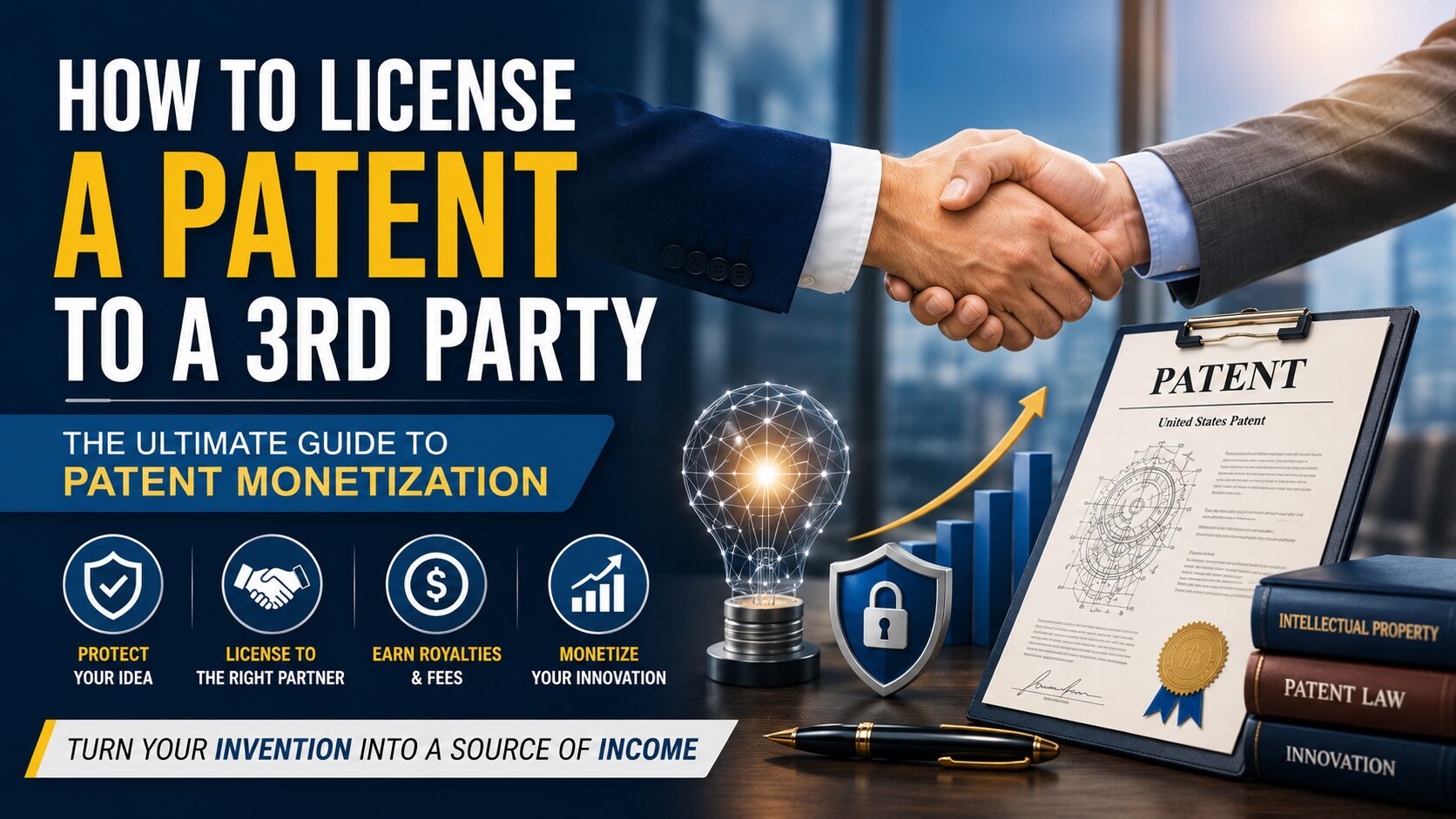
Months or years have gone by in creating that visionary thought and converting it into an asset covered by law. You now possess a patent that the patent office officially granted. While this document serves as proof of ownership, having a patent in no way guarantees earnings.
There are many inventors who do not have the money, factories, and marketing experts capable of marketing their product worldwide. Thankfully, there is no need for you to form a huge company in order to make profits out of your invention.
Patent licensing becomes your tool to gain access to the resources that these companies already possess. In doing so, you get to earn without putting any further effort into making your inventions work. Therefore, you will be able to concentrate on your forte: inventing.
In this complete guide, we will discuss the basics of licensing IP.
What is Patent Licensing and Why Choose It?
Prior to the whole procedure, you should familiarize yourself with the business model behind IP. As you know, an IP licensing deal is similar to a commercial rental for your patent. While keeping possession of the latter, you sell it to a third party for certain payments and allow its use.
You arrange the deal according to specific terms in the licensing agreement. Therein, you specify how the licensee can use the patented product, the period, and the territories. As compensation for your patent rights transfer, the company will pay you some money, specifically, fees and royalties from the patent.
What are the advantages of a licensing deal over manufacturing?
- Lower Financial Risks: No need to borrow lots of money to erect plants.
- Fast Market Introduction: The company already has its sales channels, established brands, and active sales forces.
- International Market: You can license your patent to several companies in different countries.
Therefore, licensing is a very effective instrument for earning money on patents.
Patent Licensing Agreement Steps: The Journey from Idea to Income
In order to monetize the patent, one needs to take an organized and systematic approach. One cannot just call up the company’s CEO and demand payment. To effectively leverage the invention, one needs to take certain patent licensing agreement steps.
Step 1: Assess Your Invention’s Value and Marketability
The first thing that needs to be done is assessing the value of your invention on the market. Companies purchase patents not because they are brilliant; they are purchased to solve some customer problem or to save production costs.
Thus, it is necessary to prepare a presentation folder for your invention containing independent market research, information about competitors, and cost assessment. Having a functional prototype also greatly increases your negotiating position.
Step 2: Do Market Research
In this step, the goal is to learn how to find companies to license your invention. Begin by checking out manufacturing companies in your niche. The best choice would be firms that lack the very feature that you can provide.
Another option would be to find manufacturing companies that are underperforming in comparison to the top competitor. Such businesses tend to crave innovation. Generate a list of 15 to 30 firms that have the capability to implement your product on an industrial level.

Step 3: Sell Your Idea
To understand how to license a patent to a company, it is crucial to stop thinking of your invention in technical terms. Corporations care about their profitability and reducing costs wherever possible.
Thus, when approaching these people, one should not only describe how exactly the invention works. It is equally important to point out how much money this invention would help save. Make sure your letter is short, clear, and solely about the financial benefits of the deal.
Step 4: Negotiating the Deal Memo
After getting interest from the firm, you move into negotiating the deal memo. At this point, you sign the NDA prior to any information being shared. From there, both sides make a non-binding term sheet. This document details the structure of the deal, performance targets, and the exchanged rights
Exclusive vs Non-Exclusive Patent License: Choosing Your Strategy
The second thing affecting your licensing agreement’s success is the decision on exclusivity. In any case, this choice dictates your earnings and market access. It also shapes your daily business interactions.
The Exclusive Patent License
Exclusive means you transfer all commercial rights to one licensee only. For the defined period, nobody else—even you—can sell the technology.
Companies prefer an exclusive patent license because it grants a full market monopoly. Due to this lack of competition, they agree to higher upfront costs. However, it is risky if your partner fails to promote the invention properly.
The Non-Exclusive Patent License
On the other hand, a non-exclusive license allows you to lease the same patent to several rival firms at once. This strategy serves excellently where the technology in question is a basic or standard technology.
Individual fees may be relatively low. However, the total income from multiple licensees can easily beat an exclusive arrangement.
Moreover, this strategy reduces your risks. In case one licensee declares bankruptcy, your income flows remain intact.
The Financial Landscape: How Much Can You Make Licensing a Patent?
The one main question that all inventors seek answers to is the profitability of licensing their patents. In most cases, the honest response depends on your specific industry. It also hinges on the technology’s sophistication and your negotiating skills.
There are essentially three forms of payments associated with patent licensing:
- Fees Paid Up Front: This form of payment is usually made at the time of signing the agreement. It takes care of the expenses incurred from the early stages of development. Moreover, it demonstrates the seriousness of the licensee.
- Royalty Payments: This entails the percentage paid in sales revenue. Most industries have a normal royalty range for a patent, which ranges from 2% to 7% of net wholesale sales.
- Cash Milestones: As the name suggests, these entail lump sums of money paid at milestones such as regulatory approvals or reaching some sales threshold.
For instance, if you have a patent for some surgical tool, a firm within the medical devices industry could agree to pay you a 5% royalty rate. With revenues of $10 million annually from your product, you will have generated $500,000 annually through royalties alone.
Thoughts on Patent Monetization in the Modern Era

The best way to make money out of patents in today’s world is through licensing, whereby you license out your patents to a third party. This will help you get rid of the tedious, money-sucking aspects of manufacturing, distribution, and retail.
Always bear in mind that while a patent may be a means of protection, licensing is a business deal. When monetizing your patent via licensing, ensure you put in place strategic measures.
Price your inventions appropriately, guard your trade secrets zealously at the start, and carefully select your exclusivity policies. The right partner will turn your intellectual property into an ultra-revenue-generating business asset.
Monetization of your IP may be a complicated process, but that doesn’t mean you have to go through it on your own. If you require expert assistance to get your deal done right and protect your valuable information while earning substantial revenues, then please reach out to us at Intellect Bastion.
Frequently Asked Questions (FAQs)
What would be the preliminary preparations before offering licensing of the patent to a third party?
Initially, collect all legal documents proving your absolute possession of the patent. Then, create an impressive file, which includes working samples, CAD drawings, and production cost estimates. Lastly, perform detailed market research to illustrate clearly the benefits that your innovation brings to the company.
How should I locate companies for licensing my patent?
Start by reviewing industry journals, patent databases, and product catalogues published by firms to determine their position in the market. In particular, search for those that have launched new product lines or those suffering loss of market share because of their innovative competitors. You should then contact their IP department.
What are patent license terms, and what is the usual duration of such contracts?
Patent license terms refer to the precise period of time during which your agreement with the third party becomes legally valid. This type of agreement lasts until the end of the term of the utility patent, which usually expires after 20 years from the initial filing date. Both parties can choose any mutually convenient period of time, as well as have a provision for renewal of their agreement.
How does upfront licensing differ from royalty payments?
The upfront license fee refers to an irrecoverable fee that is paid by the licensee once the contract has been executed. In contrast to it, royalty payments are payments that the licensing firm has to make repeatedly throughout the lifetime of the contract. Royalty payments can be calculated as a fixed percentage of the actual income received through product sales.
Would I be able to manufacture and sell my invention in case I lease the patent rights to another party?
Certainly, you will be able to manufacture and sell your invention, provided you make non-exclusive agreements or enter into exclusive agreements with reservations of rights. If you enter into an unrestricted exclusive agreement, you give up your rights to commercially exploit the technology throughout the period of the agreement.
Which key components should a typical third-party patent licensing agreement have?
In a typical agreement, there should be specific provisions regarding rights granted, territorial limitations, compensation arrangements, and mandatory minimums on sales. There should also be provisions relating to audits, royalties, infringement protection, and termination conditions.
How can an inventor safeguard his intellectual property in the early licensing negotiations?
Do not discuss your product’s proprietary technical details until signing an iron-clad non-disclosure agreement (NDA). In addition, you should limit yourself to the high-level functions and claims in marketing and not reveal the enabling code, formulation, or manufacturing details.
What will happen if the third party declares bankruptcy after signing the patent license agreement?
In the event the licensee declares bankruptcy, the liquidation proceedings could entangle the license agreement unless you include certain provisions. One of the ways to avoid such a situation is to make sure that there is a clear ipso facto provision in the license agreement which terminates the agreement upon bankruptcy filing by the licensee.
Is there any way to limit the validity of a patent license geographically or by industry?
Patent rights are very divisible in nature, which means that you will find it easy to limit the scope of your license by region, industry or even geographical location. You can grant one company an exclusive license to use your patented product in automobiles in North America and, at the same time, license your technology to another firm in aerospace applications in Europe.
Which party would pay for patent maintenance fees after signing a licensing agreement?
In most cases, the inventor is liable for paying maintenance fees for his or her patent until both parties sign the license agreement. However, it is common practice for inventors to make provisions in the licensing agreement for maintenance fees and other liabilities to fall upon the licensee.
YASHIKA KORANGA
Patent Associate at Intellect Bastion