In the contemporary interlinked world of business, companies tend to expand internationally at a tremendous speed. Often, innovators create innovations in one country, produce them in another and market the products globally. Yet, the creation of such an interconnected global market brings about certain problems in securing patents.
Most inventors erroneously believe that a home country patent keeps them safe everywhere. They assume this protection automatically applies to all other countries. Sadly, this approach can cost heavy commercial loss to inventors. Knowing the real geographical scope of your patent is crucial to your future commercial success.
The following article will explain in detail whether or not a patent is valid in every country. Besides, we will delve into the concept of an International Patent and outline the procedure for filing an International patent.
The Key Concepts behind Patent Validity and Territoriality
To comprehend intellectual property in international business, you must first understand territoriality. It is essential to remember that intellectual property cannot exist independently in the international arena. Instead, they operate based on the legal system of each individual nation-state. This makes the process of Patent Registration a purely local affair.
Once you receive your patent from a national patent office, you get a legally-binding monopoly on your technology. However, this monopoly only applies to the geographic boundaries of that particular nation-state. It is impossible for the issuing government to extend their legal jurisdiction into other sovereign nations.
Consequently, each independent nation assesses patent validity separately. Your patent might be completely legitimate, binding, and rigorously protected at home. However, it will have no legal standing whatsoever in other countries. For example, a patent from the US Patent and Trademark Office protects your invention from imitation. However, that protection only applies within the United States.
Any attempts to copy your technology abroad fall outside US law. Therefore, these actions remain entirely beyond your reach. Inventors can protect patents internationally, but doing so requires a strategic approach.
Fact or Fiction: Is a Patent Valid in All Countries?
Another misconception that many startup entrepreneurs and independent inventors have is that a patent guarantees protection for the invention worldwide. Let us clear this up right now – does a patent offer worldwide protection? No, absolutely not!
There is nothing such as one single certificate that makes you own the rights to an invention around the world. Falling for this myth can hurt your international ambitions significantly. Without a Foreign Patent, you are leaving yourself completely vulnerable.
The Threat of Falling into the Public Domain
What becomes of your inventions when you venture overseas without adequate legal protection? Upon filing a patent application for publication in your country, all the technical information in your patents becomes publicly available. During the patenting process, you exchange your invention’s working mechanism for a limited monopoly.
Without foreign patents, international competitors can freely exploit your public applications. They can produce and market your exact invention without paying royalties, leaving you with no legal recourse.
International Patents and National Patents: The Key Differences
To navigate this maze successfully, you must learn the difference between national and international patents. Strategists may use the two frequently when developing business strategy, but they are totally different.
- National patents: National patents are classical and localized forms of protection. You file directly with a country’s intellectual property office, such as the Indian or German patent offices. The office will consider your application based on its own legislation. And if successful, you receive protection in this particular country only.
- International patents: But there is no international patent at all. When experts talk about international patents, they simply mean an international patent application filed under the Patent Cooperation Treaty (PCT). That is, the PCT serves as a centralized system rather than a worldwide patent office. An international application conveniently allows you to apply to many countries at once. But still, each particular state must review and approve the application individually.
How to Protect Your Patent Globally: Strategic Steps
You generally have two main approaches for securing international patent protection. Your company’s budget, the countries you want to expand into, and your business schedule will determine both.
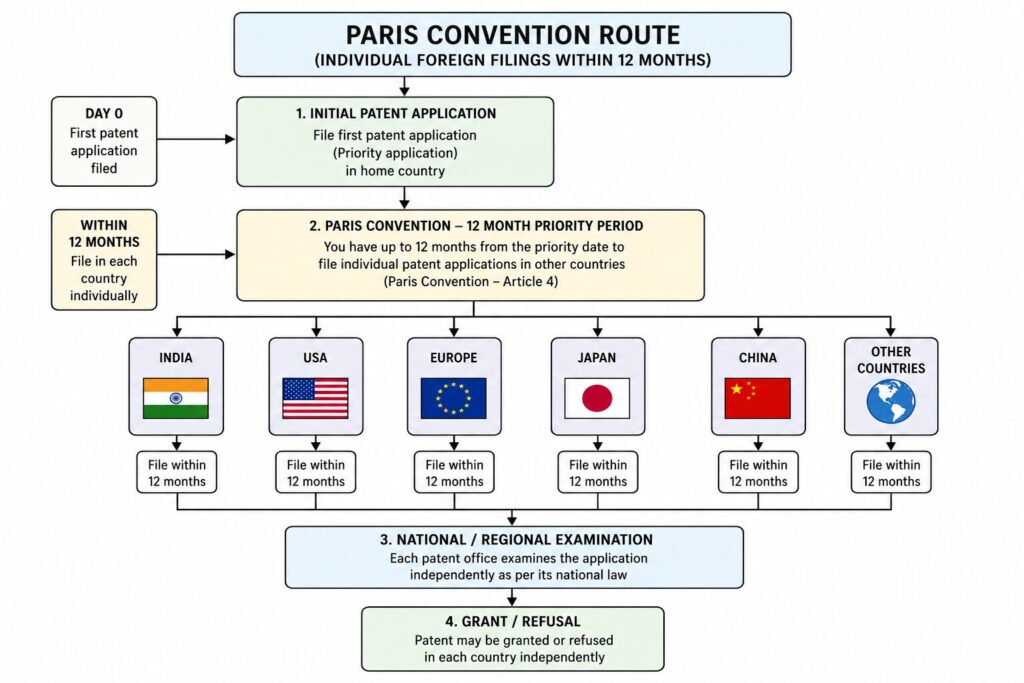
1. The Paris Convention Route
The first approach makes use of the Paris Convention for the Protection of Industrial Property. This is an international agreement that gives you the opportunity to make individual patent filings in foreign countries up to one year after your initial filing in the home country.
This will enable you to keep your initial filing date in all of those countries. The good thing about this approach is that it is great when only a few countries need protection.
2. The PCT Route
The second path to scale businesses is through the use of the PCT system. The PCT system is a great international patent registration guide for companies planning for global dominance.
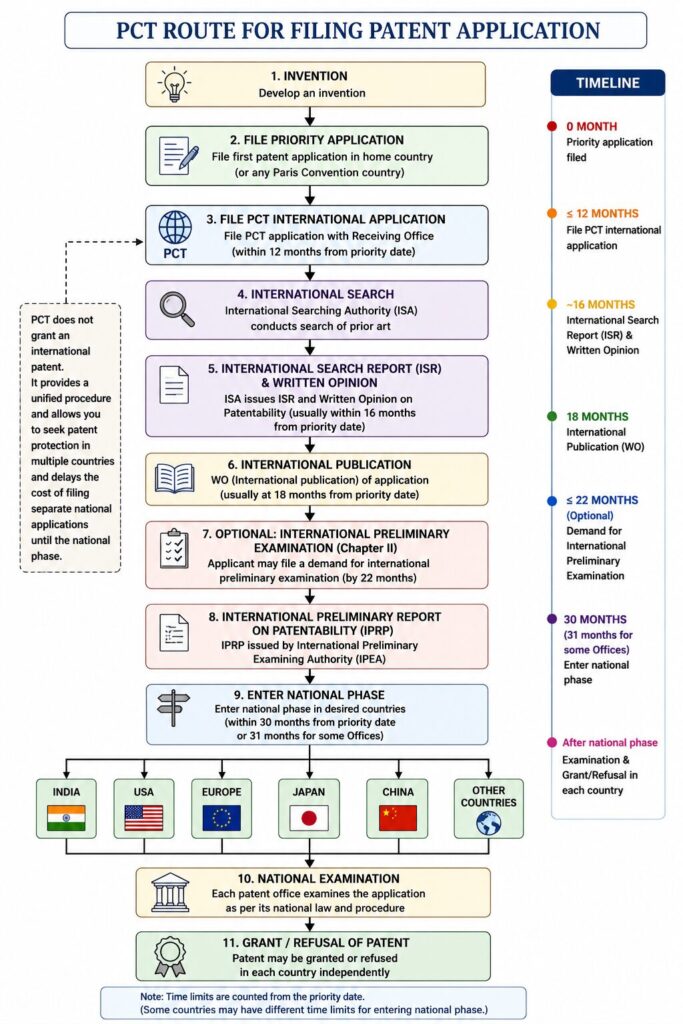
Instead of applying for several different local patents as soon as possible within your first year, you apply once for an international patent. This saves a lot of time since the 30 or 31 months start counting from the date of your first patent application.
Understanding the International Patent Filing Process
The choice to pursue the PCT path provides you with a clear and very predictable framework within which to manage Global Patent Rights. Knowledge of the International patent application system is necessary to enable you to utilize your money effectively and to avoid any legal deadlines. Let’s see how inventors obtain patents in more than one country according to the terms of the treaty.
Stage One: International Phase
Firstly, you make one single application either to the receiving office or directly to the World Intellectual Property Organization (WIPO). Upon completion of your filing, the treaty automatically fixes your priority date in all 150+ member states.
After that step, an International Searching Authority reviews your patent application. This body will provide you with an international search report and a written opinion concerning the newness and inventive quality of your invention.
Stage Two- National Phase
When you finally reach the period of 30 or 31 months, the international stage will come to an end and the national stage will begin.
During this time, you need to make sure about those countries that you wish to enter. You have to translate your patent application into the local language, use local attorneys, and pay different registration fees for each individual country as the patent office’s review your application individually under their own laws.
Conclusion: Creating a Scalable International IP Strategy
Protecting your innovations requires you to look way beyond your local borders. Believing that filing for a patent protects your innovations internationally is one of the most common mistakes and the biggest risks associated with this issue.
While there is no such thing as a truly international patent, there are systems that provide great directions in the quest to protect your innovations internationally, like the PCT system. With knowledge of how patents function in other countries, you will be able to preserve your market share, compete with other countries, and increase the value of your innovations.
Take no chances with your global market share; reach out to Intellect Bastion right away for the bulletproof advice and strategy that your innovations deserve.
Frequently Asked Questions (FAQs)
Does a patent have validity worldwide?
No, a patent does not hold validity worldwide by default. The scope of patent validity is territorial. A patent issued by any country will not guarantee legal rights in any other country’s jurisdiction.
Does obtaining a patent provide automatic worldwide rights?
No, registering for a patent will not ensure worldwide rights. For instance, if a native country issues your patent, it will offer rights only within that particular territory. You will need to apply for patents in all countries in which you want to safeguard your technology.
How can I ensure the protection of my invention in different countries?
To protect your invention in several countries, use either the Paris Convention or the Patent Cooperation Treaty (PCT). For a few select countries, the Paris Convention is the best route. Should you be looking for coverage all around the world, the way to go would be a PCT application.
What exactly is an international patent?
The idea of an international patent being something real and existing might be wrong as authorities do not officially recognize any single worldwide patent. The truth of the matter is that an international patent is an application of an international patent through the PCT.
Can my patent rights be enforced in another country?
Unfortunately, no. If a competitor copies your invention within a territory outside your own, your patent rights will have no effect on it. The only way for you to enforce your patent rights is if you register your patent with the other nation’s government.
What if I do not get a patent in a foreign country?
Without a foreign patent, your invention enters that country’s public domain. Local competitors can then freely produce and sell your product without your consent or paying royalties.
What is the cost of international patent protection?
International patent protection can cost tens of thousands of dollars. Total expenses depend on the number of countries, translation needs, official filing fees, and intellectual property attorney fees.
What are the deadlines for foreign patent filings?
Under the Paris Convention, the time period for filing your foreign patents is one year from the time of your first filing. If you choose the PCT route, the deadline for filing your patent remains the same, i.e., one year, but it gives you an extra time period of either 30 or 31 months to enter individual countries’ patent offices.
Will the same patent work in the USA or in Europe if you have a patent in India?
Certainly not, because the validity of any patent issued in India would not apply in the USA or Europe. Due to the absolute territoriality principle of patent law, you will need to file your patents independently at the USPTO and EPO offices in the USA and Europe respectively.
Is there one patent for all countries?
Not even one such kind of patent exists in this whole world where a single patent applies to all the countries at once.