Frequently Asked Questions
Find answers to top questions about Patentability Search, novelty evaluation, and the patent filing process.
How is a design search different from a standard utility patent search? ▼
While in function searches, only the functional part ("how it works") is considered, design searches look only for visual similarities.
Do you search for "look-alike" products in non-patent sources like Pinterest or catalogs? ▼
That's right. Anything publicly seen from a catalogue issued in the 1920s to an Instagram post is potential prior art that can block a design patent.
What happens if a design is similar but serves a different function? ▼
Function is generally not a consideration in design patents. Even when a particular teapot resembles a specialized industrial pump, the latter can act as prior art against the former.
How do you handle searches for graphical user interfaces (GUIs) or icons? ▼
We do specialized electronic searches of registered design collections for screen displays, icons, animations and so forth.
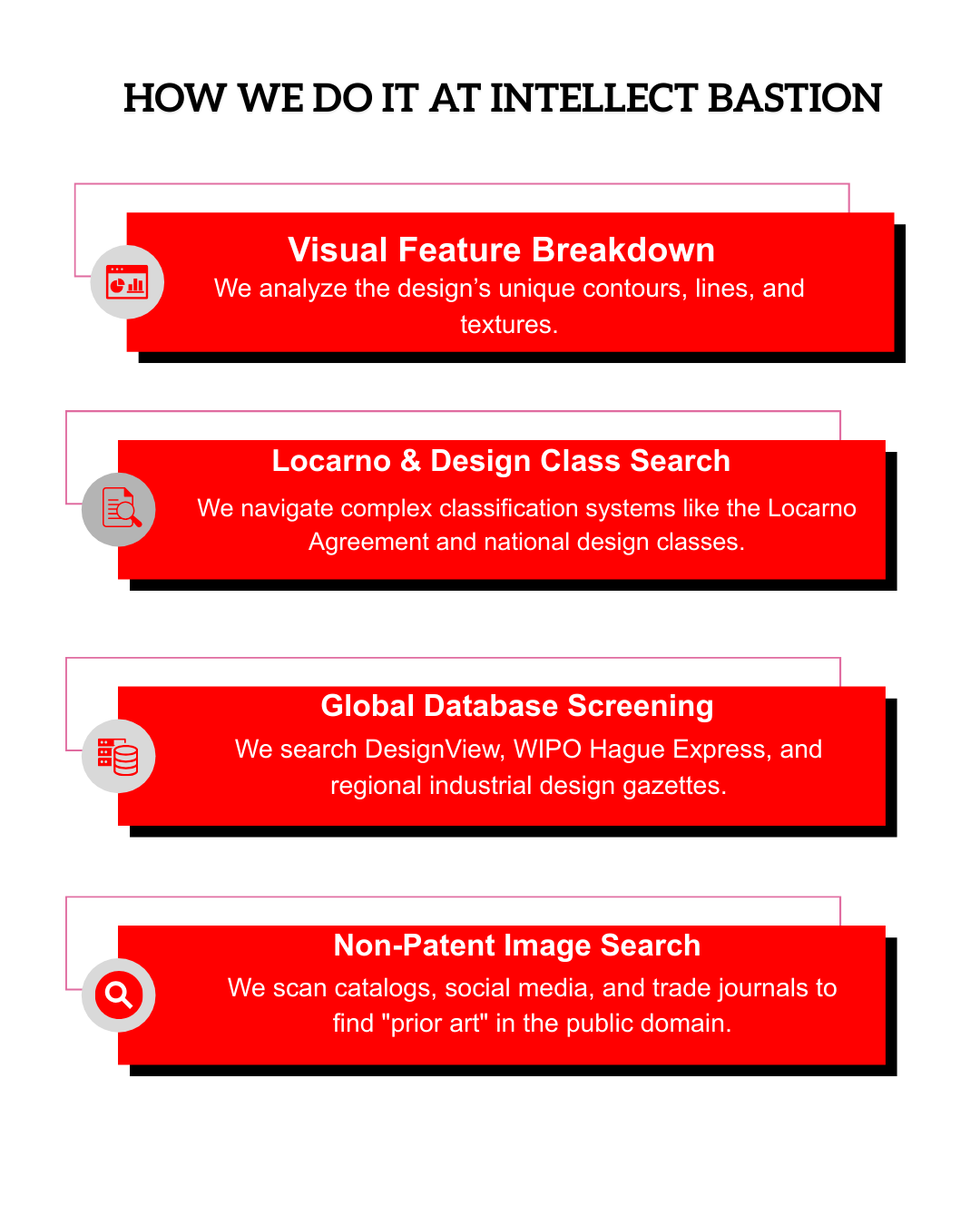
Which design databases (Locarno classification, etc.) do you utilize? ▼
Locarno Classification, World Intellectual Property Organization's Global Design Database, as well as each country's design registry (e.g. IPO, USPTO, EUIPO, JPO).
Can you search for 3D shapes and ornamental patterns? ▼
Yes, we will conduct 3D silhouette, surface texture, and pattern searches to determine whether your product's "visual DNA" is truly unique.
How do you determine if a design is "obvious" compared to existing designs? ▼
We will search for "primary references" (very similar to your work) and "secondary references" that could potentially combine to make up your design from the standpoint of an ordinary person.
Does the search cover international design registrations (Hague System)? ▼
Yes, our searches cover all international applications via the Hague Agreement to guarantee global uniqueness of your design.
What is the turnaround time for a design prior art search? ▼
Since such searches are quite visual, we usually provide the full report in 3-5 working days.
Can you help me determine if my product packaging is protectable? ▼
Yes, designs of bottles, boxes, or even unboxing procedures can be protected using design patents.