Frequently Asked Questions
Find answers to top questions about Patentability Search, novelty evaluation, and the patent filing process.
What is a "Markush" structure, and why is it harder to search? ▼
The Markush structure refers to a generic formula containing variables (like R1) that may comprise thousands or even millions of different molecules. The process of "expansion" of the formula requires sophisticated tools.
Which specialized databases (like CAS STN or Reaxys) do you use? ▼
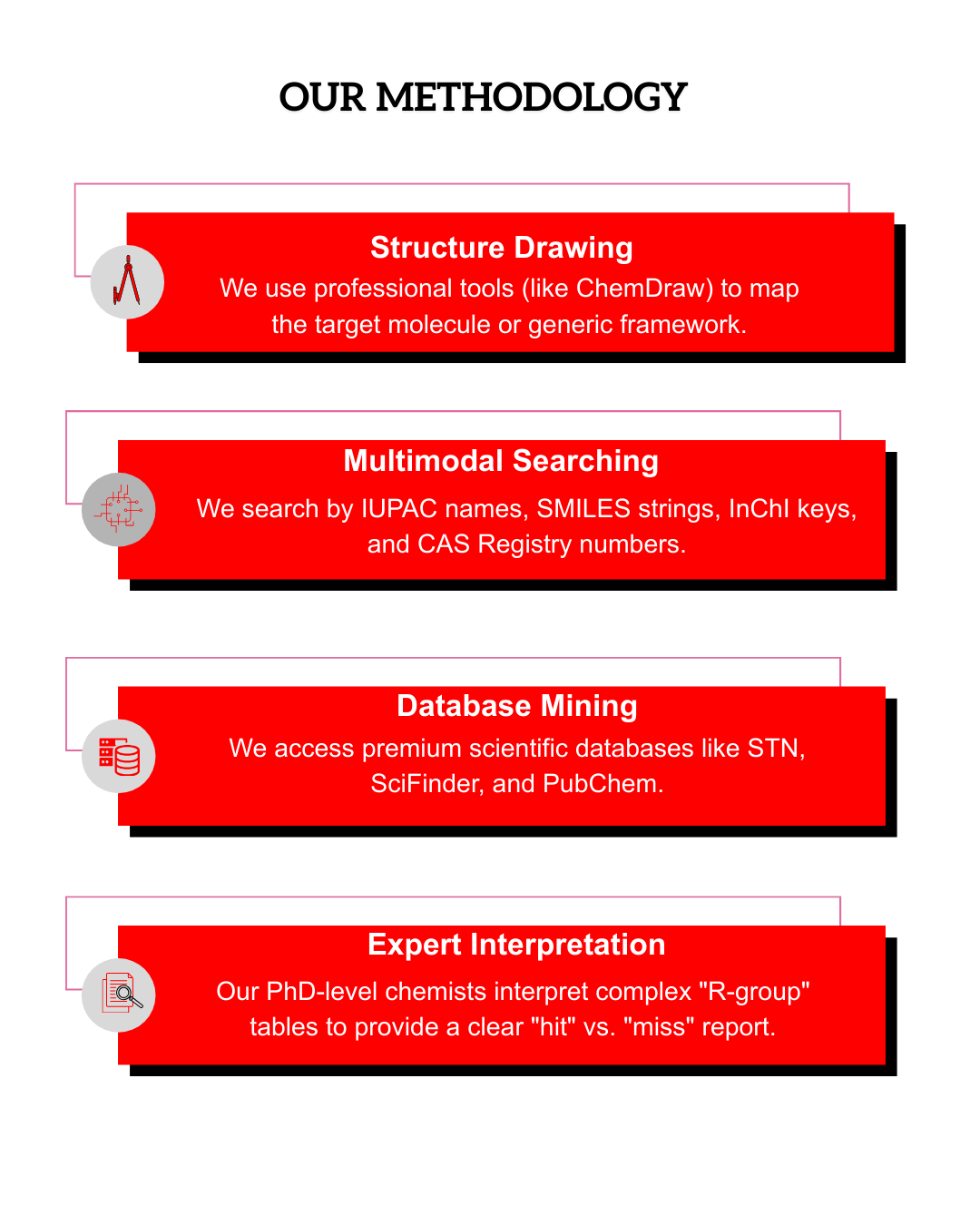
We employ the "Gold Standard" resources for the search – CAS STN, Reaxys, and PubChem, all of which provide the ability to search using the actual drawing of the molecular structure, not the keyword-based approach.
Can you search for specific isotopes, salts, or polymorphs of a compound? ▼
Yes, we are able to find a patent protecting your particular salt form or polymorphic crystal structure of an already discovered molecule.
How do you handle "substructure" vs. "similarity" searches? ▼
Substructure searches will locate molecules where your target is found as part of a bigger molecule, while similarity searches will identify molecules sharing the same "core" or molecular pattern with yours.
Can you identify if a specific chemical reaction pathway is patented? ▼
Yes, we can search for the "Method of Synthesis" to see if your specific way of building a molecule is already claimed by a competitor.
How do you report findings for a large family of related chemical compounds? ▼
Results are organized under the heading "Scaffolds" as we know the important parts of chemistry that need to be analyzed. This will help you identify which portions are active ("busy") and which are inactive ("free").
Are your analysts trained chemists or PhDs? ▼
Yes. Our chemical search experts are PhDs or Master's degree holders from the field of Organic/Medicinal Chemistry who know the science behind the structure.
Can you search for chemical formulations (mixtures) rather than just single molecules? ▼
Yes. Our chemical search can cover synergies like the ratio and combination of active substances, stabilizing elements, and solvents used in consumer products/pharmaceutical products.
How do you navigate the "vague" chemical descriptions often found in older patents? ▼
We conduct a thorough text mining analysis with a state-of-the-art IUPAC nomenclature identification engine to find compounds that were named in text but never properly "illustrated" in patents.
Can you provide the "registry numbers" for the compounds found? ▼
Each of our reports contains CAS Registry Numbers, SMILES, and InChIs to facilitate identification within your R&D department.