Frequently Asked Questions
Find answers to top questions about Patentability Search, novelty evaluation, and the patent filing process.
How can a landscape analysis help me decide my next R&D project? ▼
This allows us to identify "crowded" areas with high litigation risk, and also "open" areas where there is scope for innovation with little competition.
What is White Space, and how do you identify it? ▼
The white space is defined by technical opportunities where the level of market interest is high but the number of patent filings is low. This information is obtained from overlaying market dynamics onto patent density maps.
Can you identify which competitors are most active in my specific niche? ▼
Yes. Our solution includes "Competitor Benchmarking" analysis, which helps identify competitors leading in terms of patents filed, best-in-class IP, and those delaying innovation.
How do you visualize patent data (e.g., heat maps, 3D topographical maps)? ▼
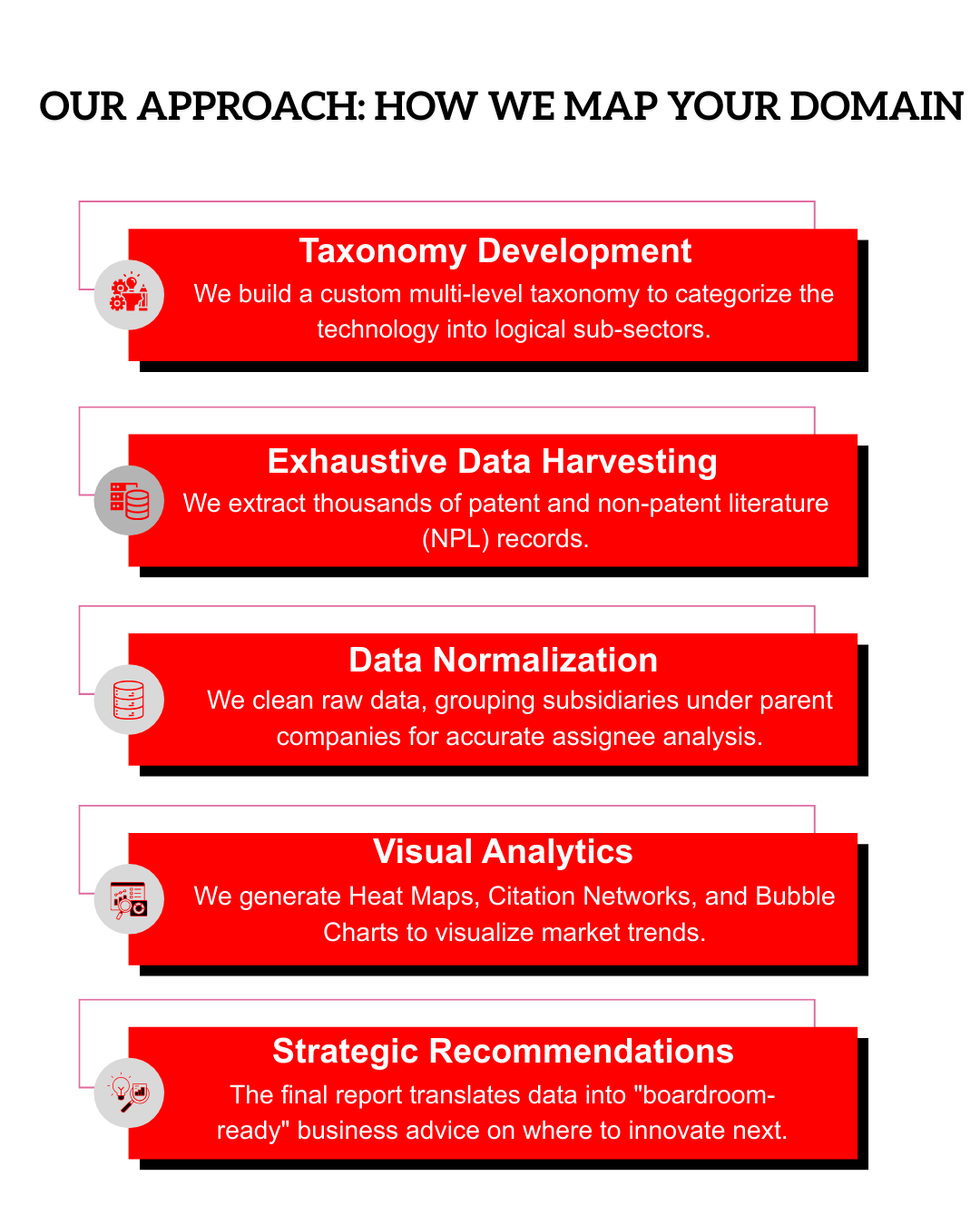
We deliver highly customizable interactive dashboards and "Landscaping Maps" that help cluster thousands of patents into groups based on their technical similarities to view "islands" of innovation.
Can this analysis predict where the technology will be in 5–10 years? ▼
By studying the "Filing Velocity" and new entrants within a particular tech domain, we can predict its future path.
How do I use this report to find potential acquisition targets or partners? ▼
We will look at small firms or universities holding “high impact” patents, which are less expensive to license than to challenge in a competitive situation.
Is the data based on granted patents only, or does it include pending applications? ▼
Both kinds are included in our reports. Patents that have already been issued indicate areas that are currently a “no-go,” whereas pending patents provide information about market trends over the coming 2-3 years.
How often should a landscape study be updated? ▼
Annually is normal for most fields; however, some fast-changing fields, such as AI or Biotech, may need quarterly reports.
Can you filter the results by "high-value" patents vs. "low-quality" ones? ▼
Absolutely. Using proprietary measures like citation counts, family sizes, and the amount of time left before expiring, we distinguish between “blockbuster” patents and low-quality patent applications.
How does this help me justify my R&D budget to investors? ▼
The landscape report can be used as a “due diligence” report, showing investors that your R&D path is truly innovative.