What are Patent Drawing Preparation Services?

Patent drawing preparation involves creating technical illustrations that visually explain an invention or a design as required under patent and design laws.

Patent Drawing Services — Full Page
Patent Drawing Overview

What are Patent Drawing Preparation Services?

Patent drawing preparation involves creating technical illustrations that visually explain an invention or design as required under patent and design laws. These drawings are an integral part of a patent or design application.

  • Utility patent applications (mechanical, electrical, system-based inventions)
  • Design registration applications (industrial designs)
  • PCT and foreign patent filings
Importance of Patent Drawings

Why are Patent Drawings Important?

  • Clearly explain the structure, working, and features of an invention
  • Support and strengthen claim interpretation
  • Reduce objections related to clarity and insufficiency
  • Improve examiner understanding during examination
  • Ensure compliance with Indian, PCT, and foreign patent office rules

Incorrect or non-compliant drawings can result in formal objections, delays in prosecution, or requirement for refiling/amendments.

Types of Patent Drawings

Types of Patent Drawings We Prepare

Utility Patent Drawings

  • Mechanical devices, systems, components, assemblies
  • Flowcharts and block diagrams
  • Perspective, sectional, exploded views with reference numerals

Design Drawings

  • Front, rear, top, bottom, and side views
  • Isometric views
  • Broken-line disclaimers where applicable
Preparation Process

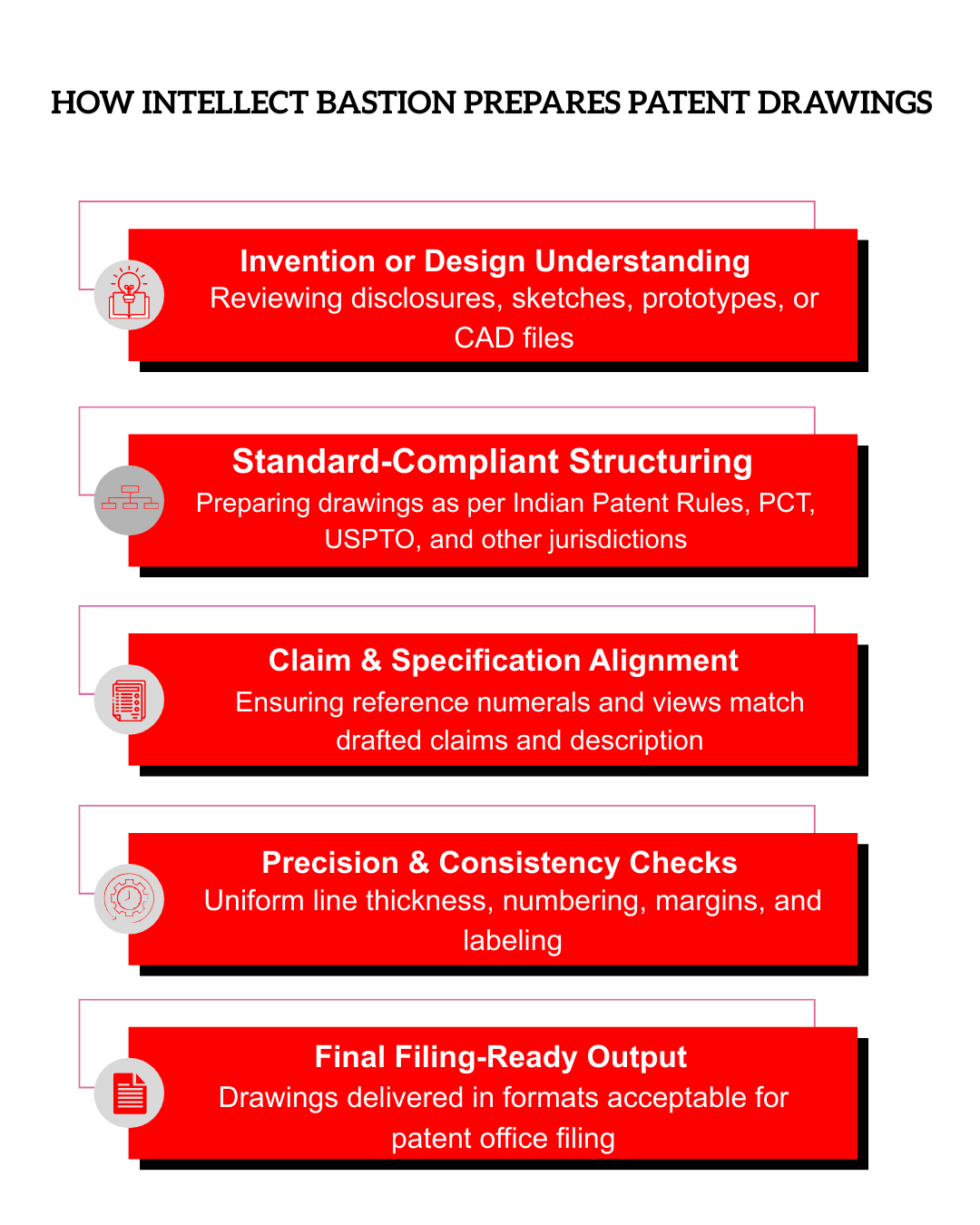
How Intellect Bastion Prepares Patent Drawings

  1. Invention or Design Understanding
    • Review disclosures, sketches, prototypes, or CAD files
  2. Standard-Compliant Structuring
    • Prepare drawings as per Indian, PCT, USPTO, and other rules
  3. Claim & Specification Alignment
    • Ensure reference numerals and views match drafted claims and description
  4. Precision & Consistency Checks
    • Uniform line thickness, numbering, margins, and labeling
  5. Final Filing-Ready Output
    • Drawings delivered in formats acceptable for filing
Why Choose IB

Why Choose Intellect Bastion for Patent Drawing Services?

  • Drawings prepared with patent prosecution perspective
  • Strong coordination with patent drafting team
  • Suitable for Indian, PCT, and foreign filings
  • Experience across mechanical, electrical, and product-based inventions
  • Reduced risk of drawing-related objections

We prepare drawings with patent law and examination requirements in mind, unlike generic drafting vendors.

A 3D cartoon character on a phone call next to a contact form for a free consultation on patent validity and invalidity search services in India.
There is some error. Please try again
We have received your request. We will connect with you shortly for further discussion

Fill In The Form Below To Get FREE Consultation 

The WHATSAPP field must contain between 6 and 19 digits and include the country code without using +/0 (e.g. 1xxxxxxxxxx for the United States)
?

Frequently Asked Questions

Find answers to top questions about Patentability Search, novelty evaluation, and the patent filing process.

Why do I need professional drawings for my patent?
Patent offices have strict technical rules regarding line thickness, shading, and margins. Poor-quality drawings are one of the most common reasons for a patent application being delayed or rejected.
Can I use 3D CAD models instead of 2D drawings?
While you design in 3D, most patent offices still require 2D line-art exports. Your 3D models must be converted into standard views (Perspective, Front, Top, etc.) with proper line weights to be accepted.
Can I just use my own photos of the product?
Generally, no. Most patent offices require black-and-white line art. Photos are rarely accepted unless they are the only way to show the invention (like a microscopic biological structure or a specific fabric texture).
What are "Broken Lines" (dashed lines) used for?
In patent drawings, dashed or broken lines usually indicate parts of the object that are not part of the claimed invention. They provide context (showing how the invention is held or used) without legally claiming those parts.
How many views do I need to provide?
For a Design Patent, you typically need seven views: front, back, right side, left side, top, bottom, and a perspective view. For a Utility Patent, you only need enough views to clearly explain the invention's mechanism.
Do I need to include dimensions or measurements?
Yes. No. Patent drawings are not blueprints or engineering plans. They are "representative" drawings. You should not include specific measurements unless a very specific ratio is critical to the invention's function.
Can I use color in my patent drawings?
Color is permitted but discouraged because it requires a special petition and extra fees. It is usually better to use hatching or shading to represent different materials or colors in black and white.
What happens if the examiner says my drawings are "informal"?
This means the drawings don't meet the technical formatting standards (e.g., lines are too blurry or margins are wrong). You will have a specific timeframe to submit "formal" corrected versions to keep your application alive.
Can I add new drawings later if I forget a detail?
This is very risky. You generally cannot add "new matter" after the filing date. If a detail wasn't in the original drawings or description, you might not be allowed to add it later without losing your original filing date.
Do I need drawings for a software or process patent?
Yes. While you aren't drawing a physical object, you must provide flowcharts or logic diagrams that show the step-by-step "architecture" of how the software or process functions.
Tube Card

Don’t File Blind — Do a Patentability Search First

Give your invention the best start! Learn why a patentability search is crucial and how to check originality using the right tools and strategies.