Frequently Asked Questions
Find answers to top questions about Patentability Search, novelty evaluation, and the patent filing process.
What is the difference between a Patentability search and an FTO search? ▼
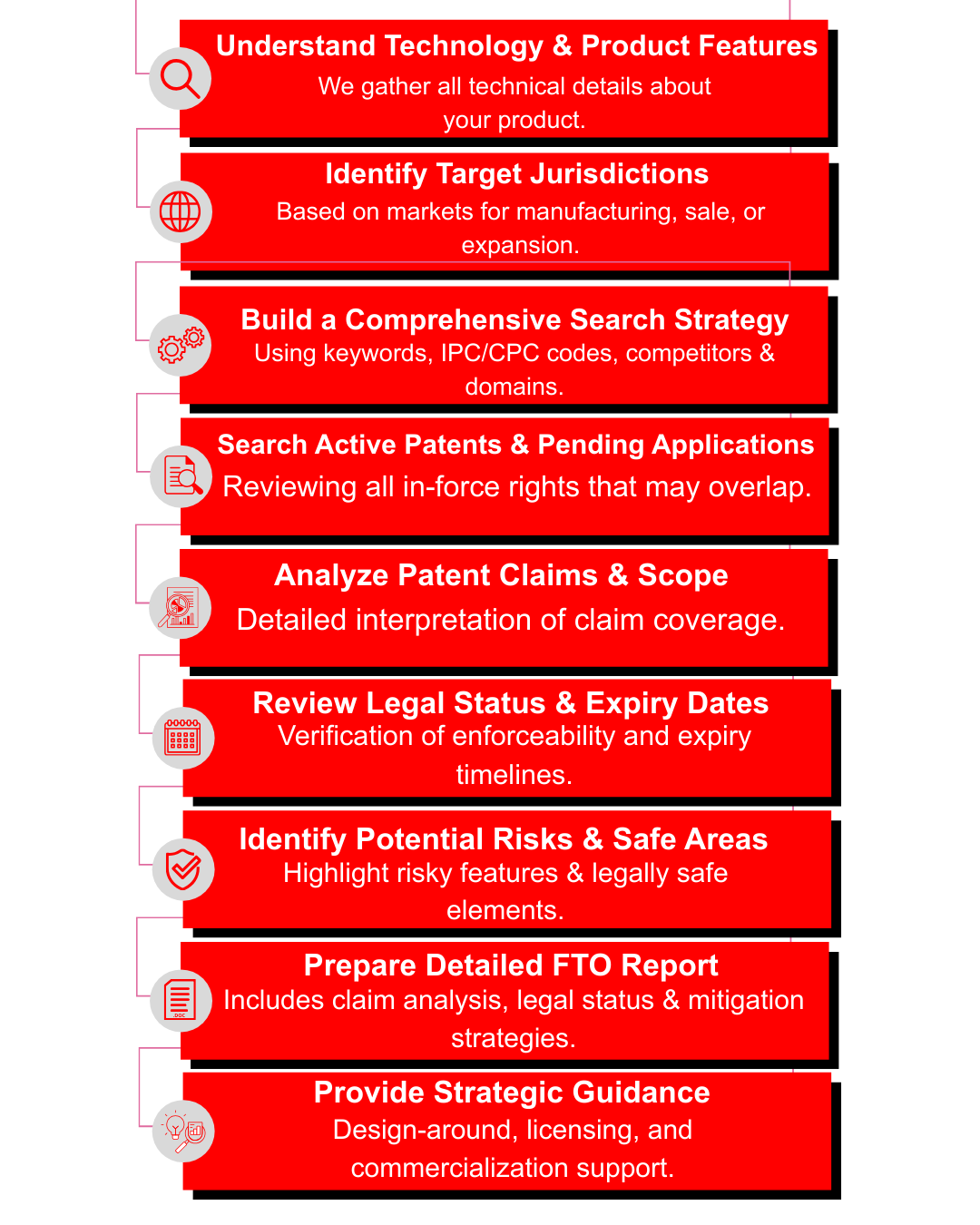
Patentability asks "Is my idea new?" FTO asks "Am I going to get sued?" FTO ignores old art and focuses only on active patents that you might infringe.
Can you perform an FTO for a specific country (e.g., just the USA)? ▼
Yes. FTO is always geographic. We can perform a search for a single country or a "Global Clearance" for all your target markets.
How do you handle "Expired Patents" in an FTO report? ▼
Expired patents are good news! We flag them as "Safe Harbors," meaning you are legally free to use any technology described in an expired patent.
What happens if you find a "Pending Application" that looks like my product? ▼
We flag these as "Emerging Risks." We monitor them to see if they eventually grant and if their claims change during the process.
If I already have a patent, do I still need an FTO search? ▼
Yes. This is a common misconception. Having a patent means you can stop others from using your invention; it does not give you the right to ignore existing patents. Your product might be an improvement on a base technology that is still under a "blocking" patent held by someone else.
What is a "Patent Landscape" and do I need one before an FTO? ▼
A Landscape is a bird's-eye view of who owns what in your industry. It’s great for strategy. An FTO is a ground-level view of specific "no-go" zones. Usually, you start with a landscape to see where your competitors are, then run a targeted FTO when you are ready to build.
What is the "18-Month Blind Spot"? ▼
Patent applications are generally not published until 18 months after they are filed. This means no search can be 100% "future-proof." To manage this, we offer Quarterly Watch Services to alert you the moment a hidden application from a competitor finally becomes public.
What is the difference between an FTO and a "White Space" Analysis? ▼
Yes. We include all international filings under the Hague Agreement to ensure your design is unique on a global scale.
What is the role of "Claim Mapping" in an FTO report? ▼
Claim mapping is a side-by-side comparison (often a table) where every element of a competitor's patent claim is matched against a feature of your product. To infringe, your product must meet every single element of at least one independent claim. If you are missing even one element, you may have a "non-infringement" argument.
How do "Patent Landscapes" help identify white spaces? ▼
A landscape visualizes patent density. Areas with very few patents are "white spaces"—technological gaps where you can innovate and file your own patents with less risk of being blocked by others. It helps R&D teams pivot toward "unoccupied" territory.