Frequently Asked Questions
Find answers to top questions about Patentability Search, novelty evaluation, and the patent filing process.
What is a "Markush" structure, and why is it harder to search? ▼
A Markush structure is a generic formula (using variables like "R1") that can cover millions of compounds. It requires specialized tools to "expand" the formula and check every possibility.
Which specialized databases (like CAS STN or Reaxys) do you use? ▼
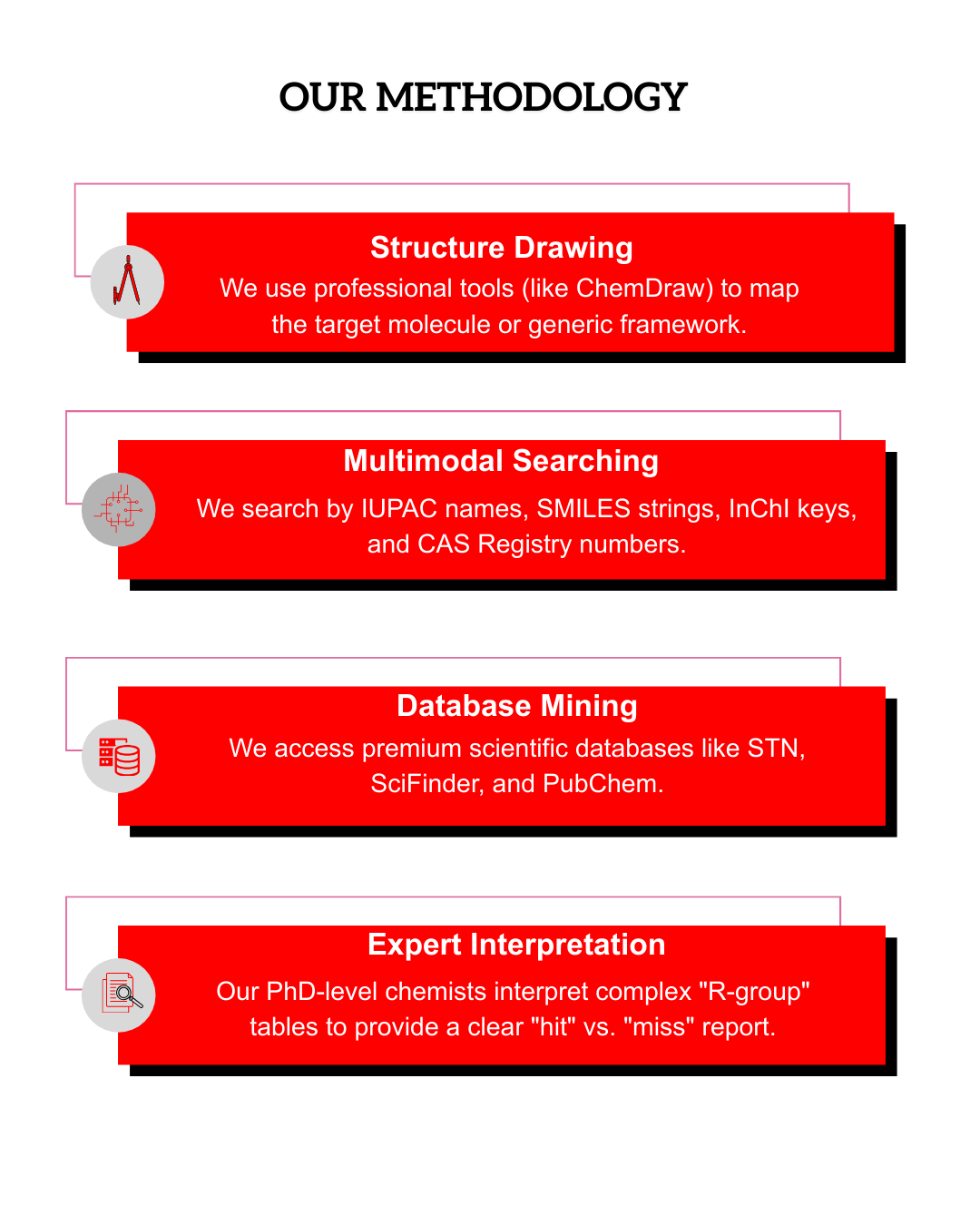
We use the "Gold Standard" tools: CAS STN, Reaxys, and PubChem, which allow us to search by actual molecular drawings rather than just keywords.
Can you search for specific isotopes, salts, or polymorphs of a compound? ▼
Yes. Our searches are granular enough to find patents covering specific salt forms or crystalline structures (polymorphs) of a known molecule.
How do you handle "substructure" vs. "similarity" searches? ▼
Substructure searches find your molecule inside larger ones; Similarity searches find molecules that share a common "skeleton" or visual profile with yours.
Can you identify if a specific chemical reaction pathway is patented? ▼
Yes. We can search for the "Method of Synthesis" to see if your specific way of building a molecule is already claimed by a competitor.
How do you report findings for a large family of related chemical compounds? ▼
We group results by "Scaffolds" (common molecular cores) so you can easily see which parts of a chemical family are "busy" and which are "free."
Are your analysts trained chemists or PhDs? ▼
Yes. Our chemical search team consists of PhDs and Master’s degree holders in Organic or Medicinal Chemistry who understand the science behind the structures.
Can you search for chemical formulations (mixtures) rather than just single molecules? ▼
Yes. We search for synergistic mixtures, such as specific ratios of active ingredients, stabilizers, and solvents used in consumer goods or pharma.
How do you navigate the "vague" chemical descriptions often found in older patents? ▼
We use advanced text-mining and IUPAC name recognition to find compounds that were described by name in old text but never officially "drawn" in the patent files.
Can you provide the "registry numbers" for the compounds found? ▼
Every report includes CAS Registry Numbers, SMILES strings, and InChI keys to ensure your R&D team can identify exactly what was found.