Patent Landscape & White Space Analysis

The Ultimate Technology Roadmap for Data-Driven Innovation.

Patent Landscape Search — Final Code

What is a Patent Landscape Search?

A Patent Landscape Search (also known as Patent Mapping) is a comprehensive analysis of patenting activity in a specific technological domain. It isn't just a list of patents; it is competitive intelligence that identifies who is innovating, what technologies are emerging, and—most importantly—where the untapped opportunities lie.

Patent Landscape Search
Why Landscape Study

Why Do Global Innovators Need a Landscape Study?

  • Identify "White Spaces" — Discover technical gaps where competitors have failed to file, allowing you to pioneer new innovation zones.
  • Competitor Benchmarking — Monitor the R&D direction of industry giants to predict their next product launches.
  • Mitigate R&D Risks — Avoid "reinventing the wheel" or investing in technologies already heavily protected by "patent thickets."
  • Identify M&A Targets — Find niche companies for potential licensing, mergers, or acquisitions.
Our Approach

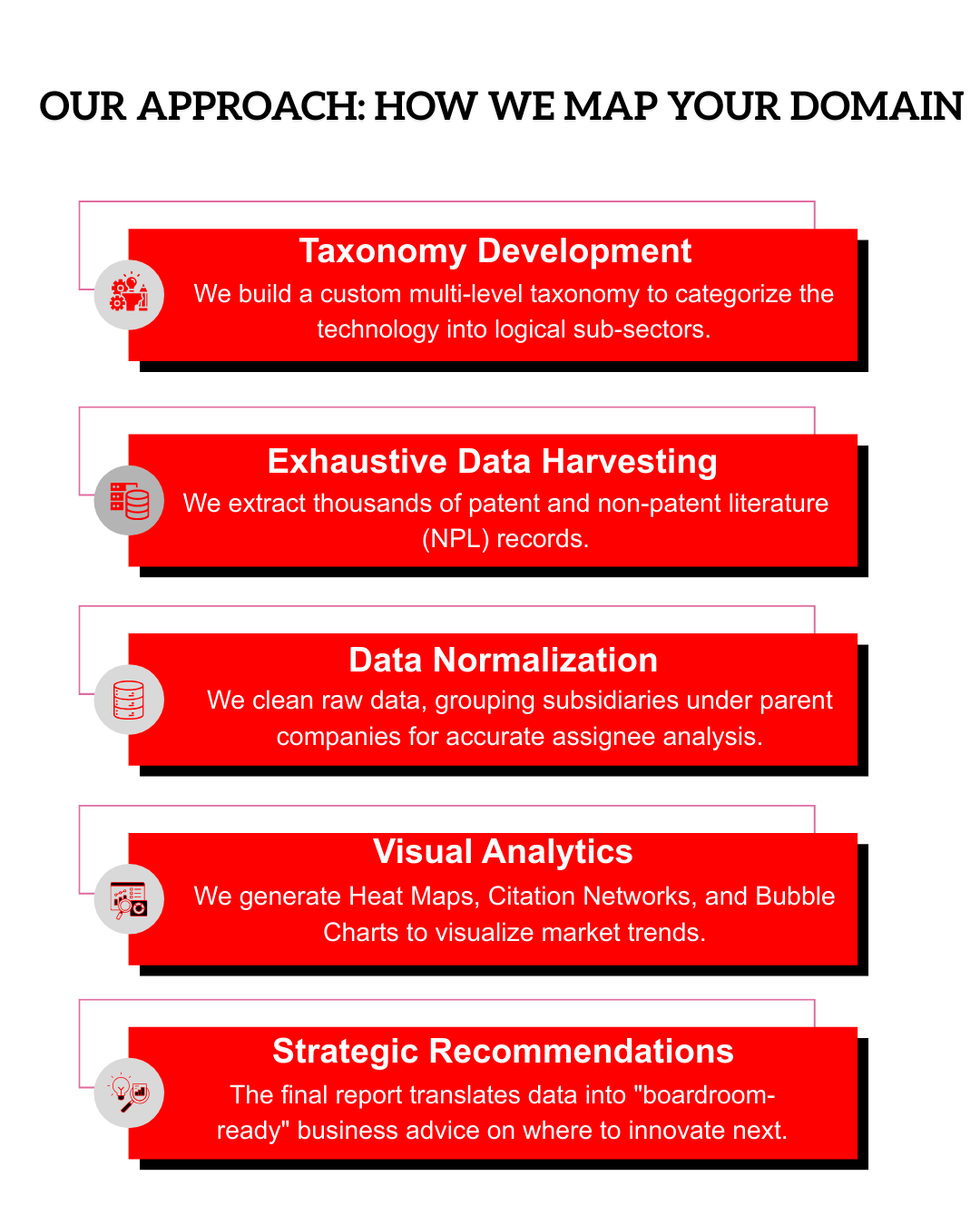
Our Approach: How We Map Your Domain

  • Taxonomy Development — We build a custom multi-level taxonomy to categorize the technology into logical sub-sectors.
  • Exhaustive Data Harvesting — We extract thousands of patent and non-patent literature (NPL) records.
  • Data Normalization — We clean raw data, grouping subsidiaries under parent companies for accurate assignee analysis.
  • Visual Analytics — We generate Heat Maps, Citation Networks, and Bubble Charts to visualize market trends.
  • Strategic Recommendations — The final report translates data into "boardroom-ready" business advice on where to innovate next.
Why Choose IB

Why Choose Intellect Bastion?

  • Actionable Insights — While others provide charts, we provide "Next Steps." We tell you where to file and whom to watch.
  • Global Intelligence — We track filings in the Indian Patent Office, USPTO, EPO and other patent offices for a global perspective.
  • Expert Authors — Our reports are authored by domain experts who understand the science behind the patents.
A 3D cartoon character on a phone call next to a contact form for a free consultation on patent validity and invalidity search services in India.
There is some error. Please try again
We have received your request. We will connect with you shortly for further discussion

Fill In The Form Below To Get FREE Consultation 

The WHATSAPP field must contain between 6 and 19 digits and include the country code without using +/0 (e.g. 1xxxxxxxxxx for the United States)
?

Frequently Asked Questions

Find answers to top questions about Patentability Search, novelty evaluation, and the patent filing process.

How can a landscape analysis help me decide my next R&D project?
It reveals "crowded" areas where litigation risk is high and identifies "open" areas where you can innovate with less competition.
What is "White Space," and how do you identify it?
White space refers to technical gaps where there is high market interest but low patent filing. We find these by overlaying market trends against patent density maps.
Can you identify which competitors are most active in my specific niche?
Yes. We include "Competitor Benchmarking" to show who is filing the most patents, who owns the highest-quality IP, and who is slowing down.
How do you visualize patent data (e.g., heat maps, 3D topographical maps)?
We provide interactive dashboards and "Landscaping Maps" that visually cluster thousands of patents by technical similarity, allowing you to see "islands" of innovation.
Can this analysis predict where the technology will be in 5–10 years?
By analyzing "Filing Velocity" (the speed of new applications) and the entry of "New Entrant" startups, we can forecast the trajectory of a specific tech sector.
How do I use this report to find potential acquisition targets or partners?
We identify small players or universities with "high-impact" patents that would be cheaper to acquire than to compete against.
Is the data based on granted patents only, or does it include pending applications?
Our reports include both. Granted patents show current "no-go" zones, while pending applications show where the market is heading in the next 2-3 years.
How often should a landscape study be updated?
Annually is standard for most industries; however, fast-moving sectors like AI or Biotech often require quarterly updates to stay ahead.
Can you filter the results by "high-value" patents vs. "low-quality" ones?
Yes. We use proprietary metrics—such as citation counts, family size, and remaining term—to separate "blockbuster" patents from low-value filings.
How does this help me justify my R&D budget to investors?
A landscape report serves as a "due diligence" document, proving to investors that your R&D direction is unique and protectable.
Tube Card

Don’t File Blind — Do a Patentability Search First

Give your invention the best start! Learn why a patentability search is crucial and how to check originality using the right tools and strategies.