
The name and the symbol are your brand personality, not only in terms of appearance but also in forming the bedrock of your business. The thing is, as you’re about to finalize your insane idea, it’s all about your idea, isn’t it? Legally establishing that it has to be yours. The key takeaway is that you need protection for your idea in such a competitive market. That starts with the genuine knowledge of the mechanics of trademark registration. Whether you’re one person in a garage, the course, or a multinational corporation putting in your best in an amazing boutique location, it doesn’t matter. But first, let’s understand what a trademark is.
What is a Trademark? (Quick Overview).
A trademark is more than just your logo or name — it’s a cornerstone for your brand in the marketplace, both for you and for your company. Consider your business your unique signature. Any symbol, word or sign that you create or a combination of these that inspires users to identify your products or services and differentiate them from competitors. So, as your signature tells your personal identity, a trademark gives identity to your business in much the same manner. A trademark is the first step towards granting your brand recognition, whether you’re using the name of your product or a logo that you’d love to use.
Types of Trademarks
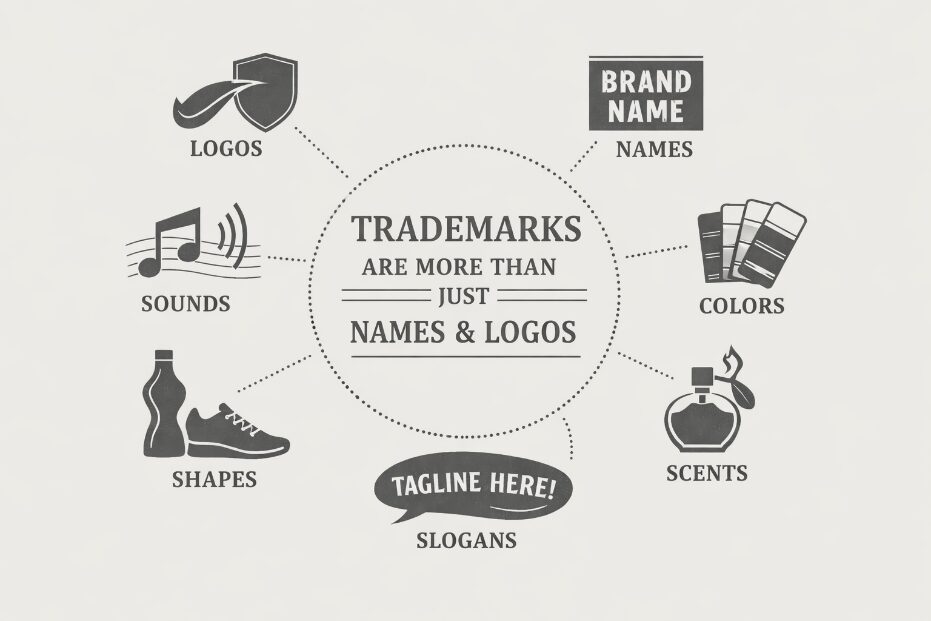
rademarks are not just limited to name and logo, they can be:
- Word Marks: You can say that word marks are the heart and soul of any brand. They can well be catchphrases, taglines, names that stay under your radar even after you stop hearing them. Some good business names can hit your brain and give you a taste of what a brand is all about in a few words.
- Device Marks or Logos: They might be called the visual cues that let us remember the brand. It’s only a case of one view of its branding (logo/branding/brand-face graphics/logo graphics), by which it’s all but certain that you love, love, appreciate or are an obsessive reader/believer in this brand, all sleek, stylish or graphic, and these all help us catch the most basic details in minutes.
- Total Points: There is nothing but the words and logos come together to form a single brand image that stands out.
- Shape Signs: For trademarking a product, the shape itself and even packaging may be trademarked. This is the case if it is a novel thing that’s easily recognizable to the consumer.
- Sound Marks: Yes, there are sounds that can be trademarked. Try the catchy jingles or the sounds that come with the brand.
- Color Marks: If a certain combination of colours lends its visual identity to the brand in a way that sets it apart from other brands, it can be trademarked. And that is what trademarks are all about — protecting the characteristics of a brand that the consumer feels are uniquely theirs.
Key Elements of a Trademark.
A trademark must be distinctive and uniquely identifiable with regard to the items or services it involves. Covered for phrases which are most likely not specific enough, it becomes typically invalidated in all cases.
- Source Recognition. It demonstrates that customers can tell where a good or service is coming from.
- Exclusivity- The trademark will be available only to the owner after registration with the Trademark.
- An intangible asset- A trademark represents an economic capital worthiness that can be sold, licensed or franchised.
Can one even apply for a trademark in India?
Consider, for example, starting with a brand from scratch, working really hard for it and then someone else invents a name or brand that sounds or looks just like yours. That kind of thing hurts.
However, this is exactly what the Trade Marks Act of 1999 was designed to prevent, and it only works if you know what you’re doing. On the plus side, you won’t have to have a huge business empire or be a cash cow to participate in the game. Indian intellectual property law is fairly forgiving in deciding who may apply. There’s hardly a one-size-fits-all solution. You can be a big company, a small firm or an artist who works locally, selling his work on the street. You have a chance right there if you’re looking to defend your brand.
Individuals and Single Proprietor: No board of directors or fancy office is needed for the person to own a trademark. A trademark may be used and registered under your own name. This is useful because no matter when you recognize your business later on, for say, going from sole proprietor to private company, you’ll still possess the mark. Just keep in mind that if you own the trademark while registration is ongoing, you still own it, so you remain the sole owner and your registered mark is bound up on some level with your real legal identity. The relationship is not cut and dry.
- Partnership Firms: For companies opened by a work colleague or friend, you can file a trademark application as a partnership firm. The paperwork is typically signed by one or more of your partners or an authorised signatory. Here’s a point to remember: that when you register as a partnership (unless you’re registered as an LLP), the law does not consider your firm itself to be a person with its own legal name like yours. The application generally names all partners so it can be sure who owns the brand actually.
- Businesses and Limited Liability Partnerships (LLP): From the beginning, or for many years before that: this kind of business structure is the most prevalent. Private limited companies, public companies, for example. Or limited liability partnerships (LLPs). And the trademark is owned by the corporation, not by individual directors or shareholders. Consider the trademark to be more than a legal formality — it’s an asset. You’re able to sell it, to license it, or to set a price for it if that’s true. Doing this kind of thing is a huge factor in having a solid brand.
- Co-Owners: In the definition of ownership, the brand can be co owned by more than one person or organization. In India, you can apply for a joint trademark by filing the registration name, so both owners will have this on a certificate. Thus sharing the rights to use and protect the trademark together. Trust and Societies. We are here to help facilitate your understanding of the necessity for protecting your organization.
- Trusts and Societies: Nonprofits struggle like anyone else, and you need to do everything possible to protect your reputation and name in the eyes of the outside world — especially if you are running an NGO, school, or charity trust. You cannot only keep them from spreading rumours and trying to raise money, but you also need to provide them with an outlet to put their thoughts out there, as you are representing them. Applications (typically) concerning your trust or society would be made and submitted under the name of the Managing Trustee or Chairman, if there exists one, so that everything is done in the best interests of the organization.
- Governmental Organizations: The function of government entities is important, if not a very critical role, for the upkeep of reputation. State and federal agencies, as well as statutory entities, often maintain their logos, seals, or program names to protect the integrity of their services to make sure people do not abuse them solely for their personal gain or misuse them. They’re always smart to take their work cautiously, formally to avoid any potential misunderstandings.
| Entity Type | Ownership Structure | Govt. Fee (E-filing) | Typical Use Case |
|---|---|---|---|
| Individual | Personal ownership | ₹4,500 | Freelancers, Influencers |
| Partnership | Shared by partners | ₹4,500 if MSME/DPIIT certificate available; and ₹9,000 otherwise | Professional service firms |
| Startup (DPIIT) | Corporate ownership | ₹4,500 (Discounted) | Tech startups |
| Pvt Ltd Company | Corporate ownership | ₹4,500 if MSME/DPIIT certificate available; and ₹9,000 otherwise | Scalable SMEs |
| NGO/Trust | Institutional ownership | ₹4,500 if MSME/DPIIT certificate available; and ₹9,000 otherwise | Social enterprises |
Role of the Trademark Class
The choice of the type of trademark class is a hard task. All of India is included in the list of the NICE classification, which has 45 different classes.
Classes 1 to 34 comprise physical goods such as electronics, clothing, or chemical products.
Classes 35 to 45 comprise services such as software, banking, or education.
The fact of the matter is that, regardless of whether you’ll satisfy the specifications, making an application with a class for which you’re not a member has no value — the protections that are there under trademarks don’t work in practice. Next, now that you are thinking about registering your brand, think about what business you are building your brand for, and the type of growth in 5 years you hope to achieve. And at the end of this one, you will be grateful for all you did!
Can all foreigners register a trademark in India?
The fact of the matter is that, regardless of whether you’ll satisfy the specifications, making an application with a class for which you’re not a member has no value — the protections that are there under trademarks don’t work in practice. Next, now that you are thinking about registering your brand, think about what business you are building your brand for, and the type of growth in 5 years you hope to achieve. And at the end of this one, you will be grateful for all you did!

Why do you think it is vital to act fast?
Well, India is actually under the First to File model with respect to trademark law in the practice of law. You may have customers who might file for your trademark in time, if you say “Let’s just wait,” but if you wait too long, you could find yourself in a bind. And so, feel free to get going, get started as soon as you can. After you file your application, you’re allowed to begin using the “TM” symbol, the sign that sends a message to all of your customers that this is your mark. But you won’t be able to sign with the “®” symbol until you’ve registered your trademark. Assuming nothing is objected to, that process typically takes from six to twelve months.
Issues in Trademark Registration
If your trademark is too similar to a trademark currently in existence or misleading, inflated (e.g. calling something “Sweet Jam” when it only refers to jam) or just a duplication, the Registrar will most likely reject your application. So, anyone, from a private individual to a patent agent, who is planning to register a trademark needs to initiate a full search. But not all of it should be a box to check off your list for the best protection of your brand. Whether you’re a freelancer or a small owner, getting your trademark registered in the Indian market should show the respect you’ve been accorded for your art.
Check the right trademark class, know some of the terms, and tell your own story in terms of how you are going to get that trademark. No other brand should have to promise you anything out there. You are welcome to apply with Intellect Bastion.
YASHIKA KORANGA
Patent Associate at Intellect Bastion