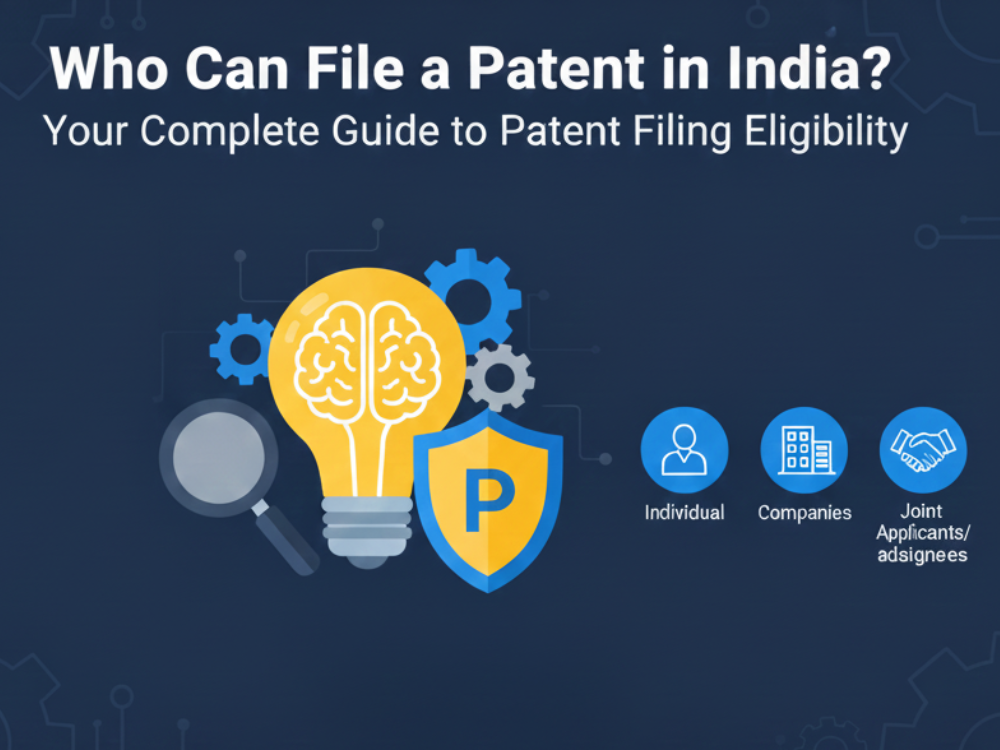
Do you have an inventive idea that you want to introduce? The necessary action to ensure that your intellectual property is safeguarded and you are given the exclusive right to the use of your innovation is by registering a patent in India. However, it is important to first discuss an important question before moving on with the detailed process of filing a patent in India: Who is eligible in filing a patent in India? The knowledge of the eligibility requirements under Indian Patents Act, 1970, is also important in obtaining a successful patent registration. This step-by-step guide will subdivide the eligible types, and the patent filing process will be right on track.
🔑 Important Applicants: The Foundation of Patent Rights.
The fundamental theme of Indian Patent Law is to secure the rights of the individual who came up with the invention. According to Section 6 of the Patents Act 1970, the following are the entities that could file a patent application either individually or together with any other individual:
1. The True and First Inventor
Definition This is the natural person or individual who in fact made the inventive step and who contributed substantively to the conception of the invention, on an intellectual level. Key Point: The inventor has to be the person who made the technology and not merely someone who financed the technology or even someone who helped on a regular basis. In case you are the brainchild of the breakthrough, you have the first right to seek the grant of the patent.
2. The True and First Inventor Assignee.
Definition: An assignee is an individual or a legal entity to whom the true and first inventor has transferred his rights to the invention legally. This is the route which is the most common by business.
• Types of Assignees:

o Companies (Large Entities): A big company in which an employee (the inventor) came up with the invention as part of his/her employment agreement. The company is usually assigned.
o Startups and Small Entities: Recognised Startups and Small Entities (under MSME Act, 2006) may file as assignees and enjoy lower statutory fees as well as, in certain instances, faster examination.
o Educational Institutions and Research Organisations: in many cases, inventions made by an employee or a student at a university or a research organisation are made the property of the university or research organisation. •
o Requirement: The Proof of Right should be a copy of a valid in writing (Assignment Deed or other relevant employment contract) demonstrating the assignment of patent rights.
3. The Legal Representative of a Dead Inventor.
Definition: When the true and first inventor dies before the process of filing patent or during the process of application pending, the legal representative scheduled by that inventor (such as an executor or heir) is allowed to file or proceed with the application.
Filing Jointly: Collaborative Invention
In case more than two people worked on the invention, that is, each contributed considerably to the inventive act, they may file as Joint Applicants. Joint Inventors: Joint inventors are two or more natural persons who participated together in the conception of the invention.
• Inventor and Assignee: A joint filing may be made by either an inventor and the company (assignee) of whom they have assigned some rights (partially or wholly).
• Routes:
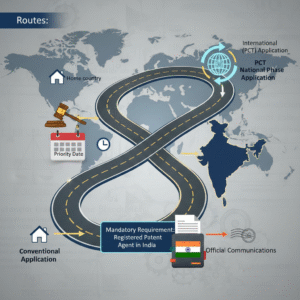
o Conventional Application: Direct filing within 12 months of the initial application in their home country (claiming priority date).
o PCT National Phase Application: Application in India following an International (PCT) application; the application is usually filed within 31 months of the earliest priority date.
Mandatory Requirement: All foreigners are required to designate a registered Patent Agent, or have an address in which to receive official communications in India.
✅ Overview of Eligibility to File a Patent.
Summary of Patent Filing Eligibility
Applicant Category | Description | Key Requirement |
Individual Inventor | The natural person who conceived the invention. | Form 5 (Declaration of Inventorship). |
Assignee (Company/Startup/Entity) | A person or entity to whom the inventor has legally transferred the rights. | Proof of Right (Assignment Deed, Form 1). |
Legal Representative | A person legally entitled to act for a deceased inventor. | Death Certificate and legal appointment documents. |
Joint Applicants | Two or more individuals/entities who collaboratively filed the application. | All parties must be named on Form 1. |
Foreign Applicant | Any individual or entity not resident in India. | An address for service/registered Patent Agent in India. |
✅ Overview of Eligibility to File a Patent.
💡 Beyond the Applicant: The Patentability Requirements. Although it is important to know who is allowed to file, keep in mind that your invention should also satisfy the statutory requirements on what qualifies as patentable by the Patents act, 1970.
A patent can be granted only when the invention is:
1. Novelty: It has to be novel and not popular with the entire world on the date of filing.
2. Inventive Step (Non-Obviousness): it should not be apparent to someone who has the capability, knowledge and vocation to the art or field. It has to entail a technological innovation.
3. Industrial Usability (Utility): It should be usable or manufacturable in an industry.
4. Not Fall Under Section 3 & 4: It shall not be a subject matter, that is excluded, e.g. a mere discovery, a mathematical or business method or a computer program, as such.
Company Planning to Innovate?
Patent application is an elaborate legal and technical process. In either case, you are the true and first inventor or are an Startup filing under the name of an assignee you would be well advised to seek the advice of a registered Patent Attorney or Patent Agent. They are able to assist in the process of patent search, patent drafting of the full specification, and assure you all formal compliances to enable you to get the much desired grant of patent.
Contact us to secure your innovation now!