In the modern innovation-driven economy, a patent is more than just a certificate; it is a powerful strategic asset. For Indian startups, researchers, and corporate giants, securing a patent from the Indian Patent Office (IPO) is the ultimate goal to safeguard intellectual property. However, the road from filing a Patent Application to a final grant is often riddled with hurdles.
If you have received a First Examination Report (FER) or a hearing notice that seems daunting, you are not alone. A significant percentage of patent applications in India face rejection not because the idea is bad, but because the application fails to meet the stringent legal criteria set by the Indian Patent Act, 1970.
how professional guidance from Intellect Bastion can help you navigate this complex legal landscape.
The Landscape of Patent Prosecution in India
Before diving into the reasons for rejection, it is essential to understand that the Indian Patent Office acts as a gatekeeper. Its primary duty is to ensure that only “true and first inventions” that add value to society are granted a monopoly. The process of examination is rigorous, focusing on both the technical merits and the legal compliance of the application
Understanding the grounds for refusal is the first step toward building a “rejection-proof” patent strategy.
1. Lack of Novelty (Section 2(1)(j))
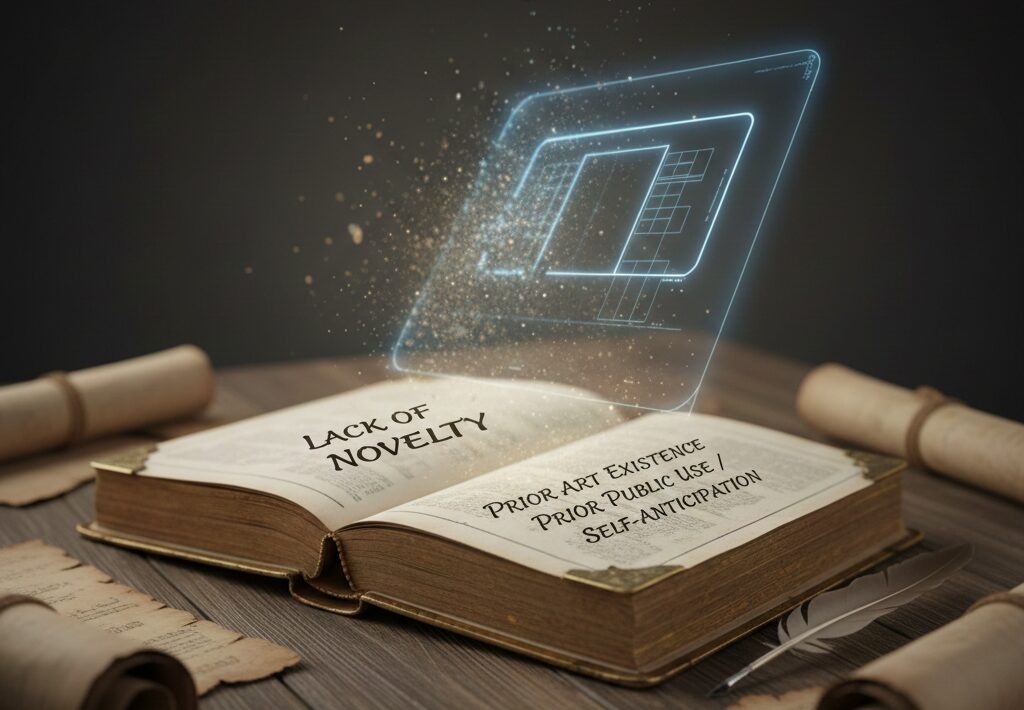
The most fundamental requirement for any patent is Novelty. Under Section 2(1)(j) of the Indian Patent Act, an invention is considered new if it has not been anticipated by publication in any document or used in the country or elsewhere in the world before the date of filing.
- Prior Art Existence: The Examiner finds a document (research paper, previous patent, or blog post) published anywhere in the world that describes your invention.
- Prior Public Use: If you showcased your invention at a public exhibition or sold a prototype before filing a provisional application, it loses its novelty.
- Self-Anticipation: Ironically, many inventors “kill” their own patents by publishing their research in journals before filing the patent application.
Why Rejections Happen:
To avoid this, it is crucial to perform a Comprehensive Patentability Search before filing. Learn more about how to secure your ideas on our Home Page.
2. Lack of Inventive Step or Obviousness (Section 2(1)(ja))
Even if an invention is “new,” it must also be “inventive.” Section 2(1)(ja) defines an Inventive Step as a feature of an invention that involves a technical advancement compared to existing knowledge or has economic significance (or both), making the invention not obvious to a Person Skilled in the Art (PSITA).
Common Rejection Grounds:
- The Obviousness Test: If a person working in the same field can easily arrive at your solution using existing tools and knowledge, the patent will be rejected.
- Mosaicking: Examiners often combine two or more prior art documents to show that your invention is merely a logical combination of existing technologies.
Proving a “Technical Advance” requires high-level drafting skills to highlight the “problem-solution” approach effectively.
3. Non-Patentable Subject Matter: The "Section 3" Hurdles
India has one of the most unique and stringent sets of “Exclusions” in the world. Even if your invention is novel and inventive, it may be rejected if it falls under Section 3 of the Act.
A. Section 3(d): The "Evergreening" Barrier
This is perhaps the most famous clause in Indian Patent Law (highlighted by the Novartis case). It prevents the patenting of a “new form” of a known substance unless it shows a significant increase in efficacy.
- Rejection Reason: Filing for a new salt, ester, or polymorph of an existing drug without proving it works significantly better.
B. Section 3(k): Software, Algorithms, and Business Methods
In India, “a mathematical or business method or a computer programme per se or algorithms” are not patentable.
- Rejection Reason: If your software patent application focuses only on the code or the logic without demonstrating a Technical Effect or a Technical Contribution involving hardware, it will likely be rejected.
C. Section 3(i): Medical Treatment Methods
Any process for the medicinal, surgical, curative, prophylactic, diagnostic, or therapeutic treatment of human beings or animals is non-patentable.
- Rejection Reason: Attempting to patent a new “method” of performing surgery or a “method” of diagnosing a disease. (Note: The device used might be patentable, but the method is not).
D. Section 3(p): Traditional Knowledge
An invention which is in effect traditional knowledge or which is an aggregation or duplication of known properties of traditionally known components is not patentable.
- Rejection Reason: Trying to patent a wound-healing cream made of turmeric (Haldi), as this is part of India’s Traditional Knowledge Digital Library (TKDL).
Understanding these nuances is vital. For a deeper dive into the specific steps of filing, check out our blog on The Step-by-Step Patent Filing Process in India.
4. Lack of Industrial Applicability (Section 2(1)(ac))
Under the Indian Act, an invention must be capable of being made or used in an industry. If an invention is purely theoretical or defies the laws of physics (like a perpetual motion machine), it will be rejected.
5. Insufficiency of Disclosure (Section 10)
A patent is a “contract” with the government: you get a monopoly in exchange for revealing exactly how the invention works. If your Complete Specification does not describe the invention clearly enough for a person in the same field to replicate it, the patent will be refused under Section 10(4).
Common Mistakes:
- Vague descriptions.
- Missing drawings or flowcharts.
- Failure to disclose the “Best Method” of performing the invention.
6. Non-Compliance with Formal Requirements
Sometimes, it’s not the science that fails, but the paperwork. The IPO is very strict regarding:

- Form 3 (Statement and Undertaking): Failure to update the Controller about corresponding foreign applications within the prescribed timelines (Section 8).
- Biological Material: Failure to obtain permission from the National Biodiversity Authority (NBA) if the invention uses biological resources from India.
- Foreign Filing Permission: If an Indian resident files a patent abroad without first filing in India or obtaining a Foreign Filing License (FFL) under Section 39.
7. Failure to Respond to the FER Timely
Once the IPO issues a First Examination Report (FER), the applicant has six months (extendable by three months) to meet all requirements. If the applicant fails to submit a comprehensive response that satisfies the Examiner, the application is deemed “Abandoned.”
How to Overcome a Patent Rejection?
Receiving a rejection notice or a “Hearing Notice” is not the end of the road. With the right legal strategy, many objections can be overcome:
- Amendment of Claims: Narrowing down your claims to exclude prior art while retaining the core value of your invention.
- Technical Arguments: Providing comparative data to prove “Technical Advancement” or “Enhanced Efficacy” (especially for Section 3(d)).
- Expert Affidavits: Using declarations from experts to prove that the invention was not “obvious” at the time of filing.
- The Hearing Stage: Representing your case effectively before the Patent Controller to clarify technical misunderstandings.
Why Professional Assistance Matters
The Indian Patent Act is a complex blend of science and law. A single error in drafting a claim or a delay in filing a form can lead to the loss of millions of dollars in potential IP valuation.
At Intellect Bastion, we specialize in helping inventors navigate the maze of the Indian Patent Office. From conducting high-accuracy novelty searches to drafting robust specifications and representing you in patent hearings, our team ensures your innovation gets the protection it deserves.
Don’t let your hard work be rejected due to technicalities or improper drafting. Connect with us today via our Contact Us page to schedule a consultation with an experienced patent agent.
Conclusion
A patent rejection in India is often a call for better strategy, not a sign of a failed invention. Whether it is a Section 3(k) objection on a software tool or a Section 3(d) hurdle for a pharmaceutical compound, understanding the law’s intricacies is the key to success. By identifying the common pitfalls—lack of novelty, obviousness, or formal non-compliance—you can prepare a stronger application that stands the test of examination.
Are you ready to protect your innovation? If you are facing an objection from the Patent Office or planning to file a new application, fill out the form below, and our experts at Intellect Bastion will get back to you shortly.
Reach Out to the Experts
Please fill in the details below to receive a free preliminary evaluation of your patent query.
Disclaimer: This blog is for informational purposes only and does not constitute legal advice. For specific legal concerns regarding the Indian Patent Act, please consult with a registered patent attorney at Intellect Bastion.