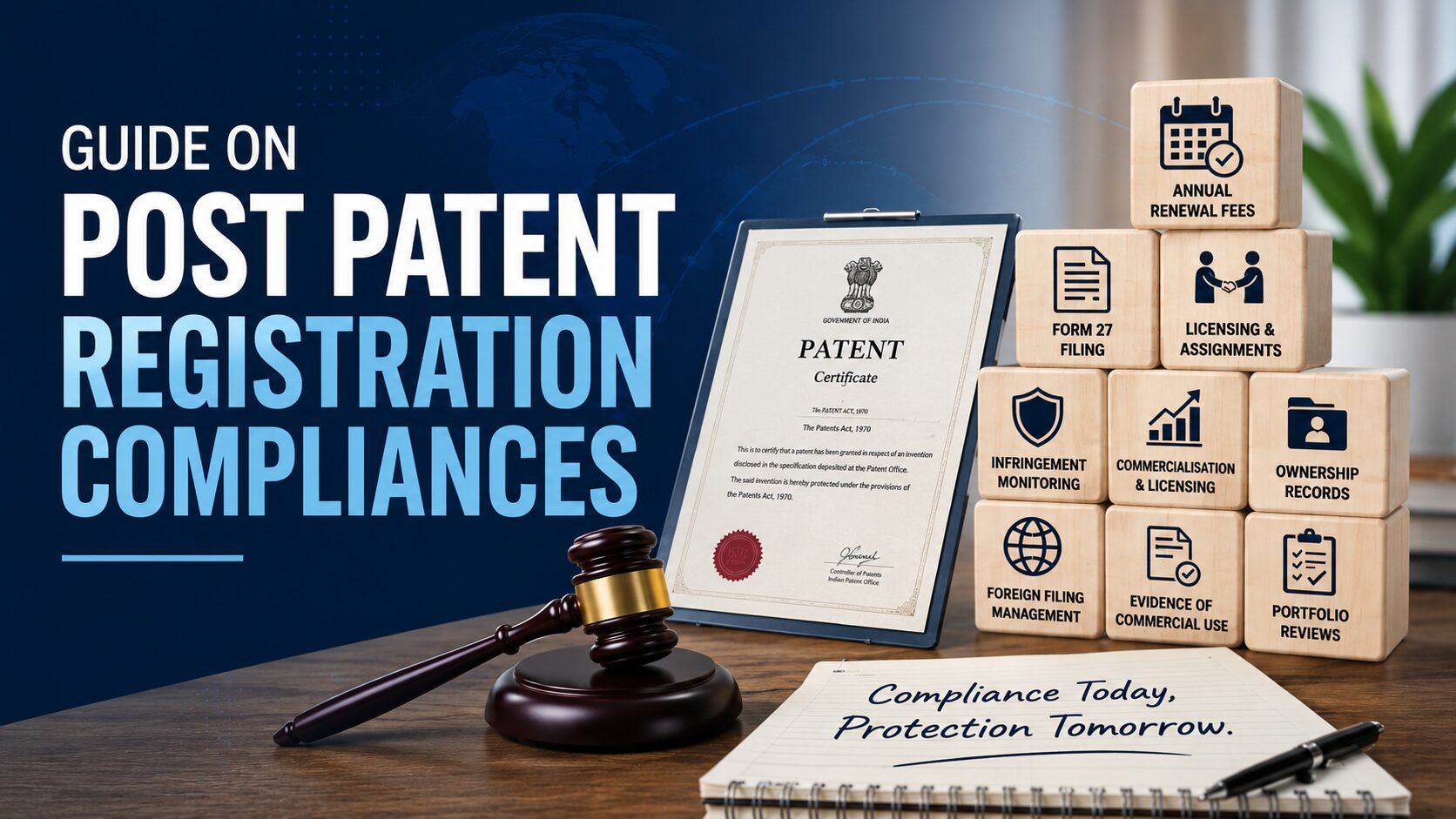
A patent grant is an important milestone for any business, university, startup, or creator. But the patent certificate is not the end of patent protection. Over the course of its 20-year term, a granted patent is subject to several statutory obligations and maintenance requirements. Penalties, rights loss, compulsory licensing risks, and even patent revocation may result from noncompliance with these post-grant obligations.
Why is Post-Grant Patent Compliance Important?
Many patent holders mistakenly believe that once a patent is granted, no further action is to be taken. But in reality, a patent is a legislative right that must be maintained through timely compliance.
Proper Compliance helps in the following ways:
- Keep the patent in force
- Preserve protection against infringers
- Avoid penalties and legal complications
- Enhance patent valuation during licensing, investment, or acquisition
- Demonstrate commercial exploitation of the invention
In this blog, you will read about post-patent registration compliance in India in detail, which every patent holder must know.
1. Payment of Annual Renewal Fees
The IP India has established a schedule for the payment of annual Patent maintenance fees. Patents are alive up to 20 years from the date of filing, subject to payment of annual renewal fees. Renewal fees are applicable from the 3rd year onward and continue until the 20th year.
You can also read our full blog on Patent maintenance and renewal in India, here.
Patent Renewal Fee Timeline in India
Fees for patent maintenance are due several times during the effective length of your patent. Those deadlines are as follows:
| Patent Year Range | Annual Fee (Natural Person and Small Entity) | Others |
|---|---|---|
| Year 0 to 2 | 0 | 0 |
| Year 3 to 6 | 800 | 4000 |
| Year 7 to 10 | 2400 | 12000 |
| Year 11 to 15 | 4800 | 24000 |
| Year 16 to 20 | 8000 | 40000 |
According to Rule 80(3) of the Indian Patent Rule 2003, the applicant may pay the annual renewal costs payable for two or more years in advance. Provided that the applicant pays the renewal fees in advance by electronic means for a period of at least four years, the patent office shall apply a ten per cent discount on fee for that renewal.
2. Filing Form 27
Section 146(2) of the Patents Act of 1970 requires each Indian patent holder and exclusive licensee to submit a Form 27 annual statement to the Indian Patent Office. The form indicates how much of the patented invention they used commercially in India during the preceding fiscal year.
Information Required for Filing Form 27
The current Form 27 asks the patent to provide:
- Patent Number in India
- Whether the invention is working in India during the financial year.
- The value and quantity of patented products manufactured in India, imported into India, and the total turnover in India.
- Particulars of any licence and sub-licences
- If the patent is not being worked, the reason
- Details of steps being taken to work on the patent.
3. Recording Licenses and Assignments
Patent licensing is a type of agreement between a patent owner (licensor) and another party (licensee) to allow the use, make, or sell their patented invention in exchange for compensation or royalties. Whereas a patent assignment occurs when the original patent holder transfers ownership of a patent to an assignee. The assignee obtains total ownership and control of the patent upon completion of the assignment, including the ability to use, market, or grant additional licenses for the invention.

Recording patent licensing and assignment in the Indian Patent Office is very important. It helps in:
- Establish clear ownership
- Enable enforcement action
- Prevents future title disputes
- Assists in commercialisation and investment activities
4. Monitoring Patent Infringement
Every Patent owner needs to monitor patent infringement by competitor products, manufacturing activities, online marketplace and weekly journal release by the IP office.
Patent monitoring helps you to protect your patent by observing newly granted patents; you can see whether a competitor company is infringing your own property rights, and can respond to this in good time with an objection
5. Commercialisation and Licensing Compliance
After the grant of a patent, a patent holder has the right to commercialise their patent or licence it to others for profit. Patent commercialisation occurs when the original patent owner sells the patent for a fair price, licenses the property, or introduces a replacement product in the marketplace based on the invention. In layman’s terms, it means that the patent has provided some financial benefit to the owner.
Section 68 of the Indian Patent Act 1970 commands that every patent licensing agreement must be in writing and registered with the IP Office. Registration is essential for the agreement to be legally valid and enforceable.
The following formalities under the Indian Patent Law
- Filing of Form 16
- Submission of executed licensing agreement
- Payment of prescribed fees
- Compliance with procedural requirements under Patent Rules
6. Maintaining Ownership Records
Ownership of patent are need to be updated all the time. Changes need to be recorded:
- Name changes in patentee
- Changes of address
- Corporate restructuring
- Conversion from proprietorship to company
- Assignment to another entity
“The patent office must maintain a Register of Patents in accordance with Section 67 of the Patents Act, 1970. This register contains the names and addresses of patent grantees, notifications of patent assignments, extensions, and revocations, and details of any other issues about the validity or proprietorship of patents as may be specified.”
According to Section 69, a person must apply in writing to the Controller in the prescribed manner for the registration of their title or, if applicable, notice of their interest in the register if they become entitled to a patent or a share in a patent through assignment, transmission, or operation of law, or if they become entitled to any other interest in a patent as a mortgagee, licensee, or otherwise.
7. Foreign Filing and Global Portfolio Management

If you want to file a global patent application, the Patent Cooperation Treaty (PCT) is the most popular way to do so. It is a way to stop someone else from using an innovation without permission and claiming ownership of it. It facilitates the transition to a national phase in many countries. You can read the full blog on foreign patent filing here.
8. Maintaining Evidence of Commercial Working
The patent holder should preserve every evidence demonstrating commercial exploitation of the invention, documents such as:
- Manufacturing record
- Sales invoices
- License agreement
- Import documents
- Bank statement.
9. Patent Portfolio
Once a year at least, conduct a portfolio review. A patent portfolio review is a structured review of any company’s patents and applications to evaluate their strategic, financial and legal value. The main objectives are ensuring alignment with current business objectives, identifying monetisation opportunities, reducing maintenance fees and reducing litigation risks.
10. Restoration of Lapsed Patents in India
The patentee loses the patent on the date of expiration if they do not pay the renewal fee within the allotted time frame and during the six-month extension period that they can request. If the patentee does not pay the renewal or maintenance fee, they may renew the patent within eighteen months after the date of lapse.
It is not certain that the expired patent will be restored after all the necessary paperwork has been submitted. In order to restore the patent, the controller reviews the data supplied by the patent holder. The controller will publish the application and the patent in the official gazette in accordance with Rule 84(3) if the evidence persuades the controller that the non-payment was inadvertent and that there was no excessive delay in submitting the application.
| Post Patent Grant Compliance Calendar for Patent Holder | |
|---|---|
| Compliances | Date |
| Renewal Fee payment (From 3rd Year) | Every Year (From 3rd Year) |
| Form 27 | Every 3 financial years |
| Ownership Record Updates | When changes occur |
| Infringement Monitoring | Ongoing |
| Portfolio Review | Annual |
| Licensing Review | Annual |
| Commercial Working Documentation | Ongoing |
Frequently Asked Questions (FAQs)
1. What happens if I miss a patent renewal deadline?
Missing the patent renewal deadline initiates a series of events, starting with a grace period (0-6 months) and can be permanently loss of your patent rights.
2. Who is legally required to file a Statement of Working (Form 27)?
Every patentee who holds the right and every licensee has to submit Form 27. Every person must file Form 27 for every period of three financial years, and they must submit their statement within six months from the end of the three years.
3. Can a granted patent still be challenged by competitors?
Yes, a granted patent can also be challenged. A competitor can challenge your patent by submitting post-grant oppositions through the court.
4. Can I pay patent maintenance fees in advance for the entire 20-year term, or must they be paid annually?
Yes, you can pay patent maintenance fees in advance for the entire 20-year term, also. If you pay an advance payment of at least four years, you can receive 10% discount on it.
5. Is there a standard grace period for late patent renewal payment, and does it involve surcharges?
Yes, there is a 6-month grace period for late payment renewal. For the grace period, you have to file Form 4 with the prescribed fee; after that, you get a 6-month grace period.
6. If a patent lapses due to non-payment, what is the exact legal process and timeline to petition for its restoration?
For restoration of your patent, you must submit Form 15 to the Indian Patent Office and there is an 18-month deadline also.
7. Do patent maintenance fees increase over the lifespan of the patent, or do they remain flat?
Under the Indian Patent Rules, 2003, the fees for patent maintenance increase over the lifespan.
8. If a patent has multiple co-owners, must each owner file an individual Statement of Working, or can they submit a joint report?
For the co-owners of the patent, who can submit a single joint statement of the working Form 27, they are not required to file individual forms.
Conclusion
Understanding post-patent registration compliances are much important for investors, innovators, or businessmen in today’s fast-growing world. A patent not only gives you a legal certificate, but it also gives you the right to protect your invention from others stealing it.
Many investors or businessmen think that granting the patent means the work is over, but actually, you have to maintain it.
You can hire any professional for the maintenance of the patent. A professional with years of experience in the maintenance of patents, they can provide you with a valuable service and save you money and time.