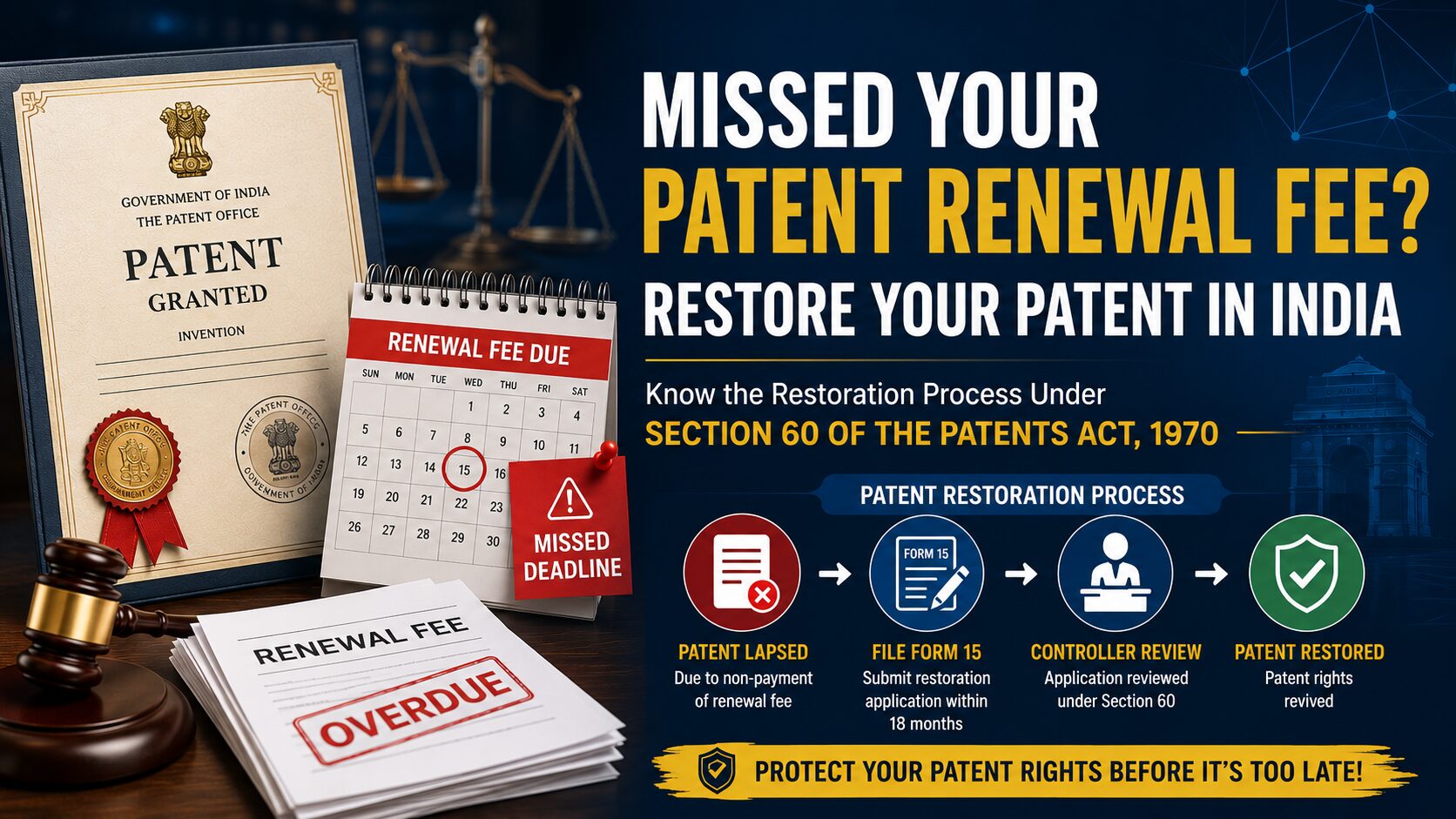
Patents are one of the most valuable intangible assets that any individual owns. Patents provide exclusive rights to the inventor for his invention. Furthermore, organizations often view patents as a crucial tool for competitive advantage. Nevertheless, obtaining a patent is not an end point by itself. Patents need renewal periodically and timely payment of renewal fees.
Consequently, failure to pay renewal fees results in undesirable outcomes. Fortunately, Indian Patent Law allows patent holders to restore certain patents that lapse due to non-payment of renewal fees.
This article provides a detailed description of how to restore a patent in India and outlines the legal provisions under Section 60 of the Indian Patent Act.
Know Patent Renewal Fees in India
Indian patents remain valid for 20 years from the date of application filing, provided the patentee pays the renewal fees.
The payment of renewal fees starts from the third year from the date of filing the patent and increases progressively with time.
Consequences of Missing Patent Renewal Fees
The timely payment of the Renewal Fees is extremely important as failure to do so will cause the termination of the patent.
Patent Renewal Fees: Importance
Patent renewal fees serve several purposes:
- Legal maintenance of patents
- Ensures only useful patents are renewed
- Avoids unnecessary blocking of technological innovation
- Generate revenue for patent administration
Ultimately, failure to pay renewal fees can lead to the loss of patents rights.
What to expect if Patent Renew fee deadline is missed?
This is the major concerns among the patent owners. However, if the renewal fees in not paid by the due date, the patent does not cease immediately.
The Indian Patent Office gives 6 months grace period. During this period, the patent owner can still pay the renewal fee but with the mandatory additional fee.
However, if you fail to pay the fees within this grace period as well, the patent ceases to have effect and becomes a lapsed patent.
Fortunately, at this point, the patent holder may seek Restoration of Lapsed Patents under the provisions of the Patents Act, 1970.
Patent Restoration in India: Legal Framework
Section 60 of the Patents Act, 1970 governs the restoration of a lapsed patent.
What is Section 60 of the Patents Act, 1970?
This section provides patent holders with an opportunity to restore their patents that have terminated due to non-payment of renewal fees.
This provision acknowledges the unintentional mistakes, administrative oversights or some other reason on the part of patentee for which he failed to pay renewal fees.
Nevertheless, the application process requires fulfilment of certain conditions as specified by laws.

Restore Lapsed Patent Application
A restore lapsed patent application refers to an application filed at Indian Patent Office requesting the restoration of a patent that has expired due to non-payment of its renewal fee.
The Controller reviews this application to determine whether the patent should be revived.
The person submitting the application needs to give a valid reason for the failure of renewal fee payment.
Timeline for Patent Restoration in India
The filing deadline is one of the crucial factors of the process of restoration.
According to Section 60, the patentee must file the restoration application within 18 months from the date the patent became ineffective. Crucially, this deadline is quite rigid.
In case, the patent holder fails to comply with it, he loses all his rights to restore the patent.
Is it possible to restore a Patent after 18 months in India?
Many people ask this question, but the answer is no.
As per the Patents Act, the patentee must file the restoration application within 18 months from the day the patent terminated. Once this period elapses, the Controller can almost never restore the patent.
Therefore, patent holders must take immediate action once they realize the patent has expired.
Restoration Conditions for Lapsed Patents
The Controller cannot grant restoration to all lapsed patents.
The applicant must satisfy the Controller that:
- Failure of renewal fee payment was unintentional.
- There was no abandonment of the patent in question.
- The applicant has submitted the restoration application within the stipulated period.
- The applicant has compiled with all procedural requirements.
Understanding the Unintentional Failure Requirement
What is the ‘Unintentional Failure’ condition?
The concept of “unintentional failure” is crucial for patent restoration.
The inventor needs to prove that the non-payment of renewal fee was an unintentional mistake. Some examples include:
- Mishandling of communication.
- Wrong calculations regarding deadlines.
- Changes in personnel responsible for IP management.
- Unexpected disruption in business.
The Controller thoroughly analyses the reason for non-payment before deciding on restoration.
An intentional failure of renewal fee payment fails to fulfil this condition.
Process of Patent Restoration in India
Understanding the restoration process can significantly increase the probability of success.
Step 1: Identifying the Lapse date
First thing to do, find out the date when the patent lapsed.
It is very important since the determination of this date will tell you whether the window of 18months is still open for patent restoration.
Step 2: Preparing the application for Restoration
The applicant needs to create an application containing:
- Valid reason for the non-payment.
- Circumstances that led to the patent lapse.
- A proof that it was not deliberate.
Step 3: Form 15 filing
Form 15 is the particular form for restoration of patent in India. It is the most important form to initiate the restoration process.
The form should be filed with the Patent Office in India with the necessary fee.
The applicant must include complete information about the reasons for the failure to pay patent renewal fees. Consequently, failure to do so will definitely damage the case.
Therefore, professionally prepared form is recommended.
Step 4: Payment of outstanding Fees
Following should be paid by the applicant:
- Renewal fees which have not been paid.
- Prescribed fees (Additional).
- Fees for restoration.
Ultimately, the actual amount will vary depending on the particular situation and the patent status.
Step 5: Examination by the Controller
The controller reviews:
- Restoration application.
- Evidence submitted in support of the application.
- Reasons for the delay in filing the fees.
- Compliance with statutory requirements.
In case the controller is satisfied, the process moves forward.
Step 6: Publishing the Application
After accepting the restoration application, the Controller publishes it in the journal of the Patent Office.
Publication gives an opportunity to other concerned parties to review the application.
Step 7: Opposition Proceedings (If there is any)
Any party may file opposition to the restoration if they feel the requirements have not been compiled with.
In addition, the controller takes in account any opposition filed by third parties before making its decision.
Step 8: Order for Restoration
If the applicant meets all requirements and convinces the Controller, the Controller issues an order restoring the patent.
The Patent Office then reinstates the patent rights, subject to statutory provisions.
Penalties and Additional Costs
Penalty for Delay in Payment of Patent Renewal Fees in India
On the other hand, if the grace period lapses:
- Patent will be invalid.
- Restoration proceeding becomes necessary.
- Restoration fees will be incurred.
Hence, the stage at which the patentee pays the fee determines the Penalty for Delay in Payment of Patent Renewal Fees in India.
When the renewal fee is paid within the grace period of six months:
- Patent will be valid.
- You will incur extra fees.
- You will not need restoration.
- The patent has already expired.
Third- Party Rights During Patent Lapse
One of the worries that many patentees face revolves around the rights of third parties during the lapse period.
Can Another Person Use My Invention If the Patent Expires?
The answer is yes in some cases.
Upon the expiration of the effectivity of the patent, there are certain situations where third parties can use the invention.
To address this, India’s patent laws attempt to achieve a balance between the rights of:
- Patent owners who seek restoration.
- Third parties acting in good faith.
Thus, there might be certain rights of third parties that survive despite restoration from the lapse period.
Naturally, this will vary depending on the facts surrounding each situation.
Therefore, we recommend seeking professional guidance from lawyers in such instances involving business operations.
Effective Ways to Prevent Patent Lapse

In the first place, while reinstatement may be an option, prevention is always better than cure.
- Keep a Renewal Schedule: Record all due dates for renewals well ahead of time. In addition, give yourself several reminders prior to each deadline.
- Leverage Patent Management Tools: Specifically, online management platforms lessen the chances of missing important deadlines.
- Hire an IP Expert: Patent agents and lawyers can keep track of renewals and make necessary payments.
- Perform Periodic Review of Your Portfolio: Assess your patent portfolio frequently to find out which patents are worth retaining.
- Keep Up-To-Date Contact Details: Make sure that all letters from the Patent Office go to the right people.
Conclusion
Non-payment of renewal fees need not necessarily imply permanent loss of your patent. In the case of the patent law system of India, Patent Restoration India has an excellent chance to make the most of the provisions under Section 60 of the Patents Act, 1970.
The applicant must meet certain conditions for restoration. The patent holder needs to prove that non-payment was unintentional and he must file the request within 18 months after cessation of the patent.
The knowledge and implementation of the Patent Restoration India procedure will increase your chances of success.
When you realize that your patent has become lapsed because you forgot to pay the renewal fee, then the first thing that you need to do is act quickly. Failure to act promptly may cost you the opportunity to restore the patent rights permanently.
Therefore, if you require help regarding Patent Restoration in India, or patent renewals, and even IP portfolio management services, Intellect Bastion is there for all your requirements. Reach out to us right away to see how we can devise an efficient strategy to protect your precious patents.