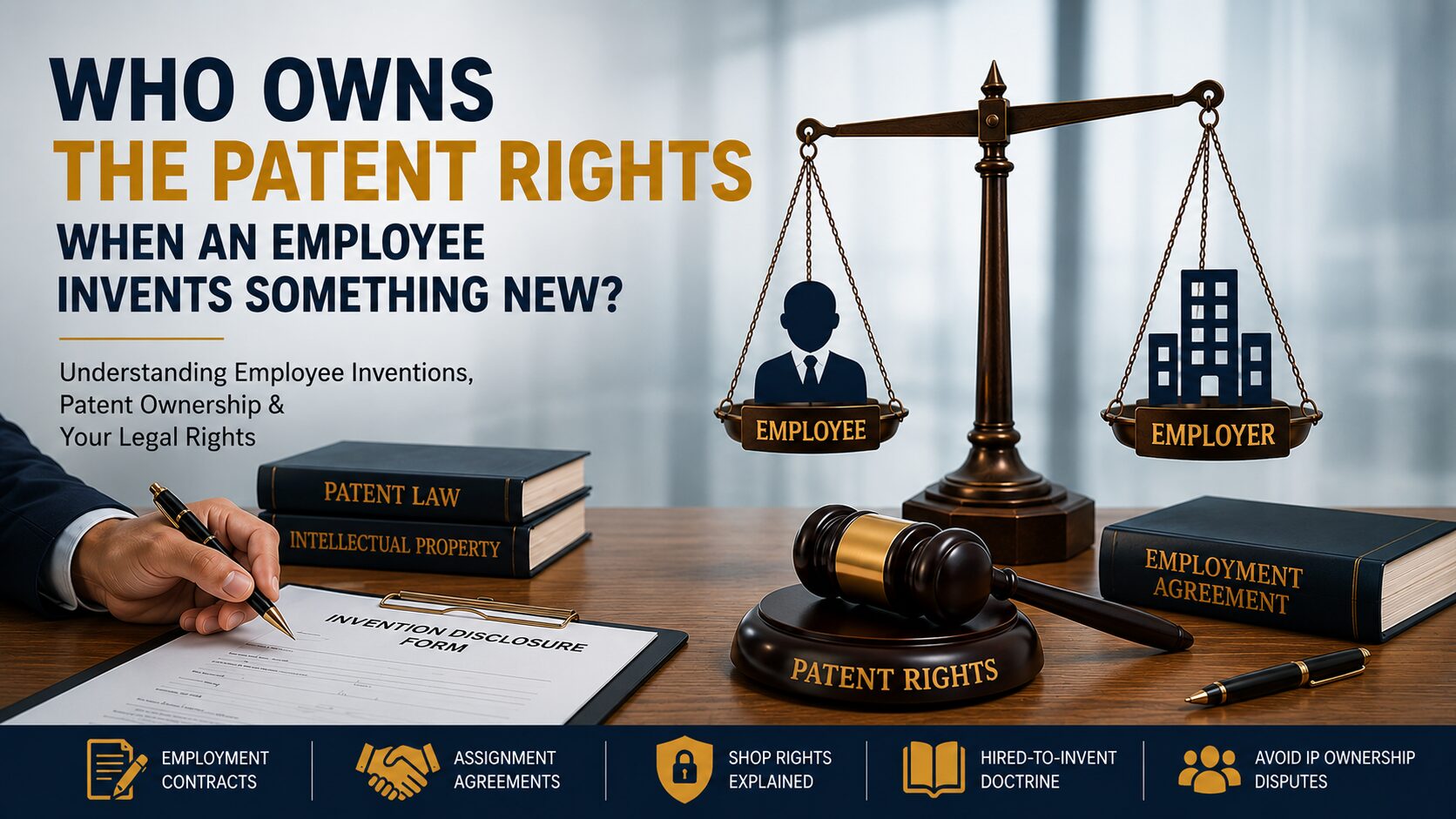
An employee might invent a revolutionary new product or process while employed. When this happens, a follow-up question inevitably arises: Does the employer or employee own the patent? The employer may think the patent belongs to the company outright. On the other hand, the employee may think that his personal creativity gives him sole claim. However, the actual ownership of the patent depends on various legal considerations. This guide will explain all you need to know regarding employee ownership of inventions and how to avoid potential conflicts.
Why Invention Ownership Confuses Employers and Employees
The fact is that many employment disputes would not even happen. This is especially true if parties made clear ownership agreements prior to the invention. Employees often think they own everything they produce on their own. Meanwhile, the employer believes that paying a salary means the entire right belongs to the company.
These assumptions have no legal value. When considering ownership, courts take into account several things, and the result may vary depending on a minor detail.
- Whether an employee was hired for an inventive purpose;
- The involvement of company’s property and time into development process;
- Whether there was any contract about ownership.
Who Owns Employee Inventions Under General Legal Principles
Ascertaining who owns an employee’s invention is a process. It begins with analyzing the nature of the employment. If there is no agreement, patent law defaults to the inventor. This is because the law grants the patent to the creator of the idea, not to the employer automatically
This is not always the case. In most organizations, inventors have to enter into agreements regarding the transfer of the invention. The courts have held that such agreements are binding on the employees provided that they are reasonable.
Patent Rights Employee vs Employer: What the Law Actually Says
The conflict over patent ownership will be much clearer when you learn about the possibilities. Three different scenarios may occur. First, the employee will keep his full ownership when neither a contract nor any rule applies. Second, the employer will get full ownership if there is an assignment agreement. Third, the employer gets usage rights but not ownership of the patent.
Legislation concerning employee patent ownership law differs from state to state. This is especially true regarding what an employer can make an employee sign.
The Hired-to-Invent Doctrine Explained
The hired-to-invent rule applies when a business specifically hires an individual to solve a particular problem. In this case, any resulting inventions belong to the employer.
This rule is distinct from standard employment. It considers the specific purpose of your hiring rather than your general daily tasks. The title of the role, the hiring paperwork, and other communication within the business would often be considered evidence.

Employer Shop Rights: A Middle Ground Solution
Sometimes, an employee creates an invention using company resources. However, they may not be bound by any specific ownership rules. In these cases, employer shop rights may apply. This gives the company a non-exclusive, royalty-free right to use the invention.
Shop rights do not make for complete ownership of the invention by the employer, and the employee remains the owner of the patent. However,
- The company gets the liberty to use the invention without paying any royalty fees
- The employee owns the invention and can license it to other parties
- Shop rights pertain mostly to business usage
Invention Assignment Agreements and Employment Contracts
An invention assignment agreement is an agreement in which workers agree to assign ownership of any inventions they create at work to their employers. An organization usually provides this agreement at the time of hiring of employees although some companies ask for this agreement during a particular project.
You must consider many things while drafting a patent clause in the employment contract; some of these include making sure that it defines a “work-related” invention, exceptions to any personal projects, and the disclosure process.
Work For Hire and Patent Ownership Explained
Many employees wrongly think that issues relating to “work for hire” in the context of patent rights ownership fall under copyright laws, but this is not so. Copyright laws clearly spell out “work for hire,” but in patent laws it is the contract, the hired-to-invent doctrine, and shop right that come into play.
This implies that companies can’t just automatically lay claim to any patents since it is not possible to do so as in copyright where it concerns written material or computer programs.
Documenting Inventions Properly From the Start
There is no doubt that every firm can benefit greatly from having an invention disclosure form for their employees. It ensures that you register all new inventions in writing to make it evident what happened, who was involved, and when.
It makes it easier to figure out the issue of ownership. Also, it helps the employees, as it will serve as proof for them about the way they created their invention.
Avoiding Intellectual Property Ownership Disputes
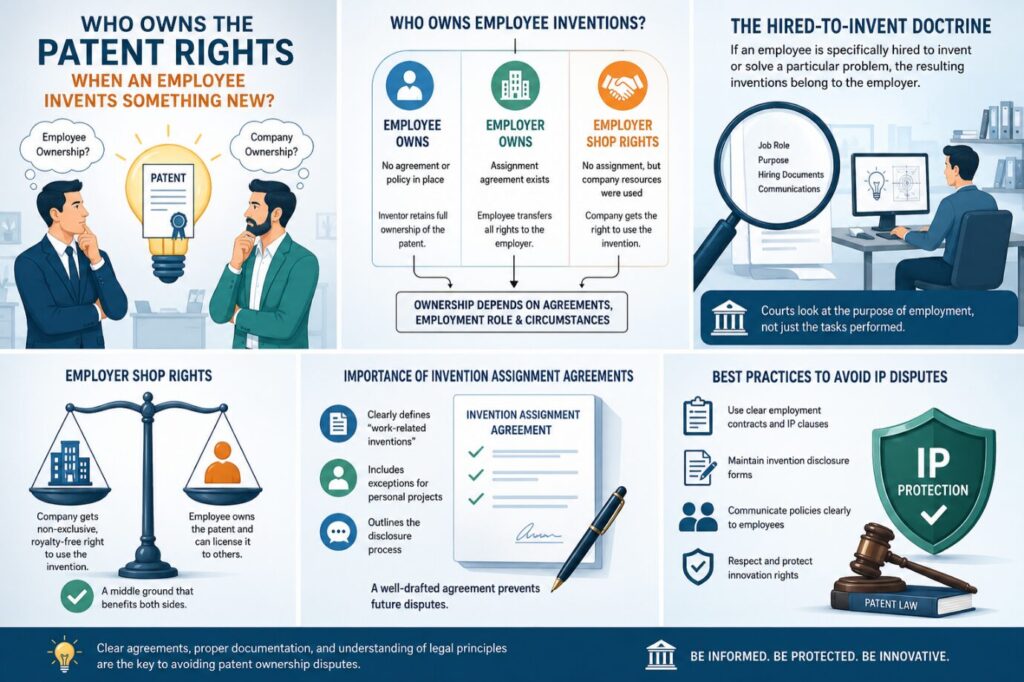
Avoiding conflicts regarding IP ownership rights in the employment environment occurs well before any inventions even occur. Proper contract creation, thorough documentation, and good communication from managers and employees greatly decrease the chance of any expensive lawsuits.
Businesses also need to educate their managers on how to determine if any side project by an employee is encroaching upon business interests. This will help them avoid wasting time and money discussing ownership of IP that has been developed in the workplace.
Conclusion
Disputes over the patent ownership of any company can disrupt an otherwise fruitful business relationship and rob the company of much-needed energy to focus on other issues. Thankfully, all such problems can be prevented by having proper documentation, a thorough understanding of legal doctrines like hired-to-invent and shop rights, and well-written agreements in place. For the best support and guidance, you can contact Intellect Bastion!
FAQ’s
1. When the employee invents something using his personal laptop at home during his time in the office, whose is it?
The owner is usually determined by the scope of work of the employee and not just by the tool he used to develop the invention. If it falls within his normal range of activities, it belongs to the employer even though it was a personal computer.
2. Do the rules for patent rights of an independent contractor apply to a normal full-time employee?
No, normally an independent contractor is the owner of his/her invention unless it is specified in the agreement. In case a firm hires an independent contractor, it is necessary to ensure that there is an assignment provision in the agreement.
3. How are patent rights affected when the inventor leaves or is fired?
In such situations, courts consider the time of conception of the invention rather than the time when the idea was perfected. Therefore, even if the inventor leaves his or her place of work, the employer can still retain the rights to the invention.
4. Is it possible to have a patent granted by an employer for an idea that an employee proposed during a casual brainstorming session?
This is a possibility, particularly if the employee was carrying out their work duties while proposing the idea. However, there must be enough content in the idea for it to be eligible for patenting.
5. What is an invention assignment agreement, and when should an employee sign it?
This document transfers the title of inventions that qualify under its terms to the employee’s employer. The employee needs to read this document very carefully before agreeing to sign it; preferably before starting their job.
6. Is the “work for hire” doctrine applicable in case of utility patents or only for copyright works?
The “work for hire” doctrine only applies in the context of copyright law. Patent law has its own ways of dealing with ownership through means such as assignments, shop right, and hired-to-invent, which we have previously described.
7. What are the legal rights of the company with regard to "shop right" if a dispute arises regarding the patent?
The organization is provided an implied, nonexclusive, royalty-free, and nontransferable license to utilize the patent (manufacture, use, and sell the same) as part of its usual business operations. Although the ownership of the patent still rests with the employee, any future transfer or licensing of the patent by any other party comes with the restriction of the already existing shop right of the organization.
8. Do employers have an obligation to pay their workers bonuses or royalties for inventing things at their workplace?
No, there is no federal legislation that compels such a practice except for a contract promising so. Some employers give bonuses voluntarily to spur creativity although this is not a must.
9. If two employees jointly invent something, but one of them quits, who holds the patent?
Generally speaking, the two would both retain co-inventor status despite any employment changes. Their rights to ownership would be dependent upon the agreements that they signed, which means the employee who quit could have duties to transfer his/her rights.
10. How could an entrepreneur ensure the protection of their IP prior to hiring their first developer or engineer?
Entrepreneurs need to create invention assignment agreements and confidentiality agreements prior to engaging in any development work. Doing so helps to eliminate any confusion right from the beginning.