If you create something impressive, like you write something, or write a song, or you make any artwork, or make software. Now you want to protect it legally. So you can file a copyright application. Filing a copyright is an online process; here, you can be stuck at any point, such as the type of work, or confusion between the author and the owner, which may lead to mistakes.
Thousands of creators make common copyright filing mistakes, it create several problems like delayed protection, raised objections, or the application may be rejected.
In this blog, you can read about online copyright filing and how to avoid copyright application errors.
Common Copyright Filing Mistakes
Here are the following mistakes in copyright registration that every creator faces.
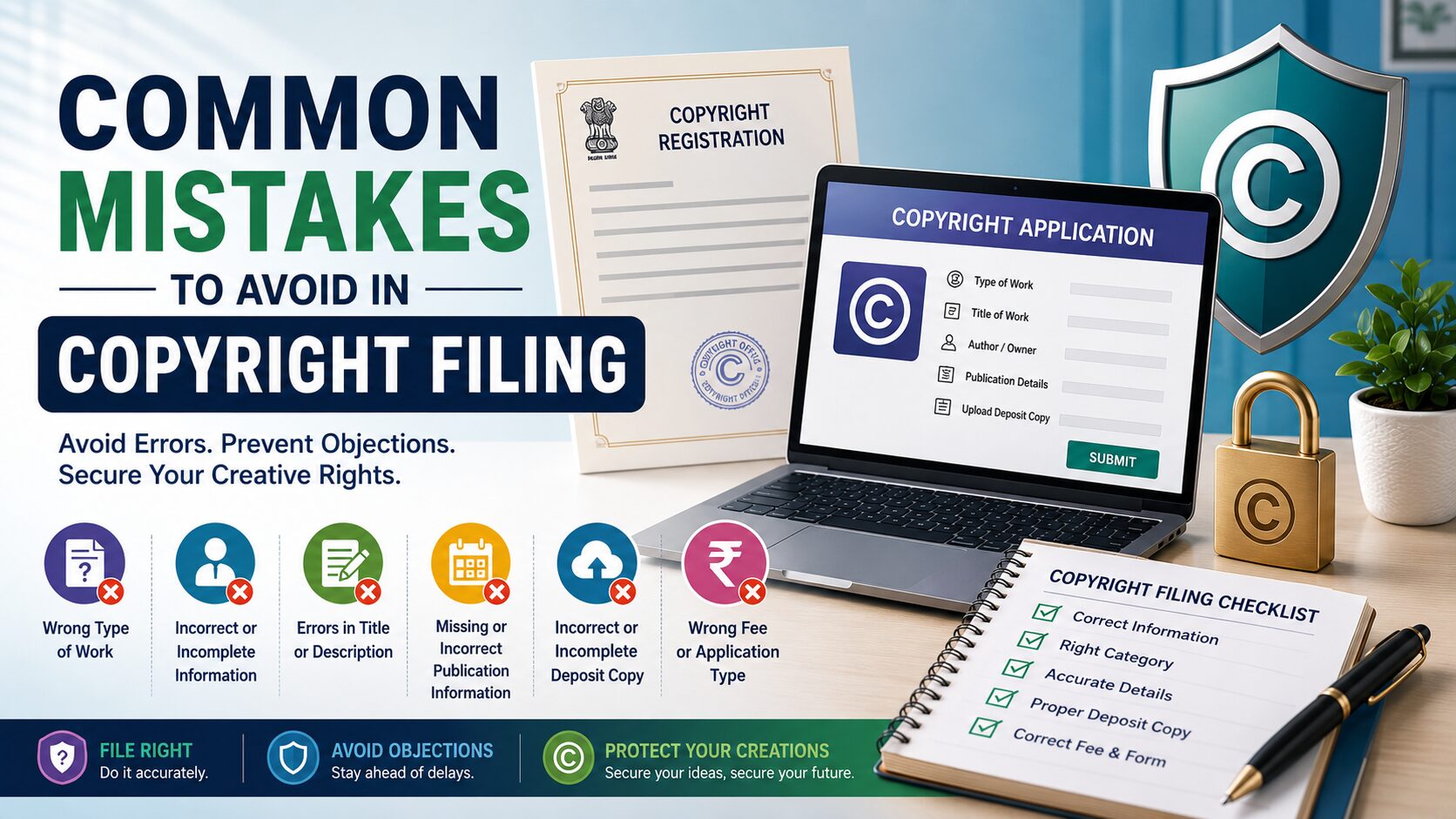
1. Misidentifying the type of work
This is one of the most common reasons why copyright applications are denied. Literary works, visual arts, performing arts, sound recordings, motion pictures, and other categories are all classified by the Copyright Office. Your application may be delayed, or a formal copyright objection may arise if you choose the incorrect category for your work.
Just take an example, a songwriter writes lyrics of his song and filed under “music work” instead of “literary work”, may face issues in the registration process.
2. Incorrect or incomplete Information
Another common cause of copyright application difficulties is entering the wrong information about the authors. This includes mispronouncing names, omitting co-authors, or misrepresenting a piece of writing as a “work made for hire” when it isn’t, and vice versa.
The legal term “work-made-for-hire” is specific. The employer is regarded as the author if an employee generated the work as part of their job responsibilities or if you have a formal agreement with a contractor designating it as such (for particular kinds of work). Ownership conflicts may become more difficult if this is done incorrectly.
3. Errors in the Title or Description of the Work
Although it might not seem like much, a misspelling in your work’s title is a serious issue. It causes a discrepancy between the work you are attempting to protect and your registered copyright. Discrepancies such as this may result in delays or requests for explanation during a copyright application status check.
The job description should also be accurate and specific. Words like “creative project” or “various writings” are too general to properly describe what is protected.
4. Missing or incorrect publication Information
If your work has been published, you must specify the country and date of the initial publication. It also matters if it hasn’t been published. These are some of the most frequent mistakes made while submitting copyright online, particularly by authors who are unaware that “publication” in copyright law refers to the distribution of copies to the public by sale, rental, gift, or other transfer.
Publication occurs when something is posted online. Copies sold at a craft fair are considered. Sharing in private with friends may not.
5. Uploading an Incorrect or Incomplete Deposit Copy
A “deposit”—the physical copy of the work being registered—is required for each copyright application. Common errors that result in rejection or copyright objection reasons include uploading the incorrect file, an incomplete version, or a low-resolution image of a visual work.
You are frequently required to present “best edition” copies of published works. There are particular format requirements for digital works.
6. Paying the wrong fee or selecting the wrong Application type
Depending on what you’re registering for, the copyright application process offers several forms and pricing schedules. The streamlined online form (and a reduced charge) is available for single works by a single author. There are specific guidelines for group registrations for photographs, unpublished works, and other collections.
Your application may be delayed if you select the incorrect form and pay too little or too much.
Correction in Copyright: What to do after filing?
If you realised any errors after filling? This is where copyright correction becomes essential.
How can you correct an error after a copyright filing?
It depends on the nature of the error and when you realise this issue.
If your application is under processing, you have already received a dairy number, but the registration certificate has not yet been issued, you can write directly to the Registrar of Copyright requesting a correction. This should be done as soon as possible, with a clear reference to your diary number and a description of the precise mistake that needs to be fixed.
According to the Copyright Act 1957 of India, under section 49, it says that you can correct an application after granted or previously registered. Under this provision, the Copyright authority has to fix any mistakes or changes in the Register of Copyright, either on its own initiative or in response to a request made by the applicant.
Can you change a copyright application?
Yes, but it’s not the same as just updating a form. The first registration is not cancelled by a supplemental registration. Rather, a new record is added, referencing and correcting the original. This is a crucial distinction: the updated data is now on file, but the original registration date is kept.
Copyright objection Reasons: Why the application gets rejected
Although you receive an objection letter from the examiner, you have a chance to justify any changes that the examiner has in your application. You can respond easily if you are aware of these objections.
Common reasons for Objection Include:
- The work is not novel – Copyright protects an original creative expression. A list of ingredients, basic facts, or a title alone cannot be copyrighted.
- The deposit Copy does not match the application – The uploaded file cannot properly match your application; it might be objected to by the examiner.
- Insufficient authorship Information – Unclear or conflicting author details can be objectionable to the examiner.
- The work is not copyrightable subject matter – If the uploaded thing is not copyrightable subject matter, like a business idea and the title of a book, etc.
You have to file a response to the objection raised by the Copyright Office. Response must be clear and specific. If you miss the objection to respond, it will lead to rejection.
Can you copyright AI Art?
The most frequent question of today is: can we copyright AI art, or can you copyright AI-generated content?
This question has a special legal standing in India. Computer-generated works are particularly covered by Section 2(d)(vi) of the Copyright Act, 1957, which defines the “author” as the person who causes the work to be made. Because it at least recognises technology-driven production inside the legislation itself, India’s legal system is noticeably more progressive than that of many other nations.
Nonetheless, the Copyright Office of India and conventional legal interpretation continue to maintain that works produced solely by artificial intelligence (AI) that lack significant human creative input are ineligible for copyright registration in India.
It is noteworthy that India has not yet released official guidelines or changes that particularly address copyright registration and AI-generated work. As of right now, there is no legally binding precedent on this matter, and the DPIIT and the Copyright Office of India have said very little about this developing subject.
Does Copyright Attribution Prevent Infringement?
No, giving credit to the original creator, or attribution, is a question of ethics and occasionally a contract, but it is not a replacement for permission. Author not be dependent on attribution to prevent unauthorised use of their work; they must use a license agreement to register their copyright and take legal action against infringers.
Copyright Application Errors to be avoided: A quick checklist
- Identify your type of work correctly
- Enter all authors’ details accurately
- Use the exact title
- Include accurate publication information
- Upload the correct deposit copy
- Select the correct application form and pay the fee accordingly
- Review before submitting
Performing Application Status check
After filing the copyright application, check the copyright status on a regular basis. Simply go to IP India and the copyright track status icon, and track your application progress.
FAQs
1. Do I have to register with the official Copyright Office to be protected?
If you create something like artistic work or write a song, or any software, to protect it you have to file a copyright online.
2. Can I copyright an idea, or do I have to create it first?
No, you cannot file a copyright for your idea. It is important to create it first for copyright registration.
3. Can you correct or change a copyright application after you submit it?
Yes, according to the Copyright Act 1957, Section 49, you can easily make corrections or changes after submission.
4. How much does it cost to file a copyright application?
The cost of copyright registration varies by the type of work. Artistic work or literary work, cinematography work and others have different fees.
5. Can I use a single application to copyright a collection of multiple works?
No, you can file one application for only one work. According to Rule 70 of the Copyright, 2013, one application for one work only.
6. Can you copyright content, art, or text generated by AI?
This is a frequent question that everyone asks; the answer is no, we can not file a copyright for AI-generated content. Any kind of text, image or video is not protected under copyright.
7. How do I copyright a business name, slogan, or logo? (Note: This is a massive search query driven by people making the mistake of confusing copyright with trademarks.
For a business name, slogan or logo, you need to file a trademark. Copyright protects creations, like music, art, literary works, or software. You can read our blog for more understanding of different types of IPR here.
Add Your Heading Text Here
Lorem ipsum dolor sit amet, consectetur adipiscing elit. Ut elit tellus, luctus nec ullamcorper mattis, pulvinar dapibus leo.
Conclusion
Copyright registration is a legal tool to protect your creation. However, many applicants experience delays and avoidable filing errors. Understanding common mistakes of copyright filing is most important to prevent form rejection. To file a copyright, you can hire any professional who can help you to file.
We, Intellect Bastion, have experienced professionals who can help you with copyright filing, which saves your application from rejection.