India is widely known as the “pharmacy of the world.” This reputation stems from its global supply of affordable, high-quality generic drugs. However, protecting these pharmaceutical innovations in a vast marketplace requires a deep understanding of unique legal provisions. Pharmaceutical patent law in India poses special challenges not experienced in the Western World. Inventors tend to wonder: Can one patent a drug formulation? And the only answer is a definite yes if the formulation meets certain statutory criteria.
How to get a pharma patent in India involves strategic planning, accurate scientific evidence, and strict compliance with the statute-based exclusions. This process balances corporate benefits and public interest. This guide examines the Indian Patents Act 1970 to outline the entire drug patent application process.
An Analysis of the Emerging Basis of Pharmaceutical Patent Law in India
Previously, the Indian patent law recognized process patents on drugs only. The past practice has helped the Indian generic manufacturers to develop other processes for life-saving molecules. Nevertheless, there was a paradigm shift structurally when India became part of the TRIPS accord and updated its laws in 2005. Therefore, such an update has provided strong product patents to open new means to protect proprietary medicinal molecules.
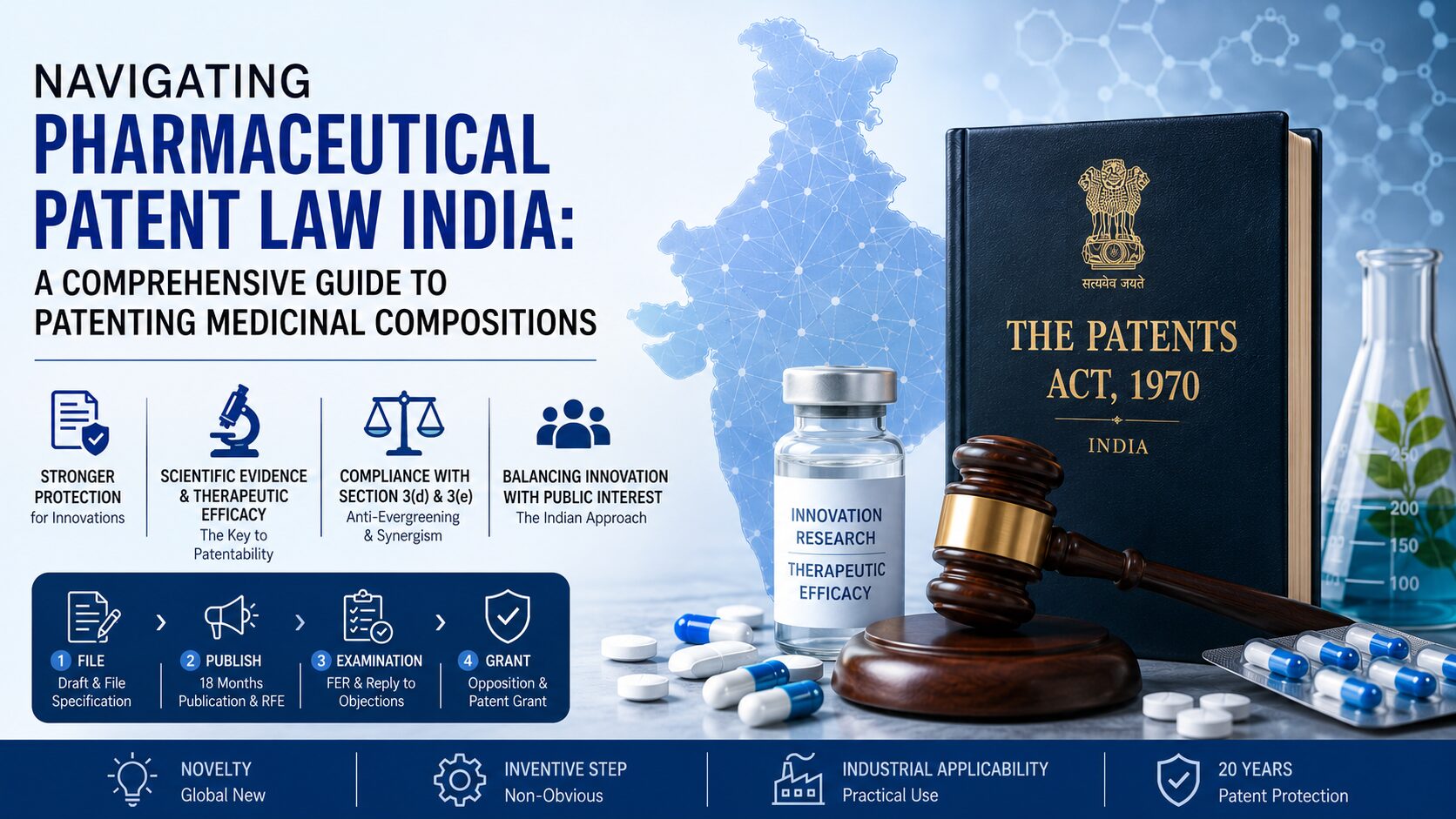
At present, the Controller General of Patents vigilantly guides and regulates all applications at the IPO. To secure exclusive rights, your formulation must demonstrate global novelty, an inventive step, and industrial applicability. Additionally, the application has to pass through one of the toughest anti-evergreening provisions in the world.
Bridging the Gap Between Statutes: Section 3(d) and Section 3(e)
Drug patent applicants in India face a significant legal hurdle. This challenge comes primarily in the form of Section 3(d). This section explicitly prevents “evergreening”—a practice where companies slightly modify existing drugs simply to extend their monopoly. To overcome this legal obstacle, the new version of the drug has to be far more effective than its predecessor.
At the same time, inventors will have to deal with Section 3(e) concerning patents for medicinal compounds. The law makes clear that no compound that can be defined as a mere “admixture” can receive a patent. Therefore, if your composition does not exceed the sum of the properties of the individual components used in it, it is not patentable under the law.
| Statutory Provision | Target of Exclusion | Core Requirement for Patentability |
|---|---|---|
| Section 3(d) | New forms, salts, polymorphs, or derivatives of known substances; new medical uses. | Has to show superior therapeutic efficiency in comparison with the original compound. |
| Section 3(e) | Formulations involving known components mixed together (Admixtures). | Has to prove synergism, when the whole effect exceeds the sum of parts. |
| Section 3(i) | Medical methods for treatment or diagnostics. | It is completely patent-unprotected; only the actual composition/device can be patented. |
Step 1: Drafting and Complete Specification Application
The process begins with a provisionally applied or Complete Specification filing. Choosing to use the provisional specification ensures that you have an early priority date while allowing your laboratory one year to prepare the empirical results. The next step is submitting a complete specification. This is the key legal document that should contain all active ingredients, dosage, method of action, and experimental results.
Step 2: Formal Publication & Request for Examination
After you file the application, the IPO publishes it 18 months from the priority date. In addition, the applicant may ask for early publication in order to speed up the process. After the publication, you need to file a formal Request for Examination (RFE).
Step 3: Handling the First Examination Report (FER)
An official examiner will review your application in comparison to the global literature that exists. Thereafter, the Intellectual Property Office will release the First Examination Report (FER), which lists all objections related to novelty, clarity, and Section 3 exclusions.
Step 4: Overcoming Obstacles and Receiving a Patent
The Controller General of Patents does not seal the document until a third party comes forward and opposes it. India has adopted a two-tier defensive mechanism in this regard, which consists of pre-grant opposition and post-grant opposition. In this regard, interested parties can file a pre-grant opposition against any weak filing. Upon successful passing of such opposition, the IPO grants the patent for 20 years.
Strategic Insights for Innovators and Pharmaceutical Companies
If you want your drug application to be successful in this environment, you have to start out with an impeccable technical basis from the very beginning. Firstly, conduct early testing specifically aimed at the tight definitions of therapeutic efficacy and synergy. Secondly, make sure that your lawyer composes claims free of broad generalization statements and with highly specific compositions supported by irrefutable scientific evidence.

Expert Strategic Advice: Make sure you disclose all information concerning your product’s manufacturing and safety in your original specification. Trying to establish completely new clinical categories in the prosecution phase can create serious procedural barriers during IPO.
Finally, getting the hang of the Indian Patent Office is all about the delicate balance between aggressive international IP strategy and the reality of public policy in the country. Knowing how to present your clinical data and being aware of the peculiarities of pharmaceutical patent law in India will help your company gain important market exclusivity and make a significant contribution to world medicine. For full support and expert strategic guidance throughout this complex filing process, contact Intellect Bastion to seamlessly safeguard your pharmaceutical innovations today.
Complete FAQs: How to Obtain a Pharma Patent in India
In order to assist inventors in learning how to obtain a pharma patent in India, we have answered all the key industry questions
Is it possible to patent a new combination of two known medicines in India?
Yes, but there is still an extremely stringent requirement in this context. According to the standard Indian Patent Act 1970 regulations, a combination of two known medicines is automatically scrutinized by Section 3(e). It is rejected by the IPO if the application does nothing more than combine the known properties of the two medicines. Thus, it becomes imperative for you to provide compelling evidence of the combination working synergistically for a much greater effect.
Can a patent be granted to any Ayurvedic or herbal medicinal composition under Indian laws?
Patenting an ancient herbal composition is not easy, but it is certainly possible under limited circumstances. If your herbal composition merely replicates ancient Indian remedies, you cannot obtain a patent. The Patent Act explicitly prohibits patenting traditional knowledge. However, if you have something novel to offer, then you can certainly get the patent.
Difference between a product patent and a process patent in the context of India.
A product patent protects the actual chemical structure or compound, regardless of how it was made. In contrast, a process patent only protects the specific chemical route used to manufacture the substance. Until 2005, India only granted process patents for medicines. This allowed generic companies to replicate famous brands using alternative manufacturing routes.
Is there a possibility that an independent researcher will be able to get a medicine patent in India, or does the process always involve a corporation?
Yes, an independent researcher has the right to apply for a patent for their medicine in India. The law provides equal treatment to independent researchers, small businesses, and huge multinationals when it comes to the filing process. Furthermore, the fee for filing a patent by an individual is much lower than that of big companies.
How is Section 3(d) of the Indian Patent Law affecting medicinal formulations?
Section 3(d) can be considered the main shield for India against evergreening by corporations. This provision denies patents to modifications, salts, or derivatives of known medicines unless they demonstrate substantially superior “therapeutic efficacy. Crucially, the Supreme Court ruled that physical or chemical improvements like higher stability or bioavailability do not equal therapeutic efficacy unless they improve treatment outcomes.
What is meant by "mere admixture" under Section 3(e) in the Indian Patent Office?
The IPO defines a “mere admixture” as a simple mix of known components where each ingredient continues to function individually. For example, combining an existing pain reliever and an antacid into one pill is a mere admixture if both ingredients simply perform their original, individual functions.
Is it possible to file a patent for new dosage forms (say, reformulating a bitter pill into a convenient liquid gel)?
Section 3(d) typically restricts altering physical forms. The law views such changes as trivial modifications of a known substance. Reformulating a solid tablet into a liquid gel or capsule is considered an obvious modification by skilled artisans. The only way to get your patent is to demonstrate that it results in improved therapeutic effects.
What constitutes "synergy" for the purpose of overcoming patent hurdles in the pharmaceutical field?
Synergy entails submission of verifiable and numerical experimental data with respect to the Complete Specifications. Applicants must mathematically prove that the combined formulation’s total effect exceeds the sum of its individual parts. For instance, if Drug A reduces viral load by 20% and Drug B by 30%, their combination should yield an 80% reduction rather than a basic 50% sum.
Can you patent a new application of a medicine already patented by another company?
Absolutely not! Indian patent law makes it impossible to obtain a “new use” patent on any compound under Section 3(d). Even if a known cancer drug perfectly treats a neurological disease, the IPO will not grant a second patent for this new use.
What data should be provided during the submission of a patent for medicine?
Your patent specification must include comprehensive data from in vivo or in vitro laboratory experiments. Crucially, your application must directly compare your new medicine against the closest prior art. If you do not provide such comparative data in your first specification, the IPO will reject your application at the FER stage.
How long does it take to complete the entire application and grant process for a pharmaceutical patent in India?
In general, the whole cycle lasts between 3 to 5 years since the filing date. However, due to recent changes in regulations, the government reduced the timeframe for submitting a Request for Examination from 48 months to 31 months. Therefore, the Controller General of Patents considerably sped up the process.
How do examiners utilize the Traditional Knowledge Digital Library (TKDL) while assessing medicinal patent applications?
The Traditional Knowledge Digital Library (TKDL) serves as an extensive digital archive of India’s traditional medicine systems of India, such as Ayurvedic, Unani, and Siddha medicines. Patent examiners in IPO compare each individual herbal application to this library in order to establish whether it is novel. If traditional practitioners have used a plant mixture to treat a disease for centuries, the examiner automatically rejects it for lack of novelty.
Can public health organizations or competing firms oppose a medicinal composition patent prior to its grant?
Yes, the strong pre-grant opposition mechanism in India provides such an opportunity to any individual, competing firm, or public interest organization to oppose the patent application. Parties can raise an opposition anytime between the patent’s publication and its actual grant. Public health organizations have often used this particular provision to oppose the costly life-saving drug patents on the grounds that their modifications do not meet the requirements of Section 3(d).