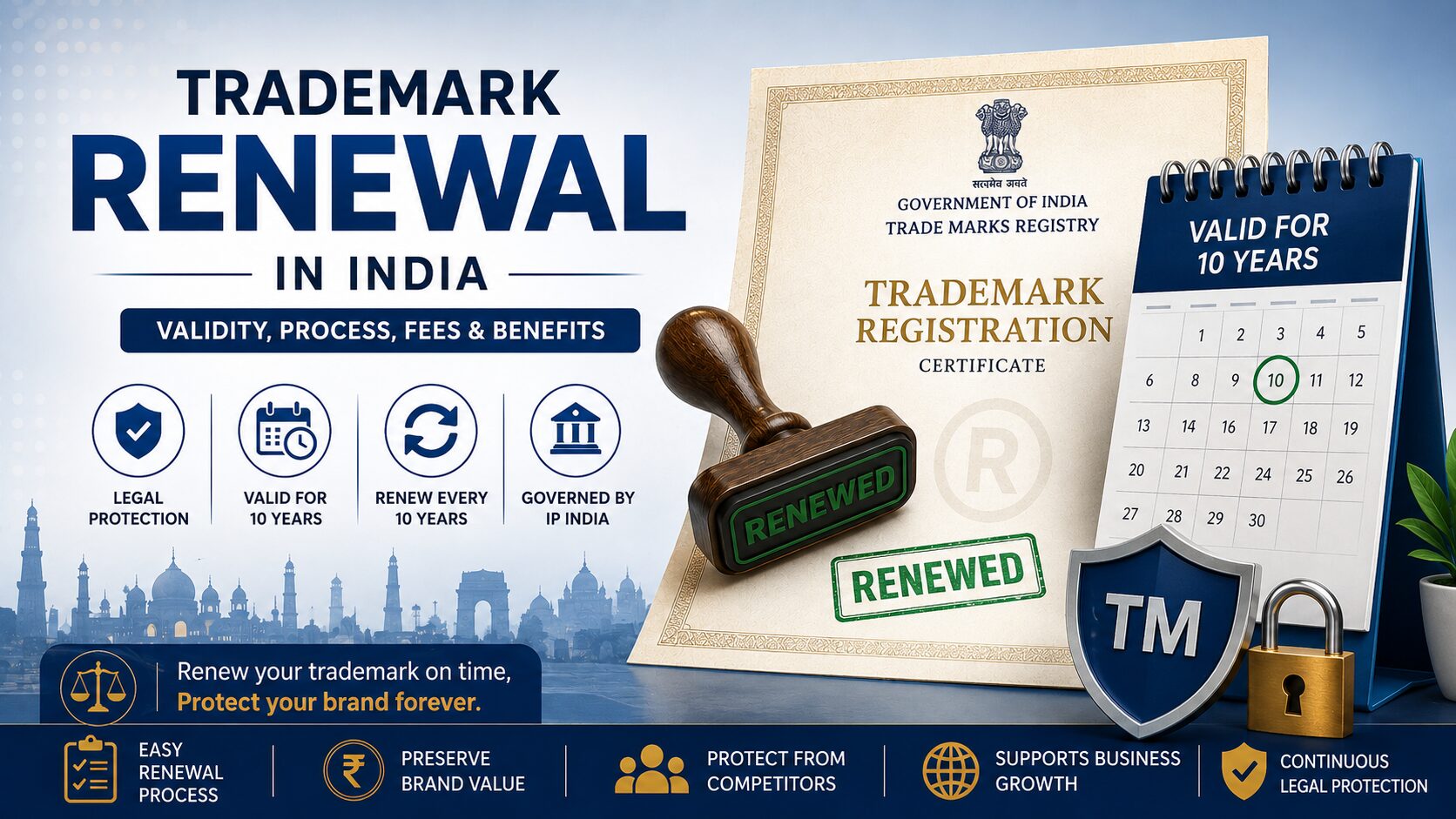
A registered trademark is the identity of your company, it is a very valuable asset. Your company’s name, logo, slogan, or other characteristic of your company can be protected from competitors by registering a trademark. After that trademark is permanently registered. It needs to be renewed on time.
How long is a trademark valid in India?
In India, a registered trademark is valid for ten years from the date of filing. After that, you have to renew your trademark every ten years. The process is overseen, and the official trademark registration is maintained by the Controller General of Patents, Designs, and Trademarks.
Businesses may keep an eye on renewal status and deadlines through IP India, the primary government platform for trademark-related services.
In this blog, you will learn about Trademark validity, trademark renewal fees and procedures in India, and what happens if you miss the deadline.
Can a trademark registration be renewed in India?
Yes, a registered trademark needs to be renewed every 10 years from the date of filing. The owner needs to submit a renewal application to the relevant intellectual property agency in order to keep the trademark protected.
To know more about trademark registration, you can read our full blog here.
The goal of trademark renewal is to maintain the legal rights provided by trademark registration. The owner’s exclusive right to use a trademark in commerce is terminated if the mark is not renewed. Consequently, it would make it possible for rivals to employ a similar mark in business, which could confuse customers and damage the brand’s identity.
Step-by-Step process of Trademark renewal in India.
Step 1 – Check trademark Expiry date
Every businessman, investor, trademark owner or individual needs to check trademark expirations regularly and always remember that a registered mark is valid for 10 years only. You must apply for trademark renewal prior to the trademark’s ten-year expiration. Before the trademark expires in six months, you can submit a renewal application.
Step 2 – Prepare the following Documents
Applicant must collect and verify all documents before filing the trademark renewal application.
- Trademark registration certificate
- Application or owner identity proof
- Address proof
- Application copy (Form TM-A)
- Power of attorney (If you filed through an attorney)
- Trademark application details
If you are facing any issue to retrieve Trademark Certificate, you can read our full blog on how to download the Trademark Certificate here.
Step 3 – File form TM-R
Form TM-R is the main renewal form. This form indicates whether you are restoring a trademark that has been deleted, renewing the trademark without any changes, or making changes (such as changing the mark). This is the formal application for trademark renewal.
Form TM-R must be submitted online or offline to the Trademark Registry in order to complete the trademark renewal process. Accurate information about trademark ownership and registration must be included in the application.
Step 4 – Payment of Trademark renewal fees
When submitting an application for trademark renewal, applicants must pay the required government charge. If the application is submitted during the grace period following expiration, there may be additional fines.
According to u/s 25 of trademark act 1999, Trademark renewal fees is INR 9000 rupees (for online filing) or INR 10,000 (for physical filing).
Step 5 – Examination by Trademark Registry
Now an examiner from the trademark office reviews all documents and provided information, and release report if he finds any doubt or may be he is satisfied with all the information than he accept trademark renewal request.
Step 6 – Issuance by Trademark Registry
After the all clarification and justification from the applicant are satisfied by the examiner then trademark office issue trademark renew certificate in the journal.
What happens if a trademark is not renewed?
Registered trademark has a time limit; after that, it gets revoked. You can renew your trademark registration to protect your trademark from revocation. Businesses can loose all legal rights from trademark if they miss the deadline for trademark and forget to renew it. Recovery becomes more difficult and costly once a trademark expires.
The following will happen if the trademark owner fails to submit a trademark renewal application within the allotted time:

- Trademark can be removed from the registry
- Loss of Enforcement Rights
- Exposure to third – Party Claims
If you failed to submit the trademark renewal form, you may also submit a trademark restoration. You can apply for trademark restoration with a prescribed cost six months to a year after the trademark expiration date.
For more on the trademark restoration procedure, schedule, and costs, visit our other blog here.
Benefits of renewing a registered trademark
To keep your registered trademark active, you must renew it every ten years by the prescribed way. For any reason you forget to renew your trademark, you can lose all legal rights, and anyone can copy your brand name, logo, and tagline of your company; it destroys reputation of your company.
Now, I hope you understand why maintenance of a trademark is important. Below is the list of advantages of trademark renewal.
1. Continuous legal protection
The most important benefit of renewing your trademark is that you will hold all legal rights for the next 10 years of your trademark. If someone tries to steal your mark or brand’s logo or company’s name, you can file an infringement case against them.
2. Maintain brand value
A registered trademark is not just a simple legal tool; it increases the value of your brand with time. When you invest money in marketing and advertising or brand promotion, the value of your trademark also increases. Renewing your trademark is beneficial to hold brand values for up to 10 more years.
3. Prevent legal disputes
A registered trademark provides you protection from various legal issues. If someone is using your company’s name, logo, or tagline, you can take legal action against them. You can prevent legal disputes for the next 10 years by renewing.
4. Keep competitors away
Businesses are constantly searching for an advantage in the highly competitive market of today. Competitors could register a similar name or logo if your trademark expires. Customers may become confused, and your brand may become less distinctive as a result.
5. Global Trademark Protection
A renewed trademark may make it simpler to defend your brand abroad if you intend to grow your company. Before offering you protection in their jurisdiction, several nations need evidence of a registered and operational trademark.
6. Protect your business identity
A registered trademark is your identity. If any customer hears about your company’s name or your company’s logo, they will notice. To keep your trademark active, it is important to renew the trademark.

7. Improve business credibility
A registered trademark provides strength to your company’s image. It shows your competitors, investors, and customers about your brand value. A trademark is a legal sign of professionalism and shows that your business is very reliable and respectable. To enjoy more of these benefits, it is important to renew your trademark on time.
8. Its long-term asset
As long as you continue to renew them, trademarks can be used indefinitely after they are registered. This turns your trademark into a useful tool for your company over time. As your company expands over time, the value of your trademark increases. This asset is safeguarded and will develop with your company if it is renewed on a regular basis.
FAQS
1. Once registered, for how long is a trademark valid in India?
A registered trademark has a validity up to 10 years. After that, it needs to be renewed otherwise it will be revoked.
2. Can a trademark registration be renewed?
Yes, you can renew your trademark easily by filing the TM-R form with the prescribed fee. You have to file a renewal application within 1 year before the date of expiry of the trademark.
3. When should a trademark renewal application be filed?
A trademark renewal application can be filed within a year before the date of expiry
4. What happens if a trademark is not renewed on time?
A six-month grace period be granted for those who don’t file trademark renewal on time for any reason. Within the six months, you have to file trademark renewal otherwise, your trademark will be revoked.
5. Is there a grace period for trademark renewal in India?
If you did not file a trademark renewal on time with any reason, you have six-month grace period so you can file trademark renewal.
6. Can an expired trademark be restored?
Yes, an expired trademark can be restored by filing a restoration with prescribed fees. From 6 months to within 1 year, you can file a trademark restoration.
7. What are the benefits of trademark renewal?
After renewing of trademark, you have various advantages like legal protections brand value maintenance and you can protect your brand identity, etc.
8. How many times can a trademark be renewed? Is there any limit?
You can renew your trademark as many times there is no any limit.
9. Who can apply for trademark renewal?
A trademark owner or businessman, or an individual anyone who have trademark, can file renewal.
10. What is the validity period of a registered trademark?
Trademarks that have been registered are good for ten years after the date of filing. Thus, you can take advantage of your legal rights for a maximum of 10 years before submitting a renewal application to maintain your protection for next 10 years, and this way for an indefinite period of time.
Conclusion
A registered trademark is one of the most powerful tools available to the business. It secures your market presence, builds trust with your customers, and acts as an important asset in your business profile.
Every businessman, investor or individual must know that trademarks are valid for 10 years only. After it expires. You have to monitor it on a regular basis. And you can also hire any professional for this work.
You can deal with Intellect Bastion, a specialist with experience in trademark filing, searching, and monitoring. We can help you reduce risk and save time and money by offering all trademark-related solutions.