Innovative ideas are often cultivated with a solution to a problem. However, invention is only sowing the seeds while developing innovation; an innovation requires both time, effort and investment. Whether it’s a ground breaking technology, a unique manufacturing process, or an everyday product that solves a common problem, your innovation deserves protection. Failing to secure patent protection could leave the invention vulnerable to competitors. Many inventors delay the patent application because of cost, uncertainty and lack of awareness about their patent rights. However, their one decision can have long term legal and commercial consequences
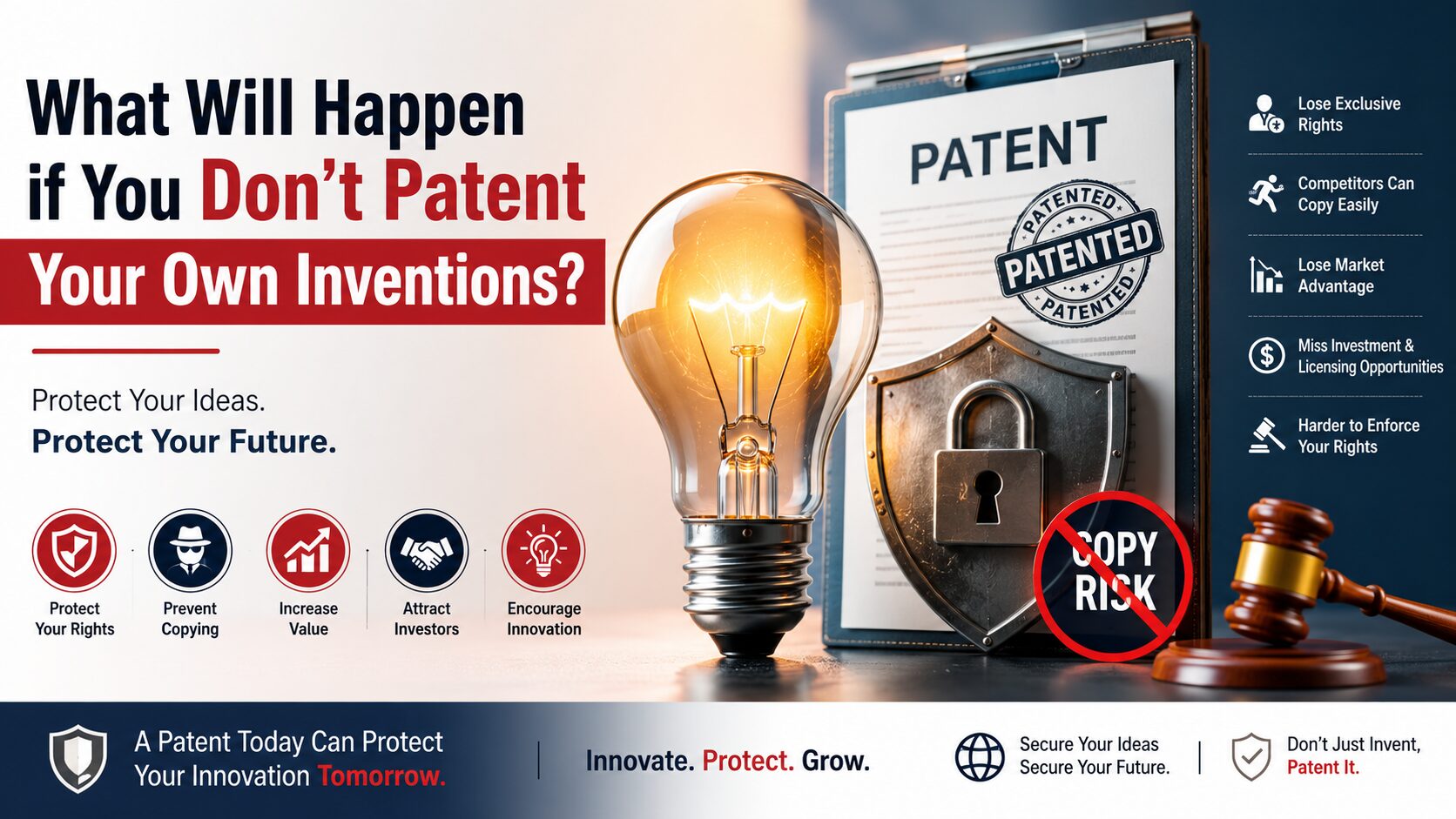
Failing the patent inventions can lead to major legal and commercial consequences. You may lose the opportunity to benefit from all the exclusive rights, and it could make it easier for the competitors to exploit your own innovations. Understanding these implications can safeguard your intellectual property
Moreover, patents help inventors attract more investors, secure licensing deals, and establish a competitive advantage, which can generate valuable business assets.
Benefits of Patent Protection
- Grants exclusive rights for the innovations
- Prevention from unauthorized copying
- Increase the commercial value of the inventions
- Strengthens brand value in the market
- Creates awareness and encourages more innovations by protecting original ideas.
- Creates opportunities for more investments and partnerships
Patents give inventors control over their ideas in a way that goes beyond just paperwork. You get to decide who can make or sell the thing you came up with for a while. This stops others from taking advantage of it commercially. It seems that being alone makes a difference for many people working on new things.
Investors tend to see patented inventions as solid because of the exclusivity it creates. It lowers some of the risks they worry about. Licensing becomes more straightforward too when you have that protection in place, and this helps with overall business value.
Some choose patents because it keeps competitors from copying directly. Valuation goes up, and it opens doors for making deals. It also builds up your intellectual property side of things. That part gets a bit messy when you try to balance everything at once.
What happens if you don’t patent your inventions?
Choosing not to patent an invention does not make it illegal for commercialization of your innovation. However, it can substantially weaken the legal protection without an enforceable patent right; competitors can illegally develop similar products unless another form of intellectual property protection applies to the products.
As the invention gains more market visibility, the likelihood of limitation also increases. Once the products with little or no difference enter the market, maintaining exclusivity becomes more difficult. In addition, proving the ownership alone does not provide the exclusive rights to the inventor unless the granted patent offers them.
Risks of an Unpatented Invention
- Competitors may copy and commercialize similar products.
- Market advantage can decrease rapidly.
- Investors can view it as a high- risk opportunity and avoid investing.
- Licensing and commercialization opportunities become limited.
- Enforcing exclusive rights against competitors becomes more challenging.
Selling Something New Without a Patent: Is It Worth the Risk?
Developing a new invention, many entrepreneurs become eager to bring that idea to market as quickly as possible. This often raises the question: Is it safe to sell a product without a patent?
The problems start when people can see your product. Customers and other companies can figure out how it works. If your new product solves a problem that people have, others will probably try to make something. Without a patent, it can be difficult to manufacture or sell similar products.

So people who come up with ideas often ask: What if I sell my new product before I get a patent? In some places, if you sell your new product or show it to people before you apply for a patent, it can affect whether or not you can get a patent. Importantly, it gives other companies a chance to learn about your new product before you have any legal protection.
Potential consequences of not patenting your invention
- You may lose exclusive commercial rights.
- Competitors could introduce similar products.
- Investors may consider your business riskier.
- Licensing opportunities may become limited.
- Enforcing your rights against copycats becomes more difficult.
Public Disclosure and Patent law
Public disclosure plays a critical role in determining patent eligibility. It involves non-confidential communication that reveals the details of your inventions to the public.
Presenting your inventions at a trade fair, publishing a research paper, and uploading product-specific technical details can qualify as a public disclosure. Consequently, these actions can affect your ability to obtain patent protection.
Common Forms of Public Disclosure
- Selling or offering the invention for sale
- Publishing journal articles for technical research papers
- Displaying prototypes at exhibitions or trade fairs.
- Demonstrating the inventions publicly.
- Sharing technical information on websites or social media.
- Presenting the invention at conferences or seminars
Provisional Patent Benefits
Many inventors are not ready to file a complete patent application immediately. In those cases, provisional patent application offers a more effective solution by filing an early filing date while allowing additional time to refine the inventions.
A provisional application is useful when the invention is under development, or the inventor is seeking for some funding before filing the complete specifications.
There are so many advantages of the provisional patent application, as it secures the early priority date. It allows inventors to discuss the inventions with greater confidence and then later serves as a foundation for filing the complete patent application.
Patent Infringement and unpatented inventions
Patent infringement can happen when someone makes use, sells or imports a patent’s inventions without the patent owner’s permission. Therefore, a patent owner can discover legal routes.
Conclusion
Choosing not to patent your precious inventions isn’t always the wrong choice, but it should not be your decision made without understanding your potential consequences. While selling an unpatented product is legal, failing to secure invention patent protection can result in unnecessary risks which can have long- term impact and outweigh the short-term savings. For the best support and guidance, you can contact Intellect Bastion!
FAQ’s
1. What happens if I launch a product without a patent?
Launching a product without a patent is legal and many startups do it to test market demand or generate early revenue. However, if the product is available without a patent, it becomes publicly available for competitors where they can see its features and, in many cases, create the same products. If you have the patent application beforehand, protecting your invention becomes challenging.
2. Can Someone Steal My Unpatented Idea?
ducts can be stolen. While ideas are now becoming more challenging to protect, the way they are disclosed can play a critical role in determining the legal rights.
If you reveal your inventions publicly without filing patent applications or securing them confidentially through a Non-Disclosure Agreement (NDA), others may lawfully use the disclosed information in certain circumstances. Although copyright trade secret law, or a contractual agreement may offer only limited protection on the invention. They do not provide the exclusivity right like patents.
Common Situations which can increase the risk of copyin
- Demonstrating the inventions at exhibitions or trade fairs.
- Publication of the technical details in research papers for educational purposes.
- Launching crowdfunding campaigns without prior protection.
- Sharing product specifications and third parties without an NDA.
3. Can someone else patent my inventions if I choose not to?
Many countries, including India and the United States, follow the First-to-File system. Therefore, the person with a valid patent application first generally receives the patent rights instead of the person who invented it first.
4. What recourse do I have if a competitor copies my unpatented design?
If you don’t have patent protection, enforcing rights will be difficult. However, there would be some remedies to protect your inventions under copyright, design rights, trademark law, trade secret protection, and confidential agreements, depending upon the nature of the copied material.
5. How does the “First-to-File” rule affect unpatented inventions?
The First-to-File rule means that, in many countries, patent rights are generally awarded to the person who files the valid patent, not the person who made the invention first. Filling early is often the right decision to protect your innovations.
Early filings often secure the legal priority which avoids further delays and the risks of losing the patent rights. It can make you an independent inventor if you file first. Businesses actively monitor new technologies and file quickly, and thus, the First-to-File rule matters a lot.
Waiting too long can permanently affect the ability to obtain patent protection. Once an invention enters the public domain under some circumstances then patent rights become difficult.
Many countries have strict rules upon the public disclosure of information before filing a patent application. Missing these deadlines can result in losing essential intellectual property rights.
6. How long can I wait to patent an invention after making it public?
It depends upon the country where you plan to seek patent protection. Some jurisdictions provide a limited grace period after the public disclosure; the product demonstrations, websites or public presentations may destroy the novelty requirements. So, it’s best to file a patent application before publicly disclosing the inventions.
7. What happens if I publicly disclose my invention before filing a patent?
Your competitors may reverse engineer with similar or no changes in the inventions and launch their optimized product, and later, you can lose market exclusivity. In many cases, securing investors becomes challenging. Licensing opportunities are reduced. Patent eligibility may be affected if the filing deadlines are missed. To avoid this risk, it’s generally recommended to file a patent application before publicly disclosing your invention.
8. Does selling a product count as public disclosure in patent law?
Yes, selling or even offering an invention for sale can constitute public disclosure because it can make the invention available in the public forum. Since public disclosure may affect patentability, it’s wise to understand the applicable patent laws and consider patents before any sort of commercialization.
9. How can I protect my invention without paying for a patent?
If you are not ready to invest in a patent application, you can explore other practical options to safeguard your invention, like a Non-Disclosure Agreement (NDA), while sharing confidential and detailed development records to restrict access to sensitive technical data and protect confidential trade secrets. However, these measures are not reliable, and the risk of unauthorized use would be there.
AUTHOR: Shubhra Pandey